

By Kathy Cheng
Founder & CEO
Nexxt Intelligence | inca
Toronto, Canada
kathy@nexxt.in

Introduction
Whenever I tell people that I’m a deeply qualitative researcher who built a conversational quantitative survey platform, I often get the same puzzled look. “Why would a quallie build a quant platform?” they ask. My answer: because qual makes quant better.
There has been an explosion of AI moderation, often framed as “qual-at-scale” in the past few years. It’s easy to see why people—especially qualitative researchers—feel uneasy about this. If AI can “moderate,” does that mean it’s replacing human moderators? My view is the opposite: AI moderation creates new opportunities for qualitative researchers to extend their craft into quantitative spaces. It gives us the tools to bring empathy, rapport, and human understanding into an area of research that has historically lacked the ability to capture these fundamental human qualities.
In fact, I believe that AI-moderated, qualitative-infused surveys represent one of the most exciting opportunities for qualitative researchers today—and potentially the most important evolution in research in decades!
Why We Need to Rethink Surveys
Surveys have long been one of the most powerful tools in a researcher’s toolkit. They help us size markets, profile audiences, segment consumers, and understand trade-offs and pricing—in other words, they inform key business decisions.
However, surveys are primarily designed for efficiency, and in some cases may not be optimized to fully capture the human experience. Traditional survey experiences can sometimes feel dull, transactional, and dehumanizing. It’s no surprise, then, that response rates and data quality are in decline. Younger audiences (conditioned to express themselves through texting and social media) are opting out; we see some research participants rushing through answers once survey length becomes excessive; and synthetic data use is on the rise as a solution to data gaps.
By rethinking how we design and deliver surveys (specifically, making them more interactive, intuitive, and people-friendly) we can strengthen the connection between the data we gather and the real behaviors and motivations behind it.
That’s a role that AI moderation plays in surveys: it introduces a distinctly “human” dimension—one of engagement, empathy, and dialogue. And that’s where qualitative researchers naturally shine.
Why Qualitative Researchers Should Care About Quantitative Surveys
The boundaries between qualitative and quantitative research have blurred, and it’s sparking a big question across the industry: what role does AI moderation play in the future of market research? We keep hearing phrases such as “automated qual,” “qual-at-scale,” “AI-moderated in-depth interviews,” or “hybrid methods,” but behind these buzzwords is a fundamental shift: quantitative is becoming more qualitative.
Engagement and enablement, two things we take for granted in qualitative research, are now emerging as important considerations in quantitative work. Quantitative researchers bring incredible strengths, notably: creative research design; detailed sampling plans; questionnaire structure and logic; and detailed analysis and interpretation. These skills are vital for reliable, scalable insights. The growing challenge for quantitative researchers is not in the mastery of the technical details; it’s the mastery of the human details. In research studies, how do we ensure that participants stay engaged, provide useful and valuable responses, and feel heard?
That’s where the qualitative mindset comes in. We, as qualitative researchers, tend to think deeply about how people experience the research process. We consider tone, empathy, and flow. We notice whether a question feels natural or intrusive, accessible or alienating.
From One-Dimensional to Engaging
When we moderators conduct a session, our first job isn’t to ask questions—it’s to build rapport. We make sure that participants feel seen, heard, and valued. We know that, when people feel safe and comfortable, they share more openly and thoughtfully.
Surveys, in contrast, can sometimes lack the ability to create an engaging, empathetic experience. But with AI moderation and conversational design, that can change—and qualitative researchers are well-suited to lead that change.
Take language, for instance. The way we ask questions has the power to transform the participant’s experience and the quality of their answers. Let’s compare examples of question phrasing that might be used in a typical survey versus how a qualitative researcher might want to write the question in a conversational survey.
Typical quantitative survey wording for a ranking question might be:
- Below are five features that could be included in the product you just read about. Please rank these features in order of how important each one is to you.
- A qualitative researcher might write the same close-ended rank order question in a more conversational manner:
- I will now show you five features that could be included in the product you just read about. Which of these features matters most to you? Can you select what matters to you most first, then the second most important, and so on?
Here’s another example: in a quantitative survey we might ask about satisfaction:
- Please indicate how satisfied you are with our service using this 5-point scale, where 1 means you are Completely Dissatisfied and 5 means you are Completely Satisfied.
While a qualitative researcher might phrase the question like this:
- Thinking about your recent experience, how did it
feel overall—where 1 means “it could have been
better“ and 5 means “I’m happy with it”?
While survey language provides instructions, qualitative language builds connection with each question.
These differences might seem nuanced, but they add up. They create warmth, trust, and engagement. They suggest to participants that there’s a human behind the survey. And, for questions in which we rely more heavily on AI for probing, we know that the AI’s wording was shaped by many human interactions. Or, at least, that the AI has been trained by someone who understands humans.
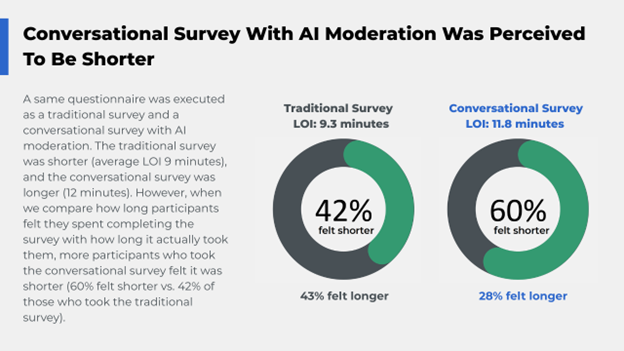
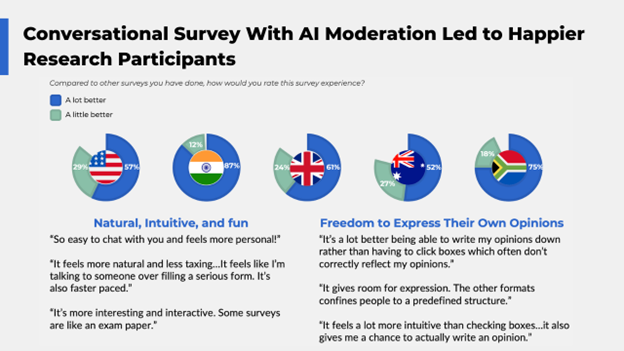
When surveys start speaking this way—through thoughtful writing and AI moderation—participants respond more naturally, give richer data, and stay engaged longer. Research on Research has shown clear evidence that while conversational surveys with AI moderation may take longer, they feel shorter (see Figure 1), and participants express higher satisfaction with their survey experience. (See Figure 2)
Now, as conversational surveys become more accessible, the qualitative mindset becomes a key to unlock quality responses and insight in creating surveys that people actually want to take—surveys that build comfort, trust, and empathy.
From “blaming respondents” to “enabling them”
In qualitative research, when responses fall short, we tend to look inward. We question whether we asked our questions in a way that people could, and wanted to, answer. Good moderation, after all, is about enabling people to uncover and express thoughts they might not even realize they have.
That same principle applies beautifully to survey design. By borrowing projective techniques from qualitative research, we can make surveys not only more engaging but also more revealing—helping research participants share what they truly think and feel.
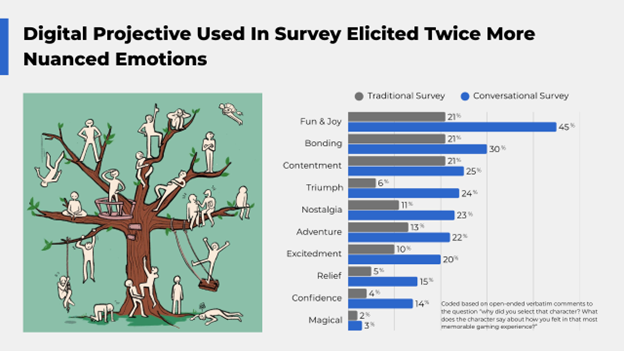
For example, in a recent Research on Research project, we wanted to explore how people felt during their most memorable gaming experience. Instead of simply asking an open-ended question, we used the Treeman (also known as the Blob Tree©, 2018, Wilson & Long) projective technique in the conversational survey. Participants first selected a character that best represented how they felt. Once they’ve made their choice, they were asked, “Why did you choose that character? What does it say about how you feel?”
Simple digital projective exercises like this have proven effective in helping participants access and articulate deeper, more emotional insights—moving beyond the functional and rational comments that often dominate open-ended survey responses. (See Figure 3)
In a quantitative survey, after a willingness to buy scale question, we might ask:
- You said you would buy this product. In the comment box below, please tell me all of the reasons why you would buy it?
A qualitative researcher might ask the open-ended question in a different way:
- Please describe the kind of person who would buy this product? What kind of image of this buyer do you have in your mind?
See the difference? The first question tends to invite a straightforward or surface-level response—participants often think, “Well, that’s obvious: I like it, so I’d buy it.” In contrast, the qualitative version encourages people to step back and reflect. By asking them to imagine the kind of person who would buy the product, it gives them space to express their perspective indirectly, which often leads to richer and more nuanced insights.
Applying qualitative principles to survey design can also elevate the quality of quantitative insights. Just as good moderation helps people express thoughts they didn’t know they had, well-crafted surveys can do the same by enabling—not constraining—research participants.
When we bring that “facilitator mindset” into survey design, we stop forcing research participants into our frameworks and start meeting them where they are.
From Static to Exploratory
The real promise of AI-assisted surveys isn’t just engagement or empathy—it’s exploration. , such as no leading, double-barreled, or loaded questions, AI moderation allows us to scale good research conversations. This shift means two important things:
- Deeper insight from surveys, because surveys can now listen and respond. Well-trained AI moderators can ask adaptive follow-ups, probing deeper where needed, much like a skilled human interviewer.
- Surveys can be exploratory, because they move from being researcher-led to participant-led. We listen to what they say in their own language and then quantify those insights into variables for quantitative analysis.
That’s a profound transformation.
This should sound familiar to any qualitative researcher—it’s exactly what we do in exploratory work. But technology alone doesn’t make an AI-assisted conversational survey exploratory. It still requires a qualitative mindset to design the right probing framework and flow. An AI machine can scale conversations, but it’s our human expertise that makes those conversations meaningful.
For example, take laddering—a classic qualitative technique for uncovering deeper emotional or value-based motivations. An AI moderator can be trained to follow up when someone says, “It’s convenient,” with a question like, “What makes convenience important to you?” But it takes a human researcher to brief the AI on why that matters—to define the logic of discovery so that answers build naturally from surface attributes to higher-level functional, emotional and social gains.
In a recent segmentation study, we applied emotional laddering through a conversational survey with 1,300 participants. The resulting segments were not only statistically robust, but also deeply human and relatable. As the client put it, “It was easier to see these people.” The outcome was powerful—we uncovered insights that inspired action across marketing, sales, and design teams.
Yes, AI helped carry the conversation, but it’s the qualitative, exploratory thinking that set the vision, boundaries, and analytical framework, ensuring that the segmentation was both purposeful and aligned with business objectives.
Designing that kind of collaboration demands more than technical skill; it requires a deep understanding of how people reveal meaning through dialogue—something that sits at the very heart of qualitative research.
A New Era of Quantitative Surveys: Engaging, Enabling, and Exploratory Beyond Measuring
With AI and conversational technologies, quantitative surveys are evolving—they are becoming more engaging, more enabling, and more exploratory. And engagement, enablement, and exploration are what quallies do best.
So rather than worrying about AI moderation taking over our jobs, we should see this as the moment where our skills are needed more than ever. The future of market research doesn’t belong to “qual” or “quant.” It belongs to those who can bridge both—researchers who can bring empathy, curiosity, and conversation into data collection at scale.
In other words, good researchers.
Conclusion: Qualitative Helps Make Quantitative Better
The rise of AI moderation isn’t the end of qualitative research. It’s an invitation—an invitation to bring the skills we’ve honed over many years of moderating interviews, facilitating discussions, and understanding people in spaces that have traditionally been labeled as qualitative.
Surveys have been due for reinvention for decades. Data quality issues, disengaged research participants, and rigid structures have not kept pace with how participants are now expressing themselves. But with qual-infused-quant, we can bring back what was missing all along—empathy, rapport, and human connection.
Qualitative researchers have spent their careers understanding people: listening, probing, and facilitating honest expression. Now, those same skills can be applied to design and interpret the next generation of quantitative surveys or AI-moderated qualitative, and to shape the future of research in ways only quallies can!
If we want surveys that people actually enjoy taking—that feel like conversations, not chores—it’s time for quallies to lean into this exciting new opportunity.
About the Author: Kathy Cheng
Kathy Cheng founded Nexxt Intelligence with 20+ years of global market research experience, and a conviction that quantitative research could be improved by adding a qualitative dimension to become more engaging, enabling, and exploratory. That’s the motivation behind her company inca, Nexxt Intelligence’s qual-infused-surveys that deliver robust KPIs, high quality data, and more human insights through a qual-like experience. Prior to founding Nexxt Intelligence, Kathy worked at Nielsen in Shanghai, and Ipsos and Environics in Canada. She holds a master’s degree in English Literature and Cross-Cultural Communication.
About the VIEWS Feature Editor: Robert Walker
 VIEWS Feature Editor: Robert Walker
Surveys & Forecasts, LLC
South Norwalk, Connecticut
rww@safllc.com