


By Rajeswari Bonala, Director & Soumya Sharma, Associate Research Director
Vox Populi Research
Gurugram, India
raji.bonala@voxpopuliresearch.com
soumya.sharma@voxpopuliresearch.com
In the fast-evolving landscape of urban India, upwardly mobile middle-class men—who comprise nearly one-third of the population—are emerging as a pivotal consumer segment. Their influence is hard to overlook—they hold significant purchasing power within households and often serve as key decision-makers across multiple product categories. For brands, understanding how to connect with this group and who they truly are is no longer optional, but essential. These men navigate a diverse spectrum of masculine identities, drawing from traditional norms, Western ideals, and narratives shaped by contemporary media. While some trends extend to higher-income men, they are most visible within the middle class, where economic and social shifts are felt more acutely. The central question is: which of these identities resonate with their authentic selves, and which are merely societal constructs imposed upon them?
 The Vanishing Man in Indian Brand Stories
As market researchers in India, we often collaborate with brands across consumer durables, electronics, automobiles, insurance, office footwear, real estate, and paints—sectors where male consumers are key decision-makers. To resonate with this audience, it’s vital to understand the psyche of the middle-class male: his aspirations, values, and everyday choices. Yet this task grows increasingly complex with the rise of conflicting masculine archetypes in social media and pop culture. Is he the metrosexual—sensitive, expressive, and fashion-forward? The hypermasculine figure—aggressive, dominant, and stoic? Or the self-contained sigma male—reserved, emotionally detached, self-driven, and often portrayed as misogynistic?
Compounding this challenge is the shifting focus of brand communication. Women, children (via pester power—the strong influence children have over parents’ purchasing decisions), and Gen Z are frequently spotlighted, while men are increasingly cast as silent protectors, rational decision-makers, or background providers. This mirrors their household role—handling functional and technical responsibilities with little visibility or recognition. This disconnect presents both a challenge and an opportunity: to recenter the middle-class male in marketing narratives and restore his visibility in categories where his influence remains critical.
Today’s middle-class male consumer is more layered and complex than ever before. He carries anxieties about his evolving role but at the same time holds ambitious aspirations for personal progress. Representing him in his full dimensionality and not merely as a provider can unlock more authentic storytelling, foster deeper consumer connections, and ultimately drive brand growth.
 The Complex Context
To truly understand urban middle-class men in India, it’s essential to unpack the socio-cultural forces shaping their lived realities. This segment operates within a rapidly evolving context influenced by multiple, often conflicting, dynamics.
- The Rise of feminism. The feminism wave is more pronounced in India than ever due to easy access to global feminist discourses through social media, higher education, rising female literacy, and rapid urbanization. As women increasingly enter the workforce, gain financial independence, and participate actively in household decision-making, traditional gender roles are being redefined. The archetype of the man as the sole provider and authoritative head of the household is fading. Many men find themselves uncertain about what it now means to be the “man of the house.” This often triggers a deeper questioning of self-worth, as the loss of traditional structures erodes familiar sources of pride, esteem, and identity.
- Erosion of joint family setup. Due to migration to urban cities and aspirations for modern living, there is a rise of nuclear families leading to loss of traditional networks of bonding and support. This includes not just the loss of community living, but also a loss of access to family elders or “male role models” who could show and guide them on how to live their life.
Traditionally, Indian society offered young men mentorship through close-knit family and community ties, where elders guided them in work, values, and masculine identity, serving as informal initiation rituals1 similar to the apprenticeship models in pre-industrial Europe. With industrialization, corporatization of work, urban migration, and nuclear families becoming the norm, those mentorship structures have eroded, leaving many young men without role models relevant to their lived realities.
- A shifting career landscape. The rise of dual-income households, the waning prestige of traditional professions (engineering, medicine, government service), and the growing legitimacy of creative and unconventional careers have created a new world of opportunity, but also uncertainty. While this expanded landscape can be empowering, it brings with it intense competition, overwhelming choice, and emotional strain. Middle-class men are caught in a tug-of-war between the security of traditional paths and the allure of unconventional ones, all while trying to define their role within a changing family dynamic.
This unprecedented urban context has triggered widespread role confusion, especially within households and relationships. Many men, particularly fathers, feel displaced or emasculated, grappling with anxiety and uncertainty about what to do beyond the roles they were conditioned to fulfill. The enduring influence of patriarchy and traditional norms from their parents’ generation further complicates this, having shaped their earliest notions of masculinity and self-worth.
The Evaluation of Dominant Narratives
Across decades, cultural narratives have both shaped and mirrored social forces and existential anxieties, deeply influencing public consciousness. The evolution of male representation in Indian media offers a compelling lens through which to examine the socio-economic and cultural shifts of each decade.
- In 1970s India, economic hardship and broken post-independence promises gave rise to the “angry young man” archetype in Indian cinema—portrayed by characters who played disillusioned rebels fighting systemic injustice.
- Following India’s economic liberalization in the 1990s, rising middle-class aspirations and exposure to Western media created a new cinematic archetype: the metrosexual male—urban, fashion-conscious, emotionally expressive, and modern, yet rooted in tradition. This softer masculinity gained prominence in the early 2000s.
- In the 2000s, however, there was a duality in male representation: juxtaposing the emotionally expressive, fashion-forward metrosexual with the dominant, stoic macho archetype, who resonated more with rural and semi-urban audiences. This showcased the complex mix of male psyche that was characteristic of the urban cities at that time.
In present times, these narratives also unfold through fast-evolving media, such as digital media, advertising, web series, memes, music videos, and influencer discourse. Examination of these media helps us understand the various narratives of masculinity that have emerged as a response to the contextual forces we described above.
- There is a resurgence of hypermasculinity in Indian media with the male protagonist embodying chauvinistic, violent, and self-righteous victimhood. Many movies have recently become blockbuster hits with high resonance of this male, who is a rebel and a narcissist, reflecting an inner discord within the male psyche. The depiction of impulsive behavior, extreme violence, and disregard for rules seems to be a response to the economic crisis and failed promises of the current socio-political situation in the country. Even in politics, hypermasculinity surfaces through metaphors of toughness, military strength, and dominance, much like the contemporary leaders in the West who emphasize physicality or toughness during crises. In India, these ideas are sometimes cloaked in religious imagery, where ancient myths are reinterpreted to support modern political agendas.
This new hyper-masculine male also carries some traits that are similar to “sigma masculinity” (lone wolf archetype characterized by self-reliance, detachment, cynicism, apathy, etc.)—disillusionment with mainstream culture, creating one’s own path, emotional detachment with a hidden misogyny.
- There is also a rise of “subversive masculinity” in popular culture as seen in films, streaming shows, and stand-up comedy where male protagonists openly confront their vulnerabilities and challenge traditional expectations. This offers some relief and relatability for men willing to engage with their insecurities. Further, this aligns closely with the more progressive definitions of masculinity in the West, where dominant narratives are questioned and values like emotional openness, consent, and sensitivity are foregrounded. Yet, for a large segment of urban middle-class men, publicly identifying with this subversive masculinity remains difficult, as fear of rejection and the lingering stigma attached to nontraditional forms of masculinity continue to remain powerful.
These cinematic and political archetypes illustrate the shifting constructions of masculinity within India’s collective imagination. However, apart from seeking “occasional comfort” in the sensitive and emotional topics touched upon by the subversive masculinity trope and the “momentary escape” provided by the savage hyper-masculine male, what is the middle-class male like?
 Who is this Male, and What are His Tensions?
In the last year, we have done primary research with middle-class men for clients operating in various categories such as consumer durables, men’s shoes, cigarettes, etc. Though the objectives of these studies were different in each case, the one underlying question was “how to resonate with the male consumers?” Synthesis of our findings across these various studies, along with our interviews with a yoga therapist that we conducted to understand the layered identity of this target group, revealed that urban middle-class males experience significant pain at being overlooked in the current milieu. Let’s decode the over-arching values and consumer tensions of this urban middle-class male.
- Continues to practice the provider role in the background. Even with the changing family structures and dual-income households where women are contributing meaningfully, there is an unsaid expectation and pressure on him to be the provider of the family, nonetheless. Even though the external forces causing this pressure seem to be weakening, his traditional upbringing makes him embrace this role as his duty because of the deeply imprinted idea of being “the breadwinner.” He finds comfort, pride, and a sense of fulfilment in holding onto this role as an anchor in these changing times.
Further, creating material success in his career—in either traditional fields (such as engineering, government jobs, etc.) or new-age careers (startup creators, influencers, etc.) is seen as reflecting his worth in society. Thus, even though the definition of the “means” to success has changed, men still find themselves struggling to meet the ideal.
- Has a yearning for the father figure. In interviews and focus groups, we increasingly find men speaking about their desire to emulate their father in how they manage the household and fulfill their duties toward family. Having moved away from their father to an urban city or living in a nuclear family setup has severed the link with their father, and, at the same time, reshaped the way they look at their father. Robert Bly (2004)¹ talks about “father hunger,” which is the longing sons feel when the father is absent or emotionally unavailable. We see echoes of this in urban men today. Their longing is not just for their biological fathers, but for contemporary role models who can help them navigate unprecedented realities.
- Desires to be the caretaker of the family. This goes beyond wanting to provide a secure future for their family through investments, educating children, etc., and involves spending quality time with their family and providing children with the right values and guidance. This seems to be a byproduct of their own longing for the absent “father figure” and increasing access to concepts around mental health, sensitivity, etc., that allows them to get in touch with their own feminine side—which is more accessible than ever with the strong feminist wave. This caretaking involves planning family trips, going out on dates/movie nights with their partner, occasional cooking, etc.
- Seeks to enhance their social image. In today’s hyper-visible digital landscape where conflicting narratives (hypermasculinity versus subversive masculinity) prevail and are difficult to navigate and choose, middle-class men often turn to close friends, family, or male confidants for emotional support and validation where they can be accepted as they are. Yet, performing idealized behaviors in public spaces creates mental dissonance, especially as these ideals vary across social groups, forcing men to constantly recalibrate their persona. This leads to self-doubt and a fragmented sense of identity. To cope, many align with activity-based communities such as gyms, political groups, etc., to project a stable public image and feel socially anchored using the group’s ideology as a means for stability and to solidify their social identity. This showcases the need for external affirmation and a growing disconnect from their inner emotional compass.
- Seeks temporal ownership and has a holistic sense of growth. Men in focus groups talk about their need for a “work-life balance” and a desire for me-time when they can relax, unwind, or mindlessly watch web series for a “change of mood,” “avoid unnecessary pressure,” and “do what is realistically doable.” As a result of the corporate lifestyle, others’ expectations, and anxieties of living in a complex socio-political scenario with rising concerns of career and economic stability, men are seen as desiring an escape from their high-pressure daily lives. They desire holistic growth, which is not just physical rest, but also mental and emotional rest.
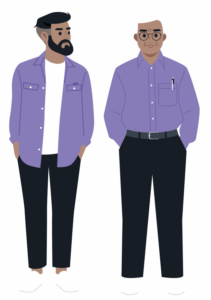
- Navigates dualities. The middle-class male constantly negotiates between tradition and modernity, as well as between his private and public selves. Raised in traditional settings, yet driven by modern aspirations, he embodies a “modernized desi style”—pairing loose T-shirts and baggy pants with a metal bangle, taking pride in his regional roots, while aspiring to move abroad. Similarly, he balances conflicting models of masculinity—caught between hyper-masculine expectations and more sensitive, vulnerable narratives. This often manifests in male consumers balancing these conflicting expectations and needs by expressing their vulnerability and emotionality more in the private domain and projecting an image of strength in public spaces.
 How to Resonate with the Middle-Class Male Consumer
To truly resonate with the middle-class male consumers, brands need to move beyond the unidimensional portrayals and engage with their lived
realities. This requires the brands to acknowledge their whole personhood authentically and do so with more granularity to establish a deeper connection and thus drive stronger business outcomes. The following are some ways through which brands could achieve this:
- Acknowledge the modern provider and create a means to feeling the lost “respect” in the family, such as campaigns that portray men not just as breadwinners, but as having multiple dimensions in their role—emotionally available, technically competent, and family-oriented. Brands could embody the values of resilience, recognition,
reputation, responsibility, stability, and respect to resonate with these consumers. - Reclaim the father figure. Brands could either embody the father figure—offering guidance,
stability, and reassurance—or resonate with the longing for the father figure through nostalgic, larger-than-life imagery. - Consumers face conflicting expectations of ideal masculinity and hence, seek escape as a form of self-care. Brands can position themselves as pockets of release from the everyday stress, isolation, and alienation.
- Own the contradictions. Brands could help make sense of the contrasts that exist in consumers’ daily lives by empathizing with these identity tensions.
- Align with the emerging markers of success, such as a balanced lifestyle, mental relaxation, and living a slower life.
By acknowledging and bringing focus to these consumer tensions and needs, brands have an opportunity of not only becoming contemporarily relevant but also fostering a deeper and enduring connection with the middle-class male consumer—a connection that feels increasingly rare in a world where brand loyalty is becoming a fleeting concept. Brands that can reflect the evolving realities of the middle-class male have the potential to earn lasting trust and create emotional resonance.