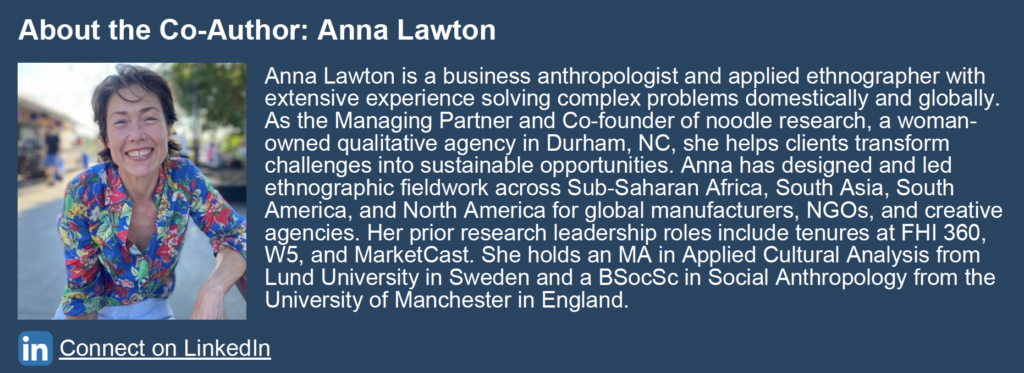

 By Anna Lawton
Managing Partner & Co-founder
noodle research + strategy
Durham, North Carolina
anna@noodleresearch.com

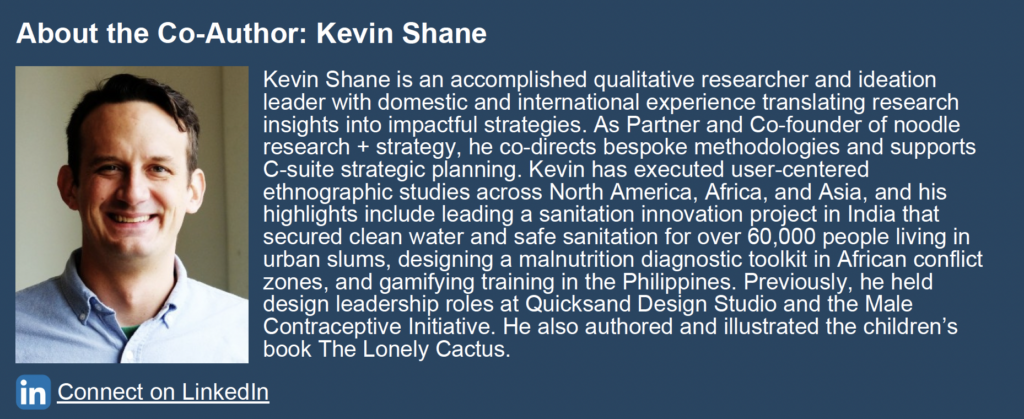
Kevin Shane
Partner & Co-founder
noodle research + strategy
Durham, North Carolina
kevin@noodleresearch.com
When pursuing innovation in general, or to improve existing or design new products or services, organizations frequently ask users directly what they want, which typically yields feature requests or lists of product complaints. However, this approach often leads to the most powerful insights capable of driving truly transformative solutions remaining hidden in plain sight. They are tucked away within the minor frustrations, clever workarounds, and unconscious habits of daily life. Uncovering these unarticulated unmet needs requires what we at noodle like to refer to as “The Anthropologist’s Eye:” a trained ability to observe and interpret these subtle clues.
The Innovation Gap: Why Users Struggle to Articulate Their Needs
Although customers are experts in navigating their own lives, they are generally not experts in design. This reality can translate to a significant innovation gap, as their capacity to clearly express what they need is hindered by several distinct factors:
- Habituation: Individuals become so accustomed to daily frustrations or convoluted processes that they accept them as normal, meaning these issues are no longer top-of-mind.
- Lack of Awareness: Users frequently do not realize that a more effective or advanced alternative is even possible.
- Cognitive Load: The routine effort required to complete a task becomes so deeply ingrained that users no longer consciously perceive the specific friction points.
- Problem vs. Solution: While people excel at explaining their current difficulties, they often struggle to conceptualize or envision novel solutions.
Due to these factors, it is imperative that researchers identify ways to expand the scope of their investigations, and utilize expansive research methodologies, elucidate as holistically as possible, the lived realities of the individuals and communities they are studying. Doing so allows the researchers, and by extension their clients, to see how the specific challenge or opportunity being investigated fits into the larger picture of their daily experiences. Conversely, failing to unpack “the bigger picture” can potentially lead to an inaccurate, or at least incomplete, understanding of the challenge or opportunity itself, as well as the insights generated by the research that are meant to provide the foundation for designing solutions that address the challenge or capitalize upon the opportunity.
There is a great parable that we like to use to illustrate the hazards of taking too narrow an approach to research: The Blind Men and The Elephant. In the parable, each blind man feels a different part of the animal’s body, but only one part. They then describe the animal based on their limited experience and their descriptions of the elephant are vastly different from each other. One thinks it must be a large snake since he only touched the trunk; one thinks it must be some kind of fan because he only touched one of the elephant’s ears; and yet still another thinks that it must be a tree or a pillar because he only touched one of its legs. The warning from this story is basically do not take too narrow a perspective, but the real power is in its moral: in order to understand complex truths, you need to understand (and combine!) multiple perspectives and develop a holistic understanding.
Furthermore, it is critical to understand, and inform, how a singular research engagement fits into a client’s larger body of understanding. Just as taking too narrow a view on a particular research project is fraught, viewing any one research initiative as a one-off activity comes with myriad risks. This type of episodic engagement and learning leads to what we see as “Insight Islands,” whose characteristic symptoms are:
- Knowledge Silos: When Marketing uncovers deep consumer motivations that never cross over (when they should) to inform Product Development or UX Strategy.
- Institutional Amnesia: How the critical ethnographic lessons learned in 2026 are completely forgotten or discarded by 2028.
- The Silo Tax: Different departments repeatedly paying separate vendors to answer the exact same fundamental consumer questions.
Ultimately, these factors lead to “Fragmented Impact,” where strategic decisions remain disjointed and reactive because they are based on isolated snapshots rather than a living, evolving understanding of human experience.
We fully understand, appreciate, and empathize with the reality that there can be significant limitations to taking expansive approaches to research engagements, as well as in building the continuum of understanding that emerges from the repeat engagements that we advocate for. These include but are certainly not limited to:
- The “One-and-Done” Budget Trap: Traditional procurement departments often treat research as a transactional line item rather than an ongoing investment in user understanding. Budgets are typically strictly allocated for a single, contained project. Selling the necessity of longitudinal, repeat engagements (where we return to the field to see how behaviors evolve) is difficult when there simply isn’t a financial bucket for iterative engagement and learning.
- The Tyranny of the Urgent: In today’s hyper-accelerated market, clients are often under intense pressure to find a definitive answer to a pressing question today. Anthropological research, which relies on observation, deep synthesis, and contextual inquiry, takes time and it can be a steep hill to climb when trying to align the deliberate pace of ethnography with a hyper-speed, two-week development sprint.
- A Lack of Internal Appetite (and the “Big Data” Bias): Selling the value of qualitative, observational research to pessimistic, internal stakeholders is a frequent hurdle. Many organizations are culturally wired to crave hard metrics, dashboards, and quantitative validation alone. To these skeptics, deep ethnographic insights can sometimes be unfairly dismissed as “soft” or anecdotal, making it hard to secure buy-in for ongoing, anthropological engagements.
- The Strategic Disconnect: Too often, research teams are siloed away from the executive decision-makers. When there is a lack of connection between research activities and overarching strategic plans, our deep-dive observations risk becoming just “interesting field notes” that gather dust.
- Fear of the Unanticipated Problem: Utilizing an approach like “The Anthropologist’s Eye” is incredibly effective at uncovering friction points, but they aren’t always the friction points the client wanted to find. True observational research often exposes foundational issues or new user needs that fall outside the current project scope. Selling a continuous research loop means asking clients to embrace ambiguity and be willing to pivot their strategy based on what we discover in the field.

However, our job as researchers isn’t just to do the research, but to act as a partner in innovation and change management for our clients. We don’t just hand over a deck of observations; we help our clients build the internal scaffolding (e.g., budgeting strategies, stakeholder alignment, and strategic integration) needed to make qualitative insights a foundational cornerstone of strategic decision-making. And for the participants in our research engagements, it is imperative to always remember that we are acting as stewards of their truths. By engaging with us and participating in our projects, they are trusting us through their vulnerability and transparency to share their experiences in order to achieve some manner of positive change.
Making the Case: How to Champion the Anthropologist’s Eye
It is one thing to understand the value of observational, evolving research; it is another entirely to convince budget-conscious, fast-moving stakeholders to invest in it. To move clients past the familiar comfort of one-off surveys and focus groups, we must change how we sell the research itself.
Here are the strategies we use to help organizations embrace the long-term value of anthropological research:
- Pitch the “Insurance Policy” (Reframing the Budget Conversation): Instead of framing longitudinal ethnographic research as an added cost, position it as risk mitigation. The most expensive mistake a company can make is flawlessly executing the wrong product. By investing in repeat, in-context research, clients are buying an insurance policy against the costly “say/do gap”: the massive chasm between what users claim they will do in a survey and how they actually behave.
- Deliver “Field Dispatches” (Solving for Time and Agile Sprints): We can’t expect product teams to halt development for six weeks while we synthesize a massive ethnographic report. To overcome the “tyranny of the urgent,” we send raw, bite-sized “field dispatches” that provide top-line summaries of each day’s activities while researching, and weekly project progress reports every Friday. This feeds immediate agile sprints while buying us time for the deeper, holistic synthesis.
- Marry the “What” with the “Why” (Overcoming the Big Data Bias): When facing quantitative skeptics, don’t compete with their data—rather complete it. Acknowledge that their analytics dashboards and big data are incredibly powerful at telling them what is happening (e.g., “Users are abandoning the cart at step three”). Then, position utilizing an “Anthropologist’s Eye” as a critical approach capable of explaining why it’s happening. Qualitative observation is the translation layer that makes their quantitative data actionable.
- Mandate Stakeholder Immersion (Bridging the Strategic Disconnect): A slide deck rarely changes a company’s culture. To connect research to high-level strategy, executives and product owners must feel the user’s friction themselves. Document field research activities with rich media that you then use as the foundation for ideation events and workshops. Build in audio clips from stakeholder interviews into detailed findings reports. When a skeptical stakeholder witnesses a real human being devise a frustrating, duct-tape workaround to use their product, the strategic disconnect vanishes. Empathy is a highly effective sales tool.
- Reframe “Unanticipated Problems” as “White Space”: Clients often fear the messy reality of the field because it might unearth problems outside their current scope. We must re-educate stakeholders to view these unanticipated discoveries not as scope creep, but as competitive “white space.” If we uncover a hidden need that no one asked for, it means their competitors don’t know about it either. It’s an untapped blueprint for true innovation.
- Design for Evolution (The “Retrospective” Approach): To sell the value of repeat engagements, build the concept of a “post-launch, ethnographic check-in” into the initial proposal. Remind clients that a product launch isn’t a finish line; it’s the introduction of a new variable into the user’s ecosystem. Selling a secondary engagement three months down the line ensures we can measure how the user’s routines have evolved in response to the new solution.
Conclusion: From Observation to Transformation
Adopting an “Anthropologist’s Eye” is ultimately about much more than changing how a company conducts research. It requires fundamentally shifting why a company conducts research by moving away from viewing research as a transactional checkbox used to validate pre-existing ideas, and instead embracing it as a continuous, strategic compass that guides true innovation.
Yes, the institutional barriers to this approach are real. Budgets are limited and limiting, timelines are compressed, and the allure of hard, quantitative data is powerful. But as we have all seen in various ways throughout our work as qualitative researchers, the cost of ignoring the unarticulated needs of customers is far greater than the investment required to uncover them. When organizations remain trapped in “Insight Islands” or rely solely on what users explicitly ask for, they build products for a world that doesn’t actually exist. They miss the messy, beautiful, and deeply human realities of how people actually live.
Our role as strategic partners is to help our clients bridge that gap. By reframing qualitative research as an insurance policy, marrying the “what” of data with the “why” of human behavior, and bringing the lived realities of research participants as holistically as possible into the boardroom, we can dismantle these barriers together.
Innovation rarely announces itself loudly. It doesn’t usually come in the form of a direct customer request or a perfectly charted data point. It is found in the quiet workarounds, the silent frustrations, and the daily rituals that users often don’t even realize they are performing. By training our eyes to see these hidden truths, and building the internal scaffolding to act upon them, we do more than solve today’s problems: we uncover tomorrow’s untapped opportunities.
This article builds on the insights Anna and Kevin provided in their recent QRCA Qcast in July entitled: “The Anthropologist’s Eye—Reading Behavioral Clues to Surface Hidden Insights.”