

By Tami Wloch
Director, Social/Digital Media
Strategic & Creative Marketing Inc.
Minneapolis, Minnesota
Tami@scmarketinginc.com
Imagine you are one week from fielding a set of focus groups and you are short recruits. You need twelve mature women who prefer to drink high-end tequila. Traditional methods of recruiting from email lists and recruiter databases have failed to bring in the recruits that are needed to fully satisfy the project specs. However, your recruiter mentions that a social media campaign may help you bring in those final elusive research respondents. You have tried social media recruitment in the past with little success, but you are told there is now one major difference that actually makes social media a viable recruiting option: AI.
Artificial Intelligence seems to be the thoroughly talked about topic across several industries, including qualitative market research. For example, qualitative researchers are now using transcription tools with built-in AI analytical capabilities that can detect themes and sentiment within a set of focus group transcripts, which has dramatically changed the how and when of the delivery of qualitative research reporting. And while much attention has been given to AI’s data analysis capabilities, AI’s uses are constantly evolving.
Qualitative researchers are now leveraging AI for its ability to reach and recruit targeted sets of people, or audiences, through social media marketing campaigns as a source to attract and recruit participants for qualitative research projects. Social media ads are one of the first adopters of AI, using it to both create the ads as well as target audiences. However, marketing and recruiting firms can be challenged in creating and running effective social media ads as a tactic to attract the right qualitative research recruits.
Case Study: Respondents Needed for a Company Producing a High-End Tequila
A brand-new business was planning to produce an expensive tequila but needed to better understand their target consumer before developing and bringing their product to market. This client came to us with a challenge: they had just one week to recruit for an exploratory study. The ideal participants were U.S.-based men and women, who were high-income earners and enthusiastic consumers of high-end tequila. The goal was to recruit 12 qualified respondents who currently drink high-end tequila.


This case study shows how social media ads are a powerful way to reach the exact recruits needed for qualitative market research projects. Instead of relying solely on utilizing recruiter databases or email lists, recruiting via social media ad campaigns allows you to target your desired audience efficiently.
Advantages of Using an AI-enabled Social Media Campaigns for Market Research Recruiting
Traditional recruitment methods—phone recruiting from email lists and recruiting firm databases—still have their place. But they also come with limitations: they’re often limited in reach, and time-consuming. AI-driven social campaigns open up new possibilities for attracting like-minded, relevant, and hard-to-reach consumers in less time compared to traditional recruitment methods.
Here’s why we believe AI-driven social-media advertising can work well for qualitative research projects:

AI allows researchers to define very specific audience criteria. Recruitment via targeted ad spending is directed toward users who best match the exact recruitment criteria, thus reducing waste. For example, AI ads can zero in on individuals who have purchased tequila, and more specifically, high-end tequila brands.

AI-powered ad platforms can be enabled to find specific respondents across multiple social media platforms simultaneously. For example, you can target individuals on major social platforms such as Facebook, LinkedIn, Messenger, and Instagram, plus also reach across 47,000 online media and entertainment platforms including sites such as Oprah, CNN, Chicago Tribune, NFL, Univision, plus apps like Candy Crush, Wordle, and thousands more. This reach is especially helpful when trying to find low-incidence populations or unique psychographics that traditional recruiting lists struggle to deliver.

AI can suggest copy variations, recommend images and designs, and even generate visuals from text prompts. AI tools can generate headlines and content variations within the ad and draw on the AI knowledge of which headline and copy combinations potential research participants are likely to actually respond to.
How to Build an Effective Campaign
The challenge in building an effective campaign is knowing how to harness the power of AI to produce the desired results: recruiting the exact people needed for a qualitative research project. How researchers use the AI ad tool determines whether they are able to motivate potential respondents—essentially, it’s all about engagement. Researchers must engage social media users in the social media recruitment ad enough to be interested in participating in the study.
Social media platforms have algorithms that determine which ad content is likely to be the most motivating. There are 20+ criteria in social-media ads that ad platforms look for, and the ones containing the most criteria get the best results. These criteria are critical to successful performance of social media ad recruitment campaigns. The more criteria you meet, the lower the cost-per-click will be and the higher engagement rate will be (calculated by taking the total engagements such as clicks, video views, shares, etc. and dividing those by the total ad views). Typical engagement rates on Meta channels, for example, are just 0.05 percent so increasing that number significantly increases the likelihood of a recruitment ad stopping the scroll and enticing the user to click through to the screener.

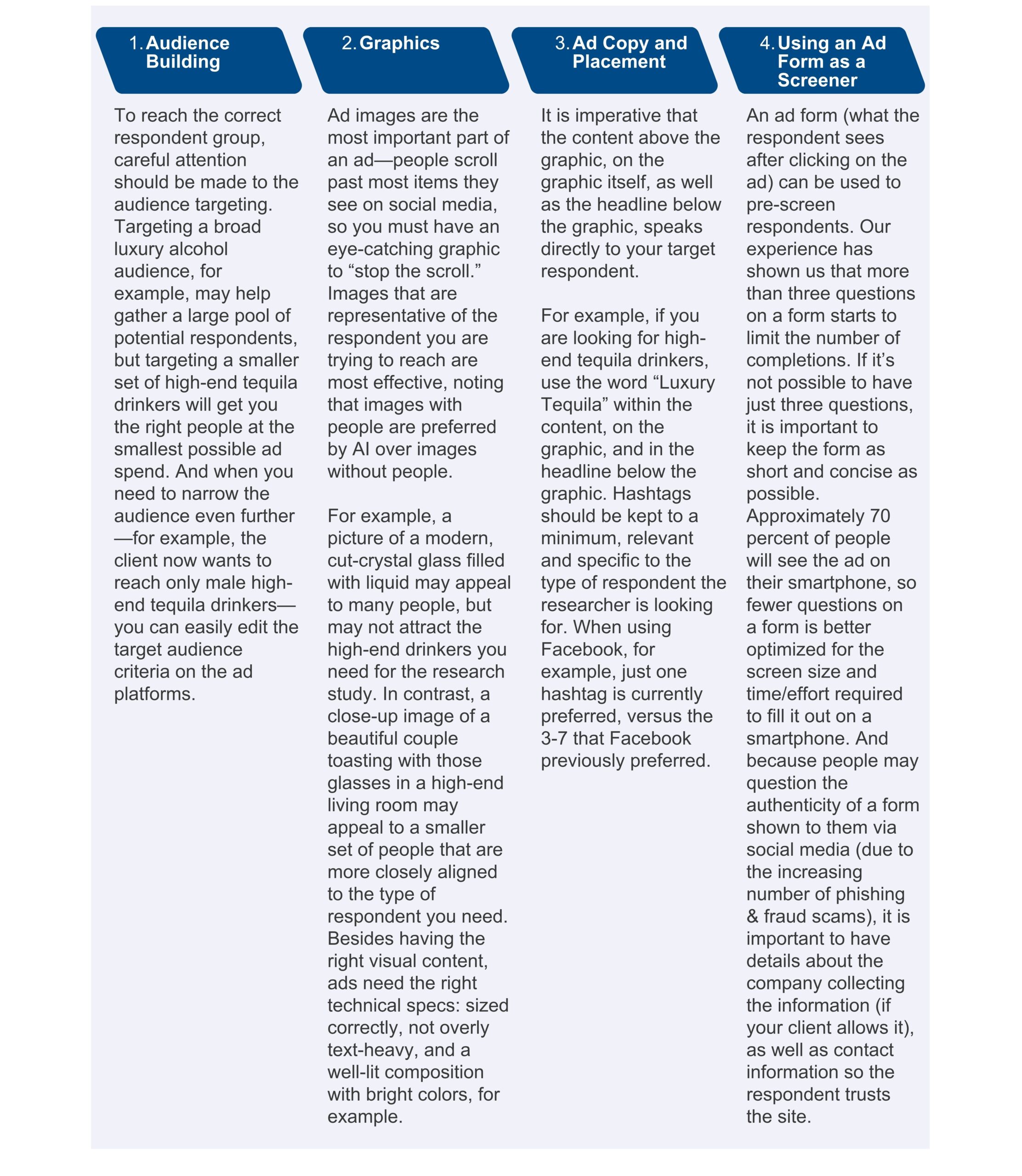
Here are a few important guidelines to use when ads are created to meet some of the criteria. Note that this information was obtained directly from Facebook & LinkedIn.
Know When NOT to use AI
Most major social platforms have now launched campaign builders where you let the platform choose all the targeting criteria for you. The AI is supposed to read the content and graphic and show the ad to those it thinks will respond the best. On Facebook, these are called Advantage+ campaigns and on LinkedIn, these are called Accelerate campaigns. Although these ads are supposed to be more effective than those targeted by humans, our experience has found this not to be the case. In conversations with other marketing firms, we’ve seen the AI blow through thousands of dollars in ad campaign in just a couple days, not even reaching the right people. We have tested them ourselves and have found that the targeting tends to go much outside the narrow audience that should be seeing the ads.

Final Thoughts: A New Frontier for Qual Recruiting
To develop effective social media marketing campaigns for recruiting qualitative research respondents, the campaign needs to be custom-built. Finding the right people to talk to is half the battle and AI-enhanced social media makes it faster, easier, and more precise. But success depends on more than just tools. It requires:
- A deep understanding of social platforms
- Cutting-edge creative that speaks directly to the target audience
- A team that knows when to use AI and when not to use AI
Following these guidelines and finding an experienced, social media marketing partner could help researchers bring in the right people for their studies. With this approach, the question isn’t whether AI can support qualitative recruitment, the question is: how will you use it to make your next qualitative recruit a greater success?