By Zoë Billington
UX Research & Customer Insights
Los Angeles, California
zbillington@gmail.com
Zoë Billington: Let’s start with the 10,000-foot view of your career. How do you tell the story of your career and how you got to where you are today?
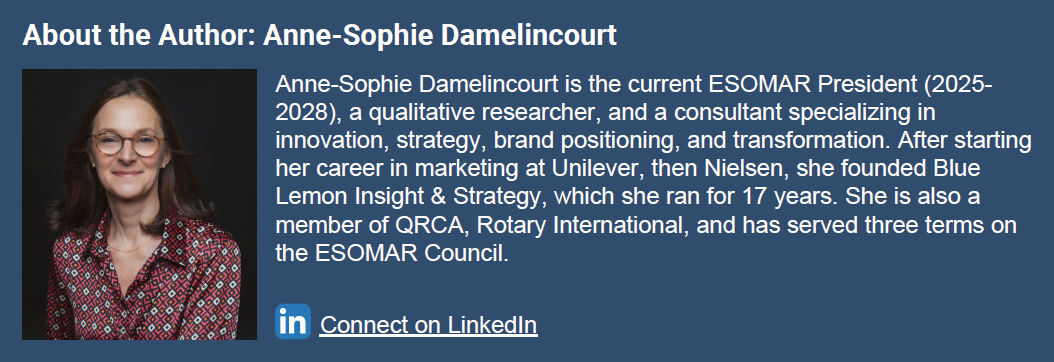
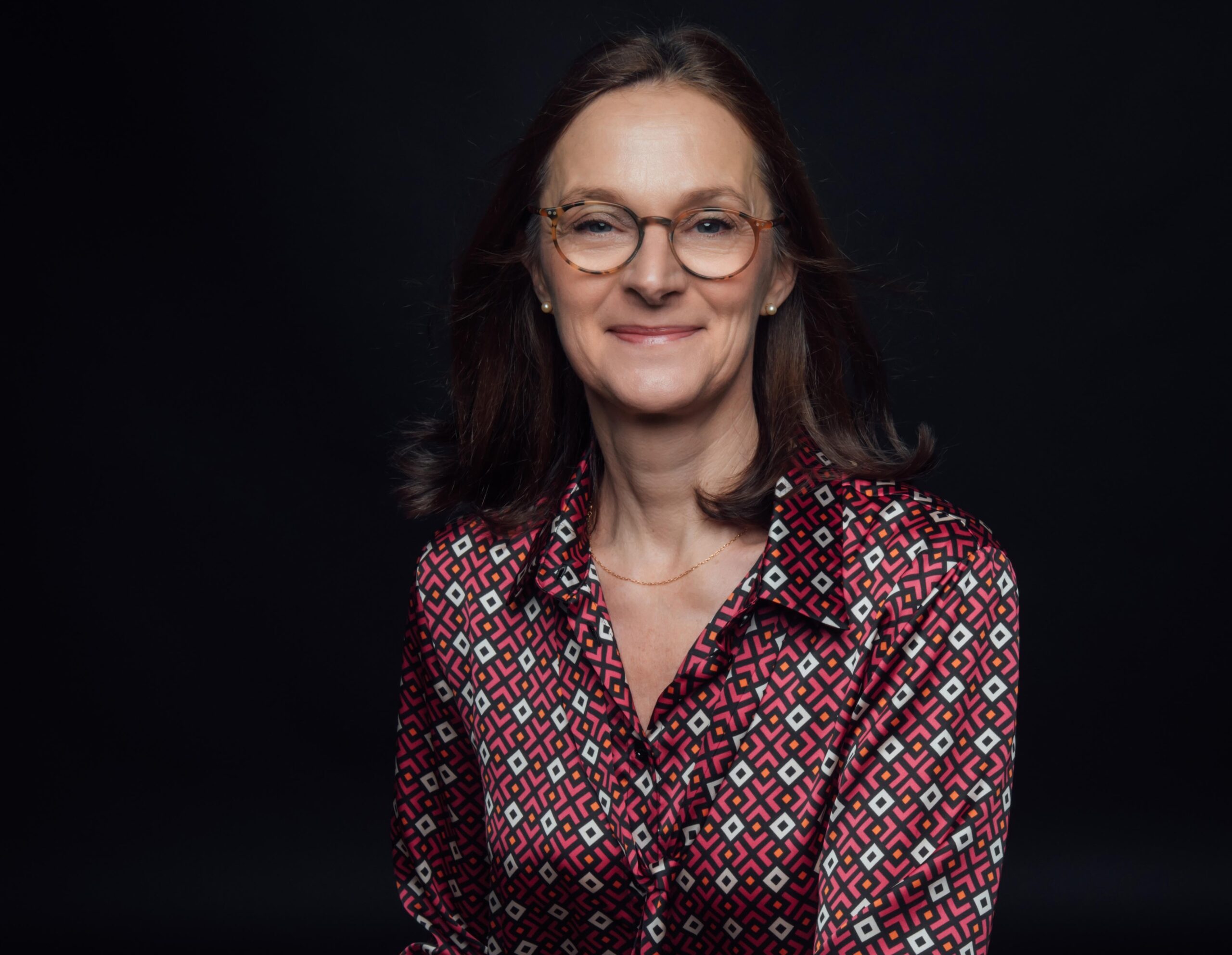
Anne-Sophie Damelincourt: It’s interesting to start like this, and when I think of it this way, I can say there’s lots of consistency in my career, because it has been driven by passion, and by innovation, strategy, and business. I’m a qualitative researcher, but what is very specific about me is my research has come from and always been very close to business. My first job was in marketing, so I have a quite good understanding of what clients do and need: I am here to help brands and companies grow. This is also what I’m doing at ESOMAR—bringing my strategic views to the organization to help it grow.
One other important link in my career and my personal life are the people. When you are a qualitative researcher, you work with humans, for humans. And this is what an association is all about, whether it’s QRCA or ESOMAR—it’s about a community of people. I am also deeply involved in my role at Rotary International, serving people with a strong local footprint for a more peaceful world thanks to education and health.
Zoë: What are some of the accomplishments you’re most proud of across your career?
Anne-Sophie: The first one would be that I founded and managed my company, Blue Lemon Insight & Strategy, for 17 years. It was a boutique agency, working with local and global brands. Associations played an important role in my business growth—QRCA, the AQR in the UK, and ESOMAR.
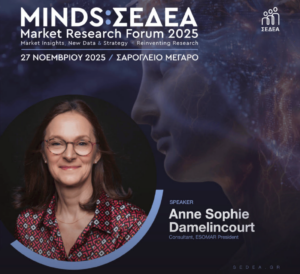
And of course, now being ESOMAR President is something really important to me. ESOMAR is the global organization for research, data, and analytics that empowers insights professionals and businesses to unlock their potential on both the global and local stage—fostering connections, collaboration, growth and knowledge. It’s great to be involved in such a project, especially now in the times of AI and when the world is going so fast and changing every week or month. We need to adapt and to make the leap to future-proof the organization.
Zoë: You said that being ESOMAR president is especially meaningful to you now because we’re in times of rapid change. Can you talk more about some of the key challenges ESOMAR is facing now?
Anne-Sophie: I think this is true for all professional associations since for most of them, their economic model is based on membership or events. And a question I have for the youngest generation is: is this model relevant for them? By that I mean the idea of paying dues and belonging to a group, when a lot is accessible for free, and when you are fully free to pick and grab what you want at any time.
There is a big gap between the younger and the older generations when it comes to their relationship to work and to the world. But I think this topic of membership and belonging is a key question right now. And associations can play an especially important role now, because with AI and with the algorithms, we only see the world through a specific lens.
You are in your bubble, and you never connect with another bubble, small or big. When you can connect these bubbles, this is where you become stronger, bigger, more relevant, and more prepared to adapt to the future. And that’s only possible through collaboration, which associations help facilitate.
Zoë: You’ve experienced our industry from within multiple “bubbles,” to borrow your word: as a marketing end-client of research; as an entrepreneur heading up your own agency; and now as an association leader. How has each of these perspectives shaped your understanding of what truly creates value in research and insights?
Anne-Sophie: I think the learnings are actually quite similar, because you’re doing research to understand people to drive value and growth.
Whether you are in marketing, working as a consultant, or managing a bigger organization like ESOMAR, it’s very similar. And today the frontiers between providers and end-clients are blurred, since the data is not collected or produced by providers only.
It seems that it has been so complicated to go beyond data for this industry—meaning, showing our real value, which is how we use insights and turn them into action. And this is the question we have today with artificial intelligence because each time a new type of tech is coming—we had the digital world 20 years ago, then came AI—we are still stuck in that question of how to move beyond being data providers. For decades, data belonged to the market research industry, which is not true anymore, and hasn’t been since around 2000.
This industry can sometimes pull in two directions at once: we have very talented and bright people, who are visionaries, and at the same time I have the feeling that it’s difficult to embrace change and to do it differently. So, it’s a kind of paradox.
On top of this, the industry has a tendency to see things in silos: we still talk about qualitative versus quantitative, human versus AI, when it should be AND rather than OR. And we need to remember that ultimately, we are here to empower brands, societies, and people through whatever mix of methods and consultative approaches are needed.
Zoë: That’s a striking paradox you’re describing—an industry full of visionaries who still struggle to embrace change. Given that, how do you think about actually making transformation happen, both in associations and in the industry more broadly?
Anne-Sophie: I truly believe in collective intelligence, and this is the role of associations. When you’re alone, it’s very difficult, and even when I say alone, it can even be when you’re working in a big company. So, this is the role of these organizations—to meet people, to interact, to collaborate, to confront, to grow.
So, to make transformation happen, I think we should start by breaking the silos I mentioned earlier. Talking to people and building together, bringing very different skills and expertise together, bridging the gap. This is how we can make our industry and our associations stronger, more relevant, and move to transformation. Everyone has a role to play: practitioners, end users, consumers, legislators, creators, innovators.
Zoë: Along those lines, what are some of the challenges that get in the way of creating these environments of collective intelligence?
Anne-Sophie: Time is a challenge. We need time. And the world and the industry are moving really, really fast. Being ahead of the curve in a fast-changing world is a big challenge, and it is even bigger in the data industry.
Another challenge would be that we are a community of bright thinkers and creative people. We are excelling in creating new ideas, but we need to follow them through with actions.
I’m working with ESOMAR at both levels— thinking but also making decisions and doing. The mix and the right balance are important. We tend to try to make big leaps, when smaller and consistent steps would be less daunting and help bring more into action and transformation.
Zoë: You also mentioned to me earlier that you see belief as being essential—belief in yourself and in others. Why is that so important right now, particularly for researchers?
Anne-Sophie: We are in a world where there is so much fake news and mistrust. Trusting, being confident in yourself and also in other people, is something really important. This is a challenge today. You hear so many people saying that they don’t feel confident because the world is challenging, or because of their lack of inner strength. Being part of a professional association brings confidence: confidence in you because it offers a space to share experience, ideas, and vision. This is the power of collective intelligence.
Being part of a professional association is also a way to strengthen our industry to spread the voice of integrity, ethics, and therefore, trust in our data and our work. In June 2025, ESOMAR revised its Code of Conduct to bring more transparency, clarity, and trust to our industry.
This Code is the world reference in conducting our profession ethically.
Zoë: What would be your advice or call to action for our readers on how they can help move the industry forward?
Anne-Sophie: It’s about collaboration. Everyone can collaborate. Collaboration is key across disciplines, across countries, generations. This is where you find the gold. And this is the purpose of an association, whether QRCA or ESOMAR.
Also, I do believe that we should try to make small steps rather than big leaps as I said above. We can try a tool or a new way of doing things and then share it with the community. The risks are not big. So, trying and sharing together, our successes and our failures, is a good way to make small leaps and to move forward.
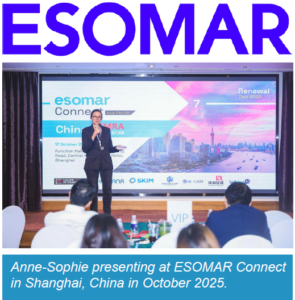
I recently opened the ESOMAR Annual Conference in Prague and the Trend Horizons event in Washington, DC. My messages were all about leading together and doing together; this is where our power is.
Zoë: Thanks so much, Anne-Sophie.