
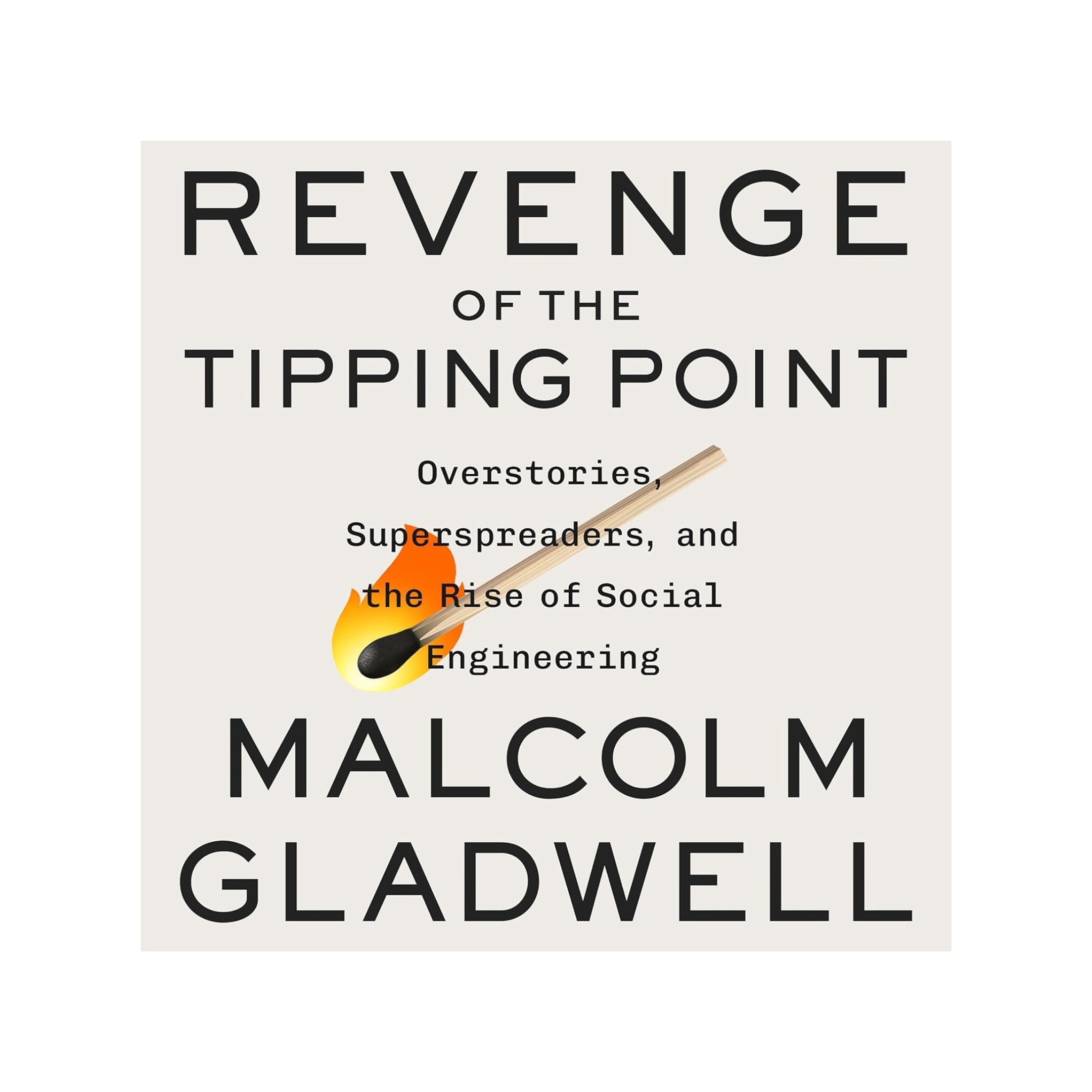
By Malcolm Gladwell, Little Brown and Company, 2024

Reviewed By Heather Coda
Principal
HMC Marketing Research
West Chester, PA
heather@hmcmarketing research.com
How did a former petty criminal set a world record for masterminding the largest number of bank robberies in history? Why are there large variations in how medicine is practiced between seemingly similar towns? Why has Medicare fraud been much more rampant in Miami than in other Florida cities?
Malcolm Gladwell attempts to explain these and other social phenomena in Revenge of the Tipping Point: Overstories, Superspreaders, and the Rise of Social Engineering, the follow-up to his first book The Tipping Point: How Little Things Can Make a Big Difference, published twenty-five years ago. He builds upon his first book’s “tipping point” content by providing examples of what he terms “social engineering.” A tipping point is the moment when a small change produces a big effect, causing an idea, trend, or behavior to spread rapidly. Social engineering is when that small change is purposefully implemented by a person or persons in a position of power. It’s the deliberate, often non-transparent design of policies, environments, or communications to influence people’s behavior for a desired social outcome. Sometimes social engineering is intended to unite or uplift people; other times, the intention is less benevolent.
Gladwell has compiled a wide range of real-life examples of social engineering in the U.S. These include the furtive Harvard admissions criteria; the reasons for the significant increase in discussions about the Holocaust in the U.S. after 1980; the ways in which gay marriage went from being unacceptable to acceptable to most Americans within a decade’s time; and the reason why the opioid epidemic has been more severe in certain states. These case studies are intriguing in their own right, and more so because of the way Gladwell artfully weaves them together, drawing parallels to validate the concept of social engineering.
Like his other works, Revenge of the Tipping Point fascinates because it demonstrates why events often unfold in unexpected ways, with unintended consequences. For example, his research and analysis showing the principle of “group proportions” in action uses the case study of Purdue Pharmaceuticals’ OxyContin. Specifically, their decision to replace the much-abused OxyContin with OxyContin OP, which could not be crushed into powder and snorted, and thus deemed safer, actually led OxyContin users to switch to the more dangerous drugs, heroin and fentanyl, leading to a sharp increase in the overdose death rate.
Gladwell also uses his examples to demonstrate corruption and greed in powerful institutions like higher education and big business. He provides eye-opening accounts of specific institutions that may make readers question if their actions are fair and democratic.
His studies also provide examples of social factors that may initially seem unimportant but can significantly impact people’s lives. One such example is the dangers of a monoculture, that is, a lack of diversity, and how it can impair the experiences of female corporate board members, based on a 2006 research study by the Wellesley Centers for Women1. A more tragic example is how a monoculture in an upscale suburban town, in which nearly all teenagers were following the same narrative of striving for academic and athletic achievement, led to a rash of suicides in a short time period. Those students who were struggling or didn’t want to follow this achievement narrative felt more isolated than in other towns where such a monoculture did not exist.
Gladwell’s research, analysis, and storytelling provide examples of how the actions of a very small number of people can have outsized consequences. He argues that epidemics have rules and boundaries, and are subject to overstories, which are powerful, overarching narratives that shape behavior and tipping dynamics. He challenges the reader to either let unprincipled people use their power and influence to create such epidemics, or look for ways to get involved to use our own influence to strive to create a more principled society.
Qualitative market researchers may have a particularly keen interest in the book for numerous reasons. One is that it demonstrates how to tell an intriguing story based on behavioral data and analysis. Another is that the “Magic Third” concept shows why we need to ensure adequate diversity in focus group samples. This book also provides evidence of how media and culture can drive significant transformations in beliefs and practices, sometimes rapidly. As researchers and marketing strategists, we should be attuned to such changes as they may have an impact on our clients.
Ultimately, Revenge of the Tipping Point alerts us that social epidemics can be started by an alarmingly small number of people, explains precisely how they occur, and encourages us to recognize when to take action to prevent social engineering from harming people. Gladwell’s real-life examples are memorable and designed to stick in our consciousness long after we’ve finished the book, to help us recognize such epidemics. As leaders in our businesses, communities, and families, this book provides meaningful lessons incorporated into an intriguing work of popular social science.
1Critical Mass on Corporate Boards: Why Three or More Women Enhance Governance, Wellesley Centers for Women, 2006
About the Author: Heather Coda
Heather Coda is a moderator, report writer and strategy consultant specializing in pharmaceuticals, biologics and other healthcare products and services, with 30+ years of experience in marketing research and marketing. Her 20+ years of marketing research experience on the supplier and client side includes 10 years of moderating, as well as management positions in marketing and patient experience on the client side.
Heather specializes in facilitating in-depth conversations with physicians around therapeutic decision-making and the evaluation of clinical communication materials. She is known for her ability to quickly build credibility with clinicians, surface implicit assumptions, and unmet needs, and uncover both the rational and emotional factors influencing treatment choices and message resonance. Her work consistently transforms complex clinical and commercial input into structured, commercially meaningful insights. Heather has an MBA from Villanova University, and a BA in Economics and Sociology from the University of Richmond. She is a member of QRCA and Intellus.
LinkedIn: https://www.linkedin.com/in/heather-coda/
About the VIEWS Feature Editor: Kelly Heatly
 VIEWS Feature Editor – Kelly Heatly
Root Research and Insights
Dallas, Texas
kelly.heatly@rootresearch-insights.com