 By Zoë Billington
UX Research & Consumer Insights
Los Angeles, California
zbillington@gmail.com
Zoë Billington: Let’s start off how we usually do in this column: what’s the 10,000-foot view of your career, or how do you tell the story of how you got to where you are today?
Indi Young: I’m a person who’s interested in helping everyone—interested in supporting. So, it’s not really about me and my career. It’s about this method, Data Science that Listens, that I created to understand people so I could help businesses build things that are better for those people.
When I first developed this method, I was consulting for a satellite company. I didn’t know about market research early in my career; I just needed a way to better understand people so I could help my client build for those people. This method also helped me get the knowledge I needed for consulting projects at Visa and quite a few dot-com startups. I later worked with Schwab, Autodesk, and a bunch of universities after the satellite company.
The method has been pretty much what I’ve always focused on: how are we going to get organizations, businesses, policy makers—all of these people who are creating things for a lot of people—to pay attention to the variety of people that are out there, and stop trying to make one thing that rules them all? People have different approaches to things, different thinking styles, neurodiversities, and a lot of different cultural backgrounds and ways of approaching things mentally. Some of it’s pretty unique, but a lot of it falls into patterns, and those patterns are what I help organizations recognize and learn how to support.
Zoë: You describe yourself as “a solution strategist who uses applied qualitative data science.” You don’t always see “qualitative” and “data science” in the same phrase. Can you explain what that means?
Indi: My title “qualitative data scientist” is kind of my little joke. When capitalism started growing, it was right around the same time that natural philosophy (the historical study of nature and the physical universe) borrowed from the scientific method. Businesses were like, “we want to be scientific,” so they borrowed the language of science. But what they were really doing was ethnography—not hard science.
Then came along the title “data scientist,” which is this glitzy name for using mathematical techniques to derive knowledge about people from quantitative data—often so you can convince, persuade, or manipulate them. And on top of that, so many people get through college without recognizing that quantitative and qualitative are not ends of the same spectrum. They are two different spectrums entirely. Quantitative research is measuring things. Qualitative research is something different. Everybody likes to say it describes the “why,” but the way researchers talk about it is that it’s the patterns of things. The patterns I look for are people’s inner thinking, emotional reactions, and personal rules—not their opinions, not their attitudes, not their observed behaviors.
So, I thought I would help people learn there are some myths here by showing them an unusual title: “qualitative data scientist.” Turns out, no one but the bots look at titles anymore.
Zoë: Your method centers around “mental models.” This is a term that gets used broadly across disciplines. How do you define it in the context of qualitative research?
Indi: I started talking about “mental models” around 2000, when not very many people were writing about it. It was mostly talked about in academia, so I built an applied method for business. People really went off into the weeds when I initially said, “mental model,” so I always added the word “diagram” when I said that phrase. When I said, “mental model diagram,” it landed people in a state of curiosity, and then I could show them my diagram, which I call the “Mental Model Skyline.” My first publisher, Lou Rosenfeld, wanted to call this diagram an “Alignment Diagram,” and later folks at Google called it an “Opportunity Map.” But I call it the Mental Model Skyline because the shape looks like a city skyline. (Figure 1)
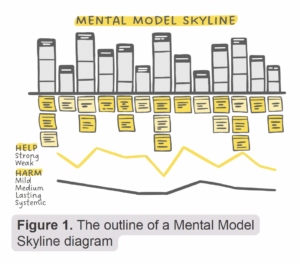 How do I build it? I collect data from listening sessions with humans, and then the patterns in the data emerge into a shape. It’s a bunch of towers, different sizes and shapes and widths, and like a city, the towers end up organizing themselves into neighborhoods based on what’s happening in there. We use people’s own words to name the towers, the streets, the neighborhoods.
And the reason I make a Skyline diagram is to visually compare or align human needs against what an organization is currently doing or planning to support those towers. And the big thing that happens is that teams are like, “Well, we were making this [product] because we thought it needed to be made, but it doesn’t match any of the towers, or it matches like all the towers sort of poorly.” I’ve had clients using the same Skyline for literally a decade, zeroing in on gaps or measuring how well their work supports one tower versus another, watching that measurement improve over time.
Zoë: Can you talk about what type of data those patterns—and ultimately, the Skyline diagram—are made of?
Indi: That’s the key question. Think of every topic a person raises in a conversation as a little spherical candy they are putting on the table. (Figure 2).
For the sake of the analogy, imagine a candy like a jawbreaker which has layers. The outer shell of the “candy” is what we normally talk to each other about: description, scene setting, explanation, names of things, facts. (Figure 3).
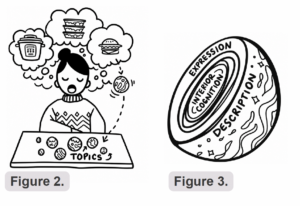
The next layer in is what I call the expression layer: opinions, preferences, attitudes, the kind of data that typically gets recorded in market research. And at the core itself is what I call interior cognition: inner thinking, emotional reactions, and personal rules. I’m interested in listening to people’s core layer because that’s where we actually can understand people without using guesses, assumptions, or biases. That’s where we learn their real-time reasoning, the feelings they’re navigating, and the principles guiding their decisions. That’s what the towers in the Skyline are built from. And that’s what most research never gets to.
Zoë: So as a researcher, how do you know when you’ve gotten to that interior cognition layer? I have a suspicion that most people might go down one layer and think they’re there.
Indi: Yeah, exactly. Dave Gray writes about something like this in Liminal Thinking—the idea that, most of the time, we’re talking to each other with our speech bubbles pressing against each other and we kind of understand the outer layers. We press our opinions, explanations, and preferences on each other. But the foundation a person is standing on, the thing underneath that speech, that doesn’t typically get exchanged. That foundation is the interior cognition. That’s what’s at the core of the candy I talked about earlier.
So, when I do a study, I help an organization do a 180°. Instead of looking at everything through the lens of their solution, we look at what a person is trying to get done. What is their goal? The Jobs to Be Done framework calls it a job. I tend to study things that don’t necessarily have an ending that people reach, like in goals. I study things like taking care of your clothing. I study things like cooking dinner as a creative home chef. Or how did you change your personal identity? Or what’s been keeping you up at night as a founder recently? These are the kinds of things that I help organizations look at so they can see farther than their solution.
Let me give you an example from a study for a washing machine manufacturer. We weren’t going to ask about how people do laundry; that’s limited by what the solution currently does for people. Instead, we find out what are people trying to accomplish or address in the broader picture. The study’s germinal question was about taking care of your clothing. What was going through their minds, and what are the patterns there? One woman in the study was a designer. For her, clothing was a design identity statement. She chose pieces from other designers she admired. She wanted people to say something about her clothes when she passed them on the street. And I remember her talking through a piece she was considering on the rack, thinking hard about how the fabric was going to stretch out and lose its shape—and deciding against buying it because she didn’t think she could take care of it in a way that would preserve the designer’s original shape. That’s inner thinking.
Then there was a man who’d lost his wife and was now managing the laundry himself. For him, being “neat and pressed” was really: I’ve still got it together. As he was recovering from his loss, he started to remember what his wife had done, remembered she’d pin things outside to dry to save electricity. Use green power, solar energy. It’s frequently foggy where he lived, so he started experimenting: hang the shirts outside, but maybe put the towels in the dryer partway through. He was iterating, problem-solving in his own quiet way. And on the surface, none of this seems to have anything to do with the washing machine. But the company also makes dryers. And once you understand that thinking style, you understand how to support it. He wanted to show he could still present himself nicely and also honor his wife’s way of thinking about using resources.
The washing machine interface at that point was just showing mechanical controls—hot water, cold water, fast spin, slow spin. But if you’re standing there with a stained shirt and you’re not sure if this fabric will release the stain, why not make the interface speak to that?
Zoë: Are there specific prompts, techniques, or signals you rely on to uncover those deeper cognitive patterns?
Indi: The first thing you have to do is define the slice—the boundary around the topic you’re studying. What intention or purpose are people addressing? In the laundry machine example, the slice was taking care of your clothing. To give another example, say you’re working for a city that gets a lot of tourism, and they want to understand their tourists so that they can support them better, or market to them better. In a study, you wouldn’t just talk about your city with those people. Well, you could but you would get survey-type data; it wouldn’t get you interior cognition. The topic has to be something that people have been doing a lot of thinking about. Maybe they are foodies, and they follow certain chefs, and they watch certain shows about cooking. And so, the slice you study could be all about the way they decide where to eat when they’re away from home, or the way that they decide what to eat. You work with the organization to figure out that slice, and it can take weeks. With one client it took two months.
Then there’s recruiting. We ask for three times as many candidates as we need and do intro sessions with each of them. We’re checking two things: are they comfortable talking at this depth, and have they actually done a lot of thinking about this slice? I once had a perfect candidate—a nutritionist who taught cooking in people’s homes—but in the intro session, she could talk about how her program worked but couldn’t explain her own interior cognition during moments with clients. She had done the thinking; she just couldn’t access it for me. So, she wasn’t right for the study.
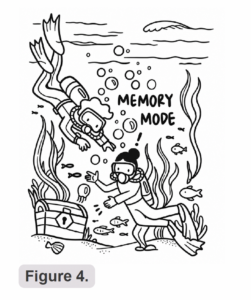
In the actual listening sessions, we go into what I call memory mode (Figure 4). Think of it like scuba diving: instead of two people in a boat where you’re on the surface of a topic, you’re both underwater, swimming through their past memory. You’re following them through it. And when they’re pointing something out and describing it, you help them unfold it with a series of very gentle prompts, mostly—not even questions.
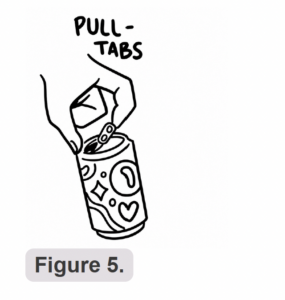
 I use something I call “pull tabs” (Figure 5). A pull tab is like a pop tab on a can. In a listening session, a pull tab is something sticking up in their conversation that signals there’s probably something underneath it. You can use “because”—just that word—as a soft prompt to get to that something underneath. Or you can use micro-reflection. For example, if someone’s talking about fabric and stains, you might just say, “So that kind of fabric?” to encourage them to continue down into their thinking from that particular moment. It’s not even phrased as a question. It gives them a chance to stay in control and keep leading you through their memory.
 And you only go into a listening session with one germinal question, something like “What was in your mind as you were cooking dinner as a creative chef last week?” And the one huge rule is that you do not bring up any topics the person hasn’t mentioned. If you do, you’re back up in the boat, and they’re scrambling to give you a generalized opinion, not their inner cognition.
Zoë: How does your approach to Mental Model Skylines change the way organizations make decisions? Can you share an example where your work led to a materially different outcome than a more traditional method might have?
Indi: Sure, here’s an example that has to do with cooking dinners. The story is that a nutrition council had been trying to get people in their region to eat better meals, and they’d run a lot of programs. The current focus was encouraging people to eat leafy greens.
We researched people’s inner thinking, emotional reactions, and personal rules from meals they had cooked when they were feeling creative. We framed the research with feeling creative so that we could use the results for a lot of future programs, and so that people thought beyond heating up a frozen prepared meal. A Mental Model Skyline emerged, showing all the focuses of mental attention when feeling creative while cooking. We worked to find the thinking styles involved. The thinking styles were then layered onto the Skyline, and the team could use that Skyline to find opportunities for regional programs over a number of years.
In this example, there were three thinking styles. One thinking style was the spontaneous creative: “What looks fresh today? Oh, the oregano on my balcony is looking perky, I’ll make something with that.” Another was the skilled chef type: someone who’s taken courses, has a bazillion recipes in their head, so when they walk down the grocery store aisle and see this fish that isn’t usually there, they think “I’m going to make this or that” and they try to get the texture just right, and they do a lot of the same dish over and over again to play with it. And then there’s another one who’s like, “I just saw the coolest meal. I want to make that, and I want it to turn out like that.” So, they’re going to get the recipe, get all the ingredients, they might have all this stuff out on the counter and notes about when to do what.
In the working session with the nutrition council, people started brainstorming interventions based on these three thinking styles. Someone said, “What if we put posters near bus shelters where she’s walking home?” Someone else said, “We should put messaging near the leafy greens in the grocery store.” And then someone else stopped the group and said: “Wait. We’re not supposed to change her thinking style. We’re not supposed to manipulate her into a different way of thinking.”
So: where did she see the meal she wanted to make? It was on a cooking show. So, go to the cooking show. See if they can do more episodes featuring leafy greens. See if they can do a special episode on how to pick them out. That’s how you support that thinking style. You go to where they encountered the thing they wanted to make.
That’s the shift. Instead of looking at everything through the lens of “what do we offer and how do we get her to use it,” you look at what she’s trying to get done and you meet her where she actually is.
Zoë: As AI and automation become more embedded in research workflows, how do you see the role of human-centered qualitative thinking evolving?
Indi: AI is supposed to give us more time to think clearly about where we’re going. As a natural side effect of that, organizations are going to be throwing a lot of things at the wall, and these are going to peel off because they don’t work. And maybe they’ll finally see: if I threw something that had thought behind it instead, the results would be different.
But I don’t know that that’s actually going to happen naturally. People’s bosses just want the answers already. That’s why it takes all of us talking about this constantly and demonstrating it.
Zoë: Is there anything else you’d like to add that we haven’t covered already?
Indi: There’s something I want to say to the business leaders. The reason science lent its language into business is partly because businesses want to believe their markets and their customers are predictable—that you can run an experiment and find an unchanging property, like in physics. But markets are not unchanging. Customers are not unchanging. People have agency, independence. Their behavior and their cognition are changeable. The sooner we can help decision-makers understand that they are not doing science, the sooner they’ll want to embrace qualitative data patterns.
And there’s something else. About a quarter of the people who use this method use it without asking their boss for permission. They just do it because it gets them the knowledge they need.
But the other part—the part I tell people constantly—is that as researchers, we tend not to be the power brokers. So, it’s so important to develop relationships with people who are. How do you do that? Do listening sessions with them. Get on their calendar and just have coffee. “What’s been on your mind? What are you grappling with? What’s been keeping you up at night about Project X?” Because otherwise, the whole organization goes in the wrong direction, you get laid off, and so much for stability. If we want stability in the work of research, we need to make relationships with those people who can act on what we find. And the beautiful thing is that the same skill—the ability to truly listen—is the thing that builds both the knowledge and the relationship.