 By Marta Villanueva
Founder and President
NuThinking, Inc.
San Antonio, Texas
marta@nuthinking.net
Picture the stack of proposals on your client’s desk. Yours is in there somewhere, third or fourth down, sitting between competitors who all promise focus groups, IDIs, and a polished report. Every one of them is competent (but competent doesn’t win the work).
You know what yours has to do. It must build credibility with a methodology the client may never have seen before. It needs to read as a solution to their business problem—not a menu of research activities. It must offer budget options—so “too expensive” never ends the conversation. And it must stand out from every other proposal that opens the same way. That’s not a writing challenge. It’s a creative one. And it’s exactly where artificial intelligence (AI), when used smartly, earns a place in your research toolkit.
For qualitative researchers and insights professionals, the opportunity isn’t just to use AI to generate ideas faster. It’s to use AI to design more thoughtful methodologies, uncover sharper lines of inquiry, and build stronger studies from the first page of the proposal. AI expands the speed and scale of ideation. But speed isn’t originality. Originality still depends on how you frame the question, challenge the obvious, and shape what the output means.
AI is not a creativity engine on its own. It’s a divergence amplifier: a system that rapidly surfaces patterns, associations, and possibilities. Without deliberate creative direction, it simply reproduces what’s already familiar, but just faster. Being familiar is exactly what your proposal can’t afford to be. The opportunity is to pair AI with proven creativity principles. Then your outputs aren’t just faster; results are more expansive, relevant, and strategically useful.
AI Excels at Divergence. You Have to Shape It.
Divergence is the phase where you generate a wide range of possible methodologies and ideas before narrowing down. It means suspending judgment long enough to explore breadth before refinement, so when you do converge, you’re choosing from a richer field. That distinction matters with AI because the quality of divergence shapes the quality of everything that follows. This includes the research design you ultimately put in front of your client.
AI performs especially well here. It can:
- Produce large volumes of ideas instantly
- Make connections across domains
- Extend thinking beyond your immediate experience
In effect, AI is a super-connector, surfacing more associations and angles than most teams could generate in a single working session. However, left unguided, it defaults to the most statistically common answers, and not what’s strategically fresh. This is where creativity principles become critical.
Shift from Prompting to Creative Direction
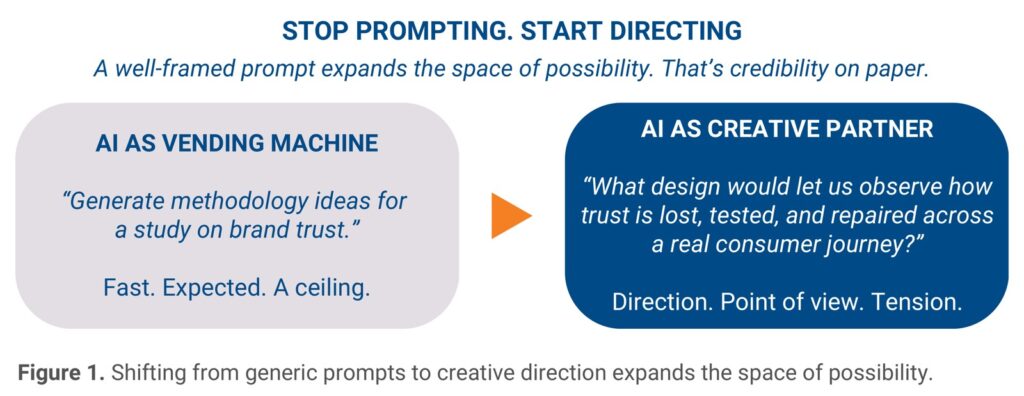
Most teams still use AI like an input-output vending machine: put in a prompt, take out an answer. That’s fast, but it’s also a ceiling. Stronger outcomes come from treating AI like a creative partner that needs direction, point of view, and tension, not just instruction. Three shifts make the difference. (See Figure 1).
First: Move from Generic Prompts to Intentional Directions
A simple prompt produces an expected output. A well-framed prompt expands the space of possibility.
Instead of prompting AI with “Generate methodology ideas for a study on brand trust,” shift the prompt from method selection to methodological design:
- Define a specific use case
- Introduce a point of view or persona
- Clarify constraints or tensions
For example, expand your AI prompts to:
- “What kind of qualitative design would allow researchers to observe how brand trust is lost, tested, repaired, and reinforced across a real consumer journey, rather than reconstructing it retrospectively?”
- “If consumers cannot fully articulate brand trust in the abstract, what methodology would best surface it through behavior, context, participant-generated evidence, and in-the-moment reflection?”
- “How would the research design change if the audience were first-time immigrants, time-starved caregivers, or frontline workers with limited availability and different trust triggers?”
This way the goal isn’t just clarity—it offers creative tension. Tension is what produces more distinctive and revealing outputs. This matters for your proposal because better prompting does more than generate options. It helps you think rigorously about what the study must capture, how experience should be observed, and which methodological design choices uncover subconscious emotions and behaviors. A design born from this kind of questioning reads as a solution to the client’s specific problem, not just a list of research activities. Now that’s credibility on paper!
Second: Apply Divergence Principles on Purpose
Classic brainstorming rules still apply. AI simply responds to them faster. Four principles are particularly powerful when working with AI:
- Defer judgment. Resist evaluating ideas too early. Let AI generate broadly before you filter.
- Strive for quantity. Volume matters. More inputs create more unexpected connections.
- Build on ideas. Use AI iteratively to expand, remix, and evolve outputs.
- Seek the unusual. Explicitly ask for unexpected, unconventional, or extreme ideas.
Without these guardrails, teams converge too quickly, often on the very first output. Does this sound familiar? Because that’s how proposals end up looking identical.
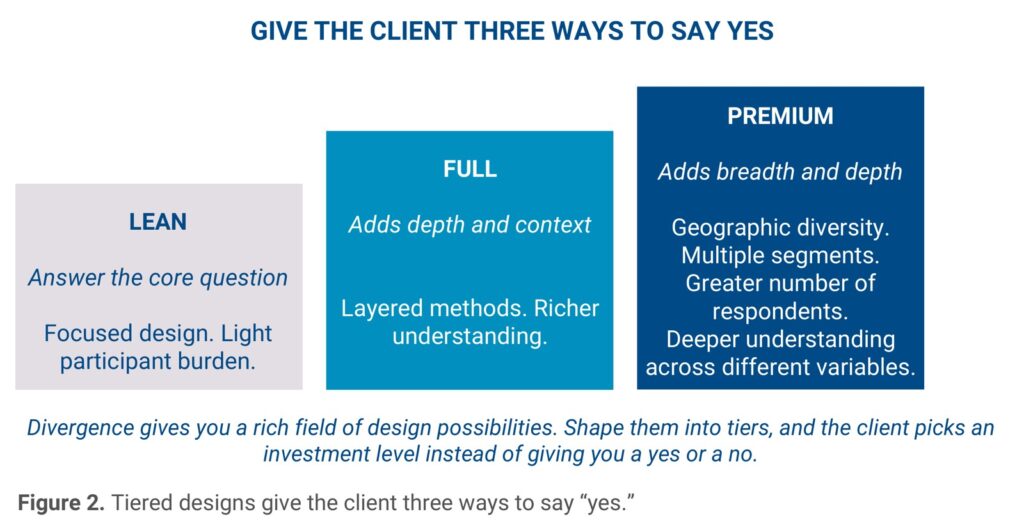
There’s a practical payoff here for proposal writing: quantity gives you options to scale. When you’ve generated a rich field of design possibilities, you can shape them into tiers: a lean design that answers the core question, a fuller design that adds depth, and a premium design that captures both breadth and depth. The client picks an investment level instead of giving you a “yes” or a “no.” (See Figure 2).
Third: Layer In Structured Creativity Tools
AI becomes significantly more valuable when paired with established creativity tools that deepen early-stage thinking. Two translate especially well.
- SCAMPER (Substitute, Combine, Adapt, Modify, Put to other use, Eliminate, Reverse). Instead of asking only for more ideas, guide AI through methodology transformation:
- What could be substituted in the methodology for greater breadth?
- What could be combined across methodologies to generate richer understanding?
- What can you adapt from adjacent fields such as anthropology, design research, or behavioral science to make the methodology more revealing?
- What could be modified in scale, intensity, timing, or format to make the methodology more insightful? Could you stretch a one-time interview into a week of in-the-moment check-ins, reveal the concept in three stages so you can watch reactions build (or fall apart) instead of capturing one snap judgment, or turn up the emotional temperature with a more provocative task?
- What could be put to another use? Could materials already being collected, such as pre-work, photos, journals, shopping screenshots, or participant-generated language, be repurposed as live discussion prompts, stimulus inputs, or concept-building material?
- What could be eliminated from the design to reduce participant burden and improve authenticity? (Eliminating wisely also trims cost, which strengthens your leanest budget tier.)
- What could be reversed so participants shape more of the inquiry, the stimulus, or the order of exploration?
- Context Expansion. Push the methodology beyond stated attitudes into lived experience:
- What contexts, moments, environments, and social dynamics should the methodology capture to understand the behavior in real life?
- How might the design surface what participants do, feel, notice, avoid, or improvise in those moments?
These tools shift AI from generating lists to helping you design richer, more revealing qualitative approaches. For example, when exploring a decision-making journey, use context expansion to move beyond what participants claim in a traditional discussion. Design a methodology that captures behavior in the moment—a methodology that documents emotional shifts over time and reveals the environmental and social factors influencing choice. That’s often where stronger qualitative work begins.
It’s also what makes a proposal memorable. The client has seen plenty of focus group line items. A design adapted from behavioral science, or shaped by participants themselves, stops the “shuffle through the proposal stack.”
Know Where AI Still Falls Short
While AI strengthens divergence, it introduces risks you must actively manage:
- Hallucinations and inaccuracies: Outputs can sound credible but lack grounding (one invented statistic in a proposal can undo every credibility point you’ve earned).
- Surface-level novelty: Ideas may feel new but are often a recombination of existing patterns.
- Input dependency: Weak prompts lead to weak outputs.
- Lack of contextual judgment: AI tends toward consensus ideas and struggles with cultural nuance and strategic fit.
These limitations aren’t reasons to step away from AI. They’re the reason your oversight, contextual understanding, and creative discipline matter more, not less. AI can expand the landscape, but it can’t decide what’s meaningful, relevant, or strategically viable for your client. That judgment is yours, and it’s exactly what your clients are hiring you for.
Redesign the Workflow, Not Just the Toolkit
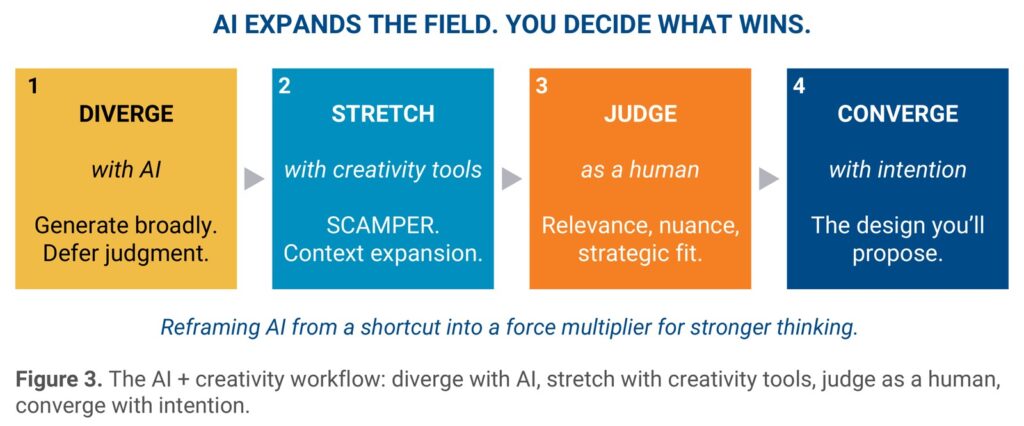
The most effective teams are redesigning how ideation happens, especially when you:
- Use AI to diverge aggressively
- Apply creativity frameworks to stretch outputs further
- Leverage human judgment to identify what matters
- Converge with intention toward actionable outcomes
This approach reframes AI from a shortcut into a force multiplier for stronger thinking. (See Figure 3).
Remember, the Advantage Is You
 AI is already reshaping the future of insights and innovation. For most teams, the advantage is becoming less about access to tools and more about how thoughtfully these tools are applied. That makes this a pivotal moment for capability-building. Many organizations are still in the tool-adoption phase, which means the teams that combine AI with stronger creative direction, sharper qualitative thinking, and better judgment now will define what excellent looks like.
So, back to that “stack of proposals” on your client’s desk. The proposal that rises out of it won’t be the one written fastest. It will be the one with a credible, distinctive design. The one that frames a solution, is priced with options, and is unmistakably shaped by a human who thought hard about the problem. AI can help you get there faster. Creative thinking is what gets you hired.