

By Julie Francis
Founder & Principal
BellaVia Research
Santa Cruz, California
julie@bellaviaresearch.com
Let me begin by painting a scenario of a typical researcher. You have a rich body of insights, including clear needs and pain points, compelling stories, and solid recommendations. You’ve delivered an engaging presentation. So, how can you get people to act on that research, connecting the insights to action?
The demonstrable impact of research is more important now than ever in this time of shrinking research team headcount and budgets, and as researchers look to expand their value and strategic consultant skillset.
Journey mapping is a well-established approach commonly used in user-experience (UX) research, customer-experience (CX) research, product design, and service design to convert insights into action.
Not familiar with this framework? Let’s start with the basics.
What is a Journey Map?
I define a journey map as “a visual illustration of a person’s experience with a thing over time.” That “person” can be a buyer, a user, an employee, etc. The “thing” can be a product, service, feature, category, brand, etc. All journey maps contain one critical feature—the passage of time (see Figure 1). A journey—or a person’s experience—always occurs over a span of time.
I prefer Catherine Lovazzano’s1 definition (when she was a UX researcher at Facebook): “a way of organizing insights for the purpose of shared understanding and action.” This definition focuses less on what a map is, but on why people create them. In fact, journey maps are appreciated as “alignment diagrams” because of their power for building cross-functional alignment. If you need to build alignment on a shared understanding of the problem space (customers’ experiences, feelings, needs, and pain points) or the solution space (the biggest opportunities to move the needle on key metrics), a journey map can help.
It’s no small feat to get diverse, cross-functional partners on a team aligned—from engineering, product, design, marketing, and insights. That is easier said than done, and it takes more than solid insights in a gorgeous deliverable to achieve it. A map is high impact because of the alignment it catalyzes, not because it looks good.
The highest-impact maps focus more on journey mapping as a process, not on a journey map as a deliverable. To deliver maximum impact for our clients and teams, we need to shift our efforts from the noun (the journey map as a deliverable) to the verb (the journey mapping as an alignment process). As Jim Kalbach2 says (when he was vice president of customer experience at Mural), “Focus on the verb, not the noun. The map doesn’t provide the answers. It’s a platform for a conversation.”
What does it mean to focus on the journey mapping as a verb? It means bringing a collaborative approach to the entire journey-mapping initiative. In the last 10 years, I’ve interviewed more than 100 journey-mapping practitioners and stakeholders to understand what makes for high-impact journey maps. Those, plus my own experience running journey-mapping initiatives inside Meta, and as an independent consultant, have revealed that how we create journey maps matters just as much, if not more, than what ends up in print.

Journey maps with the highest impact are:
- Collaboratively created
- Focused (with a clear objective and audience/stakeholder)
- Rooted in research insights
- Tailored to the objectives and intended audience/stakeholder
- Integrated into the organization’s processes
In this article, I walk through each of these principles with examples, tips, and special considerations for in-house, agency, and independent researchers.
- A High-Impact Journey Map is Collaboratively Created
Too often, journey maps are created by a researcher or a vendor working in isolation. The problem? When the intended beneficiaries don’t contribute to the map, they’re less likely to understand it, trust it, or use it, no matter how good the final deliverable looks.
Collaboration isn’t just a nice-to-have—it is the primary catalyst for the greatest impact. The highest-impact journey maps are collaboratively created from start to finish—from initiation, through research, analysis, creation of the map, and operationalization. When people help build the map, they’re more likely to use it. Or, as Leanne Waldal3 (when she was director, research, and strategy at Dropbox) says, “It’s like teaching your kids to eat. If they help cook it, they are far more likely to eat it.”
For in-house researchers, this means enlisting internal champions, bringing diverse stakeholders along during the research phase, co-creating the map, and working with cross-functional partners to identify opportunities for them to leverage the map as part of their existing processes—like in design sprints, campaign planning, or product road-mapping.
For external consultants, this is trickier. Helping your client maximize the impact of the journey map will position you as an invaluable partner, so do what you can to create the map collaboratively with your client’s teams instead of creating the map in isolation.
- A High-Impact Journey Map is Focused (with a Clear Objective and Audience/Stakeholder)
 Too often, maps try to do too much. They are stuffed with too much data and detail in a quest to be all things to all people. In the end, they don’t do anything particularly well. A high-impact journey map focuses on the information most relevant to the primary audience (i.e., research stakeholder) and objective.
What can you do to bring more focus to your journey mapping? Start by building clarity and alignment on six key questions:
- Why are we mapping this journey?
- For whom is the map intended? What disciplines will benefit most?
- Who is the actor in the journey (a persona, market segment)?
- What experience are we mapping? A broad end-to-end “macro journey,” like a persona’s engagement with our brand or the category?
A narrow “micro journey” focusing on a narrow moment in time or a specific feature, like first-time use or discovering a new product feature? - When does the map need to land (before a design sprint, road-mapping, strategic planning)?
- Who should we co-create it with? Who can champion the initiative? Which cross-functional partners can be hands-on collaborators or occasional contributors?
Getting crisp on these questions sets you up for success. When you start journey mapping with clarity on the primary audience and objective, you can use that as a guide for subsequent decisions on what information to include in the map. Without focus, these decisions are very challenging, and you’ll likely end up with a map that ultimately is hard to use, contains too much detail, or feels irrelevant to the stakeholders’ needs.

- A High-Impact Journey Map is Rooted in Research
A map is only as good as the insights it is built on. It’s difficult to map a journey without a solid understanding of the problem space. Because people’s journeys are highly individualized, I start with one-on-one qualitative interviews. How? I complete a simple worksheet, with steps on the X axis and emotions/experiences on the Y axis (see Figure 2). As participants share their experiences, I capture the sequence of events and emotional highs/lows. Diary studies are also useful for understanding people’s journeys, as they can provide in-the-moment peeks at micro interactions.
My goal is to understand not just what happened, but also the emotions. Why? According to Daniel Kahneman’s4 “Peak End Rule” in behavioral economics, people do not form their impressions from a sum-total of everything that happened; instead, they remember the peaks (which can be positive peaks or negative valleys) and the end. In qualitative interviews, capture the highs, the lows, and the end.
Even if your research focuses on a specific segment or persona, you’ll see variation in people’s journeys. Quantitative research can help validate the most common journeys. Survey people on their engagement in activities (the steps in the journey) and the order of those steps, then use factor analysis to reduce the potential journeys to a useful set.
“Opportunity scores” derived from quantitative data can help reveal what’s most important to highlight in your map. First, use your qualitative research to identify a set of needs or jobs to be done, then measure the importance and satisfaction of each. Next, an opportunity gap is calculated by subtracting the satisfaction of a particular attribute from its importance. Last, an indexed “opportunity score” is calculated by adding the opportunity gap to the attribute importance. These indexed opportunity scores surface the biggest gaps on the things people care most about.
A variety of data can help inform your map, from existing research, behavioral data from the data science team, customer-support logs, etc. If you can only do one thing, do this: talk to people one-on-one.
- A High-Impact Journey Map is Tailored to the Audience/Stakeholder and Objectives
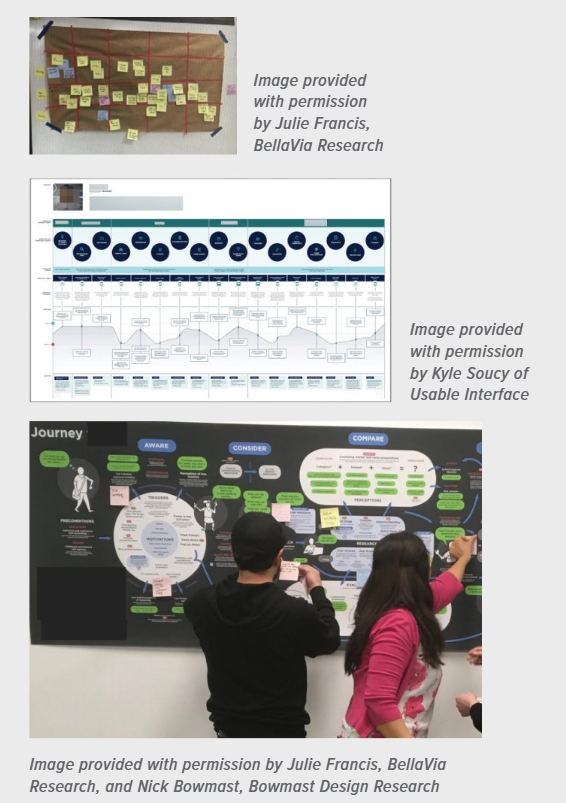
A beautiful map that no one reads is like a report that never gets opened. Know your audience: What format will resonate with them? Should you bring in an illustrator or designer to make your map visually appealing? Should it be created in a tool that makes it easy to update for a fast-moving team? What if you optimized it for internal workshops?
The audience, the objectives, and corporate culture influence the design. A journey map used by a product team in a design sprint may be scrappy and focus on what users are thinking, feeling, and doing. A journey map used by senior leadership to inform strategy and innovation may necessitate more design polish, and it may be broader in scope and tightly focused on the information most closely related to strategic decisions.
There is no “right” way to design a journey map. They vary dramatically based on their objectives, the audience, and the team culture (see Figure 3). In fact, ugly maps can be quite high impact, and gorgeous maps can be quite low impact!

- A high-impact journey map is integrated into the team
A map’s real value comes from what it enables—aligning teams on the problem space and solutions. To achieve that, journey maps need to be accepted and acted upon. They need to be integrated into existing team and company processes, like design sprints, road-mapping, and strategic planning. By involving the intended beneficiaries of the journey mapping from the beginning, teams will have plenty of time to think about, and plan, how they can use the map to support their existing processes.
What does that look like? Workshops where teams prioritize needs or pain points, brainstorm and develop potential solutions, and vote on the biggest opportunities to move the needle on KPIs. If you are a vendor, consider delivering reusable workshop templates and playbooks so your client can conduct workshops without your involvement if budgets are tight. For example, deliver a workshop plan using a tool like Session Lab, and a re-usable template in a whiteboarding tool like Miro, Mural, or Figjam. (see Figure 4). If you are an in-house researcher, allow time in your schedule to periodically support teams in using the map and updating it based on evolving insights.
Final Thoughts
When tightly focused on specific objectives and audiences, grounded in research insights, and tied to real organizational needs and processes, journey maps can spark meaningful change. They are far more likely to ignite this meaningful change when they are collaboratively created. Whether you’re working inside a company or running your own practice, applying these principles and best practices can help you make journey maps that do more than decorate walls, but instead drive action.
References
- Francis, Julie. “So What the Heck Is a Journey Map, Anyway?” LinkedIn, April 24, 2023. www.linkedin.com/pulse/so-what-heck-journey-map-anyway-julie-francis/?trackingId=bNupAywQTWq8TQmzXDfz6Q%3D%3D.
- Francis, Julie. “Best Practices for Journey Mapping.” LinkedIn, April 21, 2023. www.linkedin.com/pulse/best-practices-journey-mapping-julie-francis/?trackingId=bNupAywQTWq8TQmzXDfz6Q%3D%3D.
- Francis, Julie. “For maximum impact, Journey Maps should be collaboratively created.” LinkedIn, May 4, 2023. www.linkedin.com/pulse/maximum-impact-journey-maps-should-collaboratively-created-francis/?trackingId=yVMvdrBtRD%2Bcutg4WGA3XA%3D%3D.
- Kahneman, Daniel. Thinking, Fast and Slow. New York: Farrar, Straus and Giroux, 2013.