
By Massimo Cealti
Founding Partner
Altitude C
Paris, France
max@altitude-c.com

By Stefania Gogna
Semiotics Consultant
Marketing Researcher
Milan, Italy
info@stefaniagogna.com
The language of beauty and skincare is undergoing a continuous and profound transformation. This change is more than cosmetic; it’s rooted in a more fundamental process: that of reshaping how we define ourselves and present our identities.
For decades, the beauty industry relied on strict, binary divisions—products were “for her” or “for him,” categorized as either “delicate” or “intense,” and often color-coded by gender (like pink versus black).
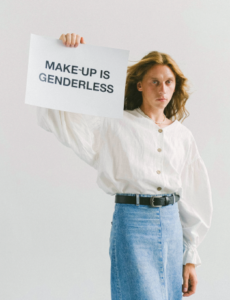 This rigid framework is now dissolving: a more fluid, personal space is emerging, allowing for shapes, colors, purposes, and experiences that are defined by the individual rather than by antiquated social roles.
In this article, based on our semiotic analysis, we describe how the language of beauty is being reshuffled and reshaped across colors, forms, materials, and lexicon. We’ll also examine how the new semiotic codes—that is signs that can be culturally interpreted or social codes emerging from this shift—are helping rewrite the contemporary relationship between identity, body, and care. Ultimately, our aim is to explore the changing cultural meaning (i.e., semiotic status) of skincare.
We are seeing a move away from products that are a stylistic tool used to adjust one’s look for others (the “external gaze”), historically a personal choice that was made within a political field of signs. Skincare is instead becoming a ritualistic gesture of reconnecting with one’s inner self. In this light, self-care acts like a language through which the body is treated as a text or a canvas—a surface we read and write upon daily, giving our physical reality deeper personal meaning.
This new genderless beauty isn’t a neutral or difference-free aesthetic; it’s an alternative approach to individual expression. It creates an open, dynamic space where authenticity and plurality are no longer at odds.
The shift is part of a larger cultural wave—the move from gendered marketing to post-gender aesthetics—which helps restore a more nuanced, inclusive, and deeply human meaning to beauty.
The Cultural Background: From Gender to Person, From Labels to Language
To grasp this change, we must look closely at the evolving symbolic codes. To understand how beauty is evolving, we first need to step back and consider how culture has long informed our notions of the body.
For generations, taking care of oneself was strictly a feminine endeavor, typically associated with soft colors, complex and seductive scents, and gentleness. If men engaged in self-care, it was under highly rigid constraints: products came in dark packaging, used technical jargon, and focused on control and function rather than pleasure and ritual.
That outdated model is now collapsing. The newer generations—particularly Gen Z and the rising Gen Alpha—don’t see themselves in those old boundaries. They reject the false dichotomy between ‘strong’ and ‘soft’, between ‘muscle’ and ‘feeling.’

They look for ways to be freer to express themselves without conforming to established categories.
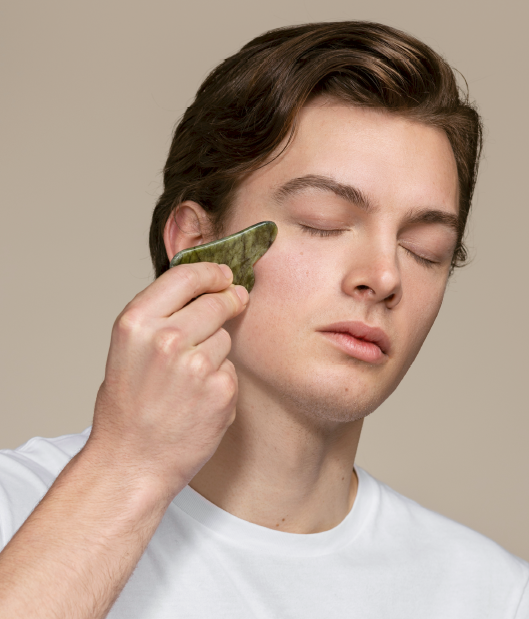
This is part of a wider cultural transformation: identity is being reimagined. The body is no longer seen as belonging to a fixed gender, but as an open site for personal symbolism and expression: on social media and in everyday life, people are actively exploring new languages of beauty choosing unisex products, inclusive images, and actions that blend or ‘mess around’ with the old distinctions.
The Semiotic Shift
On a symbolic level, what we are witnessing is a move from beauty codes that offered fixed references (that is to say, labels that describe the person) toward open-ended narratives (choices that allow the person to interpret and define themselves). This move can be distilled into three key shifts:
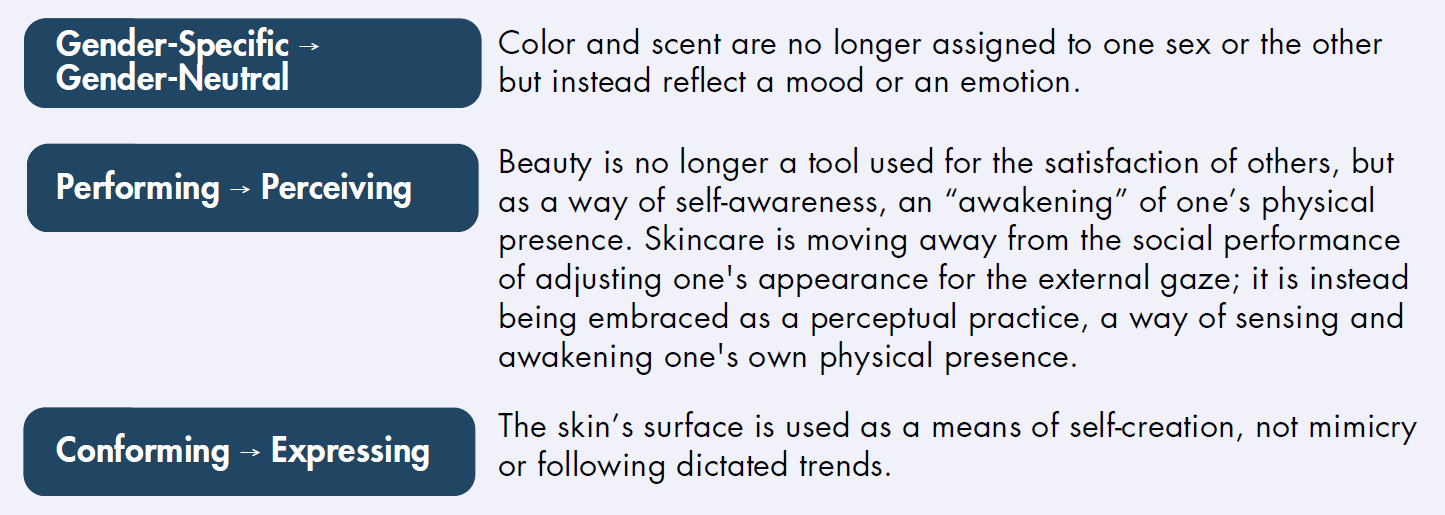 Ultimately, genderless beauty springs from a shared desire for honesty—the coherence between what one feels (internally) and what one presents (externally). The focus of this silent change is now on the person, the user not on the product category itself.
The Visual Language: From Fixed Labels to Interpretation
Everything in the beauty world speaks—everything has a voice and a message. A bottle, a texture, a color, or a word on the packaging—all carry meaning. For a long time, the language of beauty was based on sharp contrasts: pink equated with softness and femininity; black with power and masculinity; and gold signaled luxury. The consumer’s job was easy: identify with one of the pre-set signs.
But the grammar and syntax of the language of beauty is crumbling. Beauty is no longer a fixed set of categories; it has become a space for interpretation. A minimalist design isn’t “neutral”; it’s open, ready to be filled with the individual’s own meaning and projection. Similarly, a modern fragrance often avoids generic categories, appealing universally while being perceived uniquely by each person.
This change is visible everywhere: even on social media, where skincare and makeup are mashed together without distinction, creators play like poets with products as if they were words in an unknown language, using them to express themselves rather than just look a certain way. Beauty is now a conduit for personal expression, not just a representation of a fixed identity.
We can say that beauty has moved from simply describing us (denotation) to helping us interpret ourselves (connotation); it no longer tells us who we are, but invites us to discover who we could be.
This approach turns skincare into a quiet, yet powerful decision . The new language of beauty speaks softly but commands authority, offering a common language that remains intensely personal.
Decoding Genderless Design: A Layered Strategy
Genderless skincare communicates its values through a recognizable visual language. Instead of relying on one simple message, brands use a layered design strategy to communicate multiple meanings seamlessly through packaging.
The first layer establishes the core brand values—like gender neutrality—through choices that favor balance and serene minimalism. The second layer then introduces subtle cues that differentiate product function: calming hues for sensitive skin,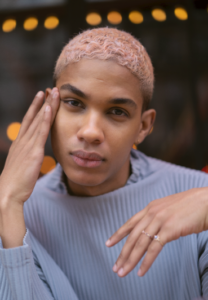 soft matte textures for oily skin, or gentle gradients suggesting deep hydration.
A study on semiotic packaging confirms that these design layers positively influence brand experience and customer trust.(1) This isn’t just about making things look pretty; it’s about providing an intuitive journey for consumers, where each carefully designed layer deepens the brand’s meaning.
These elements coalesce to create a compelling symbolic vocabulary. In philosophy (like that of Roland Barthes), a product becomes a “myth” when a simple object is imbued with a deeper social or ideological meaning. In this new landscape, brands do not impose a fixed myth upon the consumer; instead, they provide the sensory and ethical materials that allow the individual to forge their own personal myth. By selecting a product that mirrors their private values, the consumer transforms a functional tool into a meaningful signifier of their own evolving identity.
The contemporary genderless packaging renaissance is also a visual mirror of the “skin-imalism” trend in formulation, which focuses only on essential active principles. This results in an authentic, grounded approach where functionality is central, comfortably transcending outdated gender expectations.
Grounded fact: Experts and dermatologists agree that the most effective active ingredients (like retinoids, hyaluronic acid, Vitamin C, and sunscreens) are universal. While skin has physiological differences between sexes (thickness, pH), the core mechanisms of action of these active ingredients do not differ by gender (2).
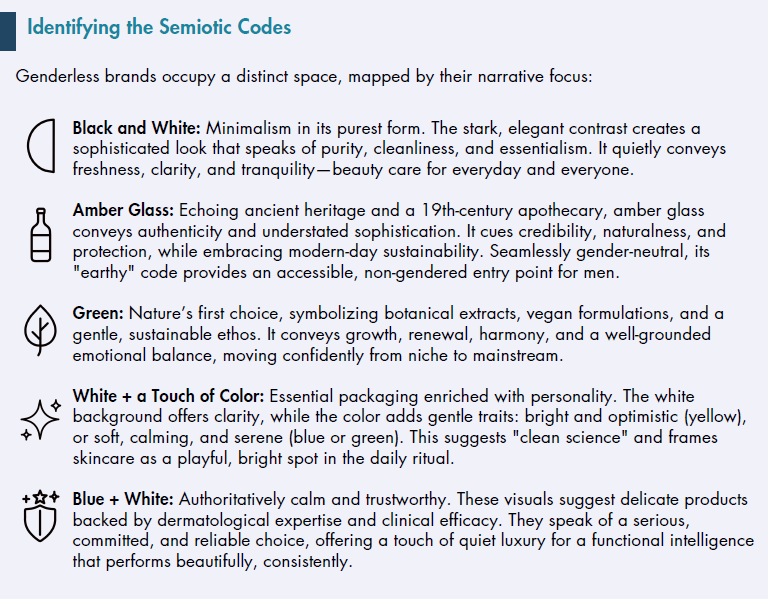 Semiotic Positioning: A Typology of Genderless Brand Narratives
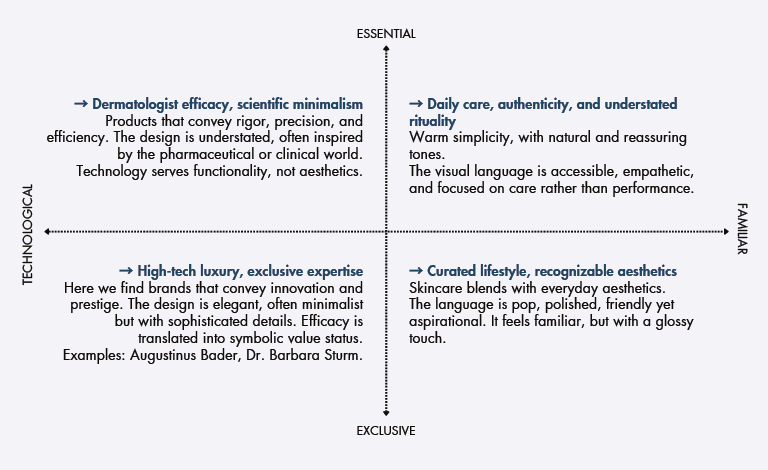
Readily apparent semiotic codes can be identified, each weaving a nuanced message into the narrative:
- Understated Rituality: This quadrant favors a warm simplicity, using natural, reassuring tones. The visual language is empathetic, accessible, and centers on the gentle act of care over performance pressure. (Examples: Aesop, Humanrace).
- Scientific Minimalism: Products that convey rigor and precision. The design is subdued, often inspired by clinical or pharmaceutical purity, where technology serves functionality, not outward aesthetics. (Examples: The Ordinary, The Inkey List).
- High-tech Luxury: Brands that blend prestige with innovation. The design is elegant, minimalist, yet detailed and sophisticated. Efficacy is translated into a symbolic value and status. (Examples: Augustinus Bader, Dr. Barbara Sturm).
- Curated Lifestyle: Skincare is interwoven with aspirational, everyday aesthetics. The language is polished, friendly, and recognizable, feeling familiar yet possessing a glossy, aspirational touch. (Examples: Glossier, Ouai).
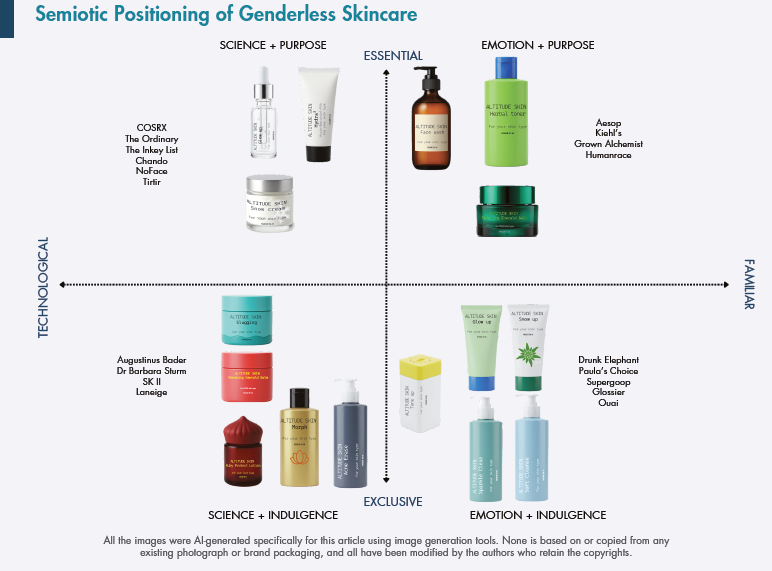
A Guiding Principle: Genderless skincare flourishes when it speaks both to scientific efficacy and to a profound emotional connection, gracefully balancing clarity and care.
 The Generational Push and the Future
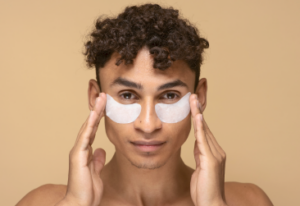 Gen Z is a driving force, but the horizon holds Gen Alpha’s revolution. This “under 15” cohort, already avid consumers, introduces fresh codes as they seek to establish identity by reinterpreting their parents’ symbols.
Pierre Bourdieu’s concept of “cultural capital”(3) explains this need for social belonging, achieved by aligning with peer tastes and establishing distance from parental norms. Developmentally, this is a necessity: adolescents form identities separate from caregivers,(4) using cultural tastes as crucial “boundary markers.”
Gen Alpha’s preferences are a sophisticated response to their radically digital environment: their digital fluency is a new literacy; their engagement with platforms like Roblox and the metaverse is productive play; and their concept of authenticity is realized through creative remixing. This is postmodern identity-making in action.
The future of genderless skincare may thus soften or bloom into codes like:
- Teal + White: Teal is inherently gender-fluid, emotionally intelligent, and suggests “soft tech,” digital-native purity. Think about portable speakers, power banks, or headphones coated with a velvety silicone/TPU compound and paired with pastel colors and the soft tech equation is Soft/Muted Color (Teal) + Soft-Touch Finish (Velvet/Matte) = Approachability and Comfort, different from the black/grey and shiny mobile phones. Teal evokes healing, delicacy, freshness, and modern innovation—an evolved, subtle, and emotionally safe new green.
- Red: Genderless packaging embracing the codes of alive luxury—desirability, uniqueness, and vitality. Skincare conveying strength (a soft self-power) and potency, with intentional, bold energy that stands out without disruption.
What This Means for Brands and Marketers: Fluidity of Communication
If beauty is becoming a fluid language, brands have got to figure out how to speak it with feeling and intelligence. But simply stripping away gender designation is not sufficient. What matters is that the whole way of communicating is up for rethinking, moving from targeting to understanding, selling to relating.
For decades, marketing has constructed its strategies on distinction: dividing, segmenting, giving colors and shapes and timbre to certain audiences. That logic, which used to be convincing, now just strikes a jarring note in our culture of inclusivity and authenticity versus prizing tidiness or control. The task is now to construct systems of meaning that are porous but coherent, able to reach diverse people without losing themselves.
Semiotics provides a clue to this conversion. By decoding the evolution of words, materials, and visual codes, it can aid brands to understand not just what people choose, but why they make these choices. The definitions of “purity,” “natural,” or “care” are changing, and they each carry new emotional baggage. Identifying those changes allows brands to stay culturally relevant, not by chasing trends but by reading the writing on the wall of their era.
To communicate fluidity is to build trust in the form of coherence, to represent values with tone, texture and experience rather than slogans. It is about recognizing that beauty is not static assurance but a progression of conversation.
Brands that take this viewpoint will not be neutral or ambiguous. They will speak with a voice that sounds familiar, understanding and authentic, a voice that can relate rather than stereotype. In this, they will not just adjust to change but help define what beauty means in a culture that is still learning how to look at itself without gender shading the view.
References
(1) Shukla, M., Misra, R., & Singh, D. (2022). Exploring relationship among semiotic product packaging, brand experience dimensions, brand trust and purchase intentions in an Asian emerging market. Asia Pacific Journal of Marketing and Logistics, 34(7), 1541-1563.
(2) Rahrovan S, Fanian F, Mehryan P, Humbert P, Firooz A. Male versus female skin: What dermatologists and cosmeticians should know. Int J Womens Dermatol. 2018 Jun 22; 4(3):122-130. doi:10.1016/j.ijwd.2018.03.002.
(3) Bourdieu, P. (1984). Distinction: A social critique of the judgement of taste (R. Nice, Trans.). Harvard University Press.
(4) Erikson, E. H. (1968). Identity: Youth and Crisis. W. W. Norton & Company.
About the Author: Massimo Cealti
Massimo is the Founding Partner of ALTITUDE C, a research consultancy specializing in innovation, AI, data analytics, sensory techniques, and strategy. With over 30 years of experience in consumer research, forecasting, and sensory science, Massimo has held global leadership roles for Symrise (Flavors & Fragrances), The Coca-Cola Company, Nestlé, and McDonald’s.
Driven by a fascination with how products communicate, he specializes in the food, fragrance, and personal care sectors, leveraging agile ‘in-context’ data and Machine Learning algorithms to decode consumer segments and forecast market performance. He has a thing for the tangible side of insights, specifically in measuring the ROI of research to ensure that data always translates into impact.
A member of ESOMAR, the French Society for Sensory Science (Methods and Ethics Committees), and the Advisory Board of Merlien, Massimo holds an M.S. summa cum laude in Business Management with a major in Statistics from Bocconi University in Milan.
About the Author: Stefania Gogna
International Independent Semiotician, member of IASS (International Association for Semiotic Studies) and AISS (Italian Association of Semiotic Studies), I have been involved in Marketing Research and Brand Analysis for the leading Multinational Companies, including Ferrero, P&G, The Coca-Cola Company, Unilever, Nestlé. Specialising in Semiotics, Cultural Analysis and Human Behaviour Research, I help corporations grow by discovering the unknown about their customers, looking at the emergent human dynamics that haven’t happened yet. I’m also committed to global projects for understanding the cultural context of brands and help their optimal positioning.
About the VIEWS Feature Editor: Oana Popa Rengle
 VIEWS Feature Editor: Oana Popa Rengle
Founder
Anamnesis
Bucharest, Romania
Oana@anamnesis.ro
I am a qualitative research expert grounded in psychology, with 25+ years of hands-on research project experience and 21+ years of business management practice. Currently I consult, train, run local & international projects and speak at market research conferences.