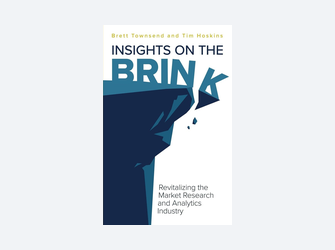
 By Brett Townsend and Tim Hoskins
Published by Quester, 2024
Reviewed by Paula Rosecky
Founder and Facilitative Strategic Partner, Paula Rosecky & Company
Seattle, Washington
paula@paularosecky.com
Sometime around early 2009, I’m sitting in the waiting area of the Frito-Lay Retail Experience Center in Plano, Texas, moments before beginning a study focused on optimizing the in-store shopping experience for Frito-Lay dips. I’m there with Brett Townsend, Frito-Lay’s Senior Manager of Shopper Insights at the time and coauthor of Insights on the Brink. And before we ever step into the research space, we’re already deep in conversation.
What we’re talking about isn’t methods or stimuli or sample size. We’re talking about people. About the role products play in everyday life—how something as ordinary as a bag of chips and a tub of dip can signal comfort, connection, stress relief, or joy. About the responsibility that comes with being invited into someone’s life through research.
We’re also talking about the weight of those moments, especially in ethnographic work, when you know this may be your only chance to understand what truly matters and translate it into something meaningful for a business. Depth isn’t a nice to have in qualitative research—it’s the whole point.
That conversation stays with me. So, when I later read Insights on the Brink, I recognized that same spirit immediately.
Although I don’t know coauthor Tim Hoskins personally, I can easily imagine the kinds of conversations Brett and Tim have together—the ones that wrestle with what consumer insights is becoming, what it risks losing, and what it could still be if we’re willing to be honest about our role.
At its core, Insights on the Brink is a reminder that insights work has never been just about data collection; it’s about understanding people well enough to help organizations make better, more human decisions—especially now, when speed and technology often threaten to overshadow judgment and understanding. What resonates for me as a facilitator isn’t just the diagnosis but it’s the invitation to consider that insights can come from anywhere—both inside and outside the organization, including stakeholders’ wisdom, other internal data, and forms of primary and secondary research.
The authors challenge insights professionals to reconsider the role we play, not as data collectors or methodology experts, but as strategic partners responsible for helping organizations make better decisions in real time under real constraints.

One of the book’s recurring themes is a shift away from centering tools and toward centering outcomes. The real question isn’t whether we used the perfect method to gather insights but whether the insights helped move a decision, solve a problem, or create meaningful change. These tools don’t create value on their own; judgment, clear thinking, and the courage to name what matters do.
Another idea that stays with me is the emphasis on storytelling—not as performance but as responsibility. Leaders don’t need to know everything we know; they need to know what will help them decide. That’s not a call to oversimplify but to discern and to understand the difference between completeness and usefulness. This is where empathy as a discipline comes in. Some of the most meaningful insights I encounter don’t emerge from averages or charts, but from contradictions, edge cases, and moments of emotional tension. These are often the first things lost when we rush to summarize, yet they’re frequently the signals leaders need most.
The book also invites us to question our own sacred assumptions: about what rigor looks like, how long insights development “should” take, and where our role ends. The idea that insights partners shouldn’t disappear once the report is delivered feels especially relevant. Following insights through to implications and action isn’t scope creep; it’s stewardship.
None of this is easy. Many of us were trained to stay safely inside the boundaries of research execution. Stepping into a more strategic role requires comfort with ambiguity, stronger relationships, accountability for what happens next—and organizations willing to do this work. Still, I find the framing hopeful.
Being “on the brink” doesn’t have to signal decline. It can signal choice.
If you work in insights, research, analytics, or strategy—and you feel this tension in your own work—this book will likely feel less like a manifesto and more like a reflection.
And sometimes, that’s exactly what helps us move forward.