
 By Marco Rovagnati
Co-Founder
Quallie.Ai
London, United Kingdom
marco@quallie.ai
What is Good Work in Qualitative Research and Strategic Insights?
Over the past 12 months, we spoke with 30 researchers about how Artificial Intelligence is entering their day-to-day work. Rather than framing the conversation as humans versus machines, we asked a more foundational question: what does good work look like in market research, and how might thinking be deliberately shared between people and systems to get there?
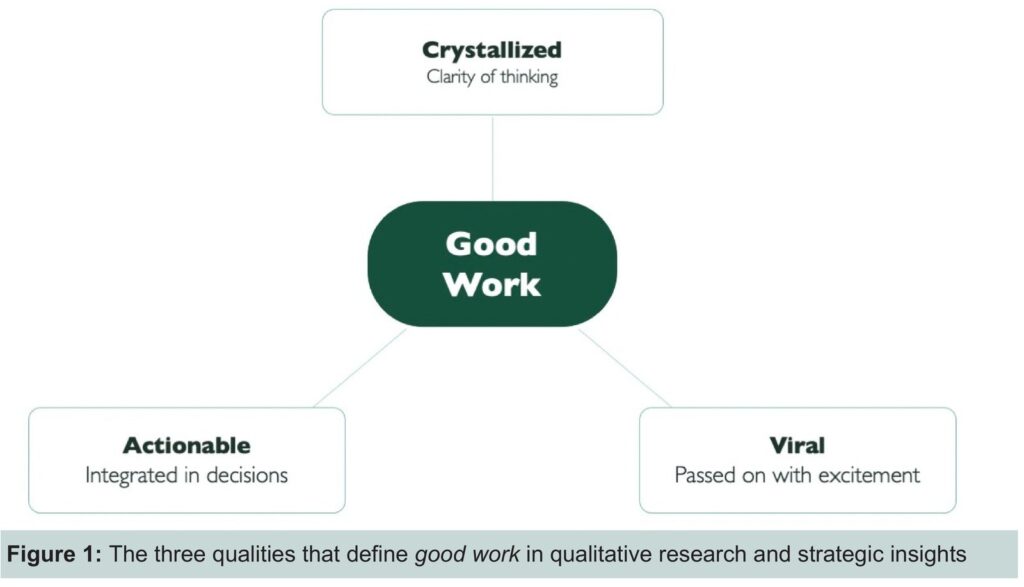
There were many definitions of good work in qualitative research, but three interdependent qualities seemed to be ever-present and unchanged by AI:
- First, a common understanding that good work is actionable and integrated in decisions in tangible ways.
- Virality was also often mentioned as a tell-tale sign of good work: compelling ideas, high-quality output that is shared inside the organization and doesn’t sit in a forgotten folder.
- And lastly, good work is seen as the result of a crystallization process that is inherently human. This process is the result of clarity of thinking and sound judgment. It’s the disciplined ability to sit with ambiguous material, decide what matters, and crystallize it into insights that can shift how a client sees their world and shape how they approach their business challenges and strategies.
What we learned is that ultimately, good work requires ownership. Researchers need to be able to stand behind their thinking, to justify conclusions, respond to curveball questions, and defend a point of view with conviction. This has always been true, but AI introduces a new tension: the seductive speed of AI-generated synthesis makes the work generated by a machine seem complete, while the psychological ownership of the researcher slowly slips away, one prompt at a time.
Ownership is built through the invisible act of thinking, discarding, and refining interpretations, forming hypothesis, and stacking small decisions. When those steps are compressed or bypassed through AI, fewer of those decisions are made by researchers.
When the insight is generated externally through AI, even if it is directionally correct, it can feel imported rather than authored. This makes it harder to stand behind a finding or insight with true confidence. By relying too heavily on AI to generate insights, we helicopter to the destination and inevitably lose our ability to reconstruct the intricate details of the trail.
In this article we’ll explore how researchers are reaffirming their ownership over good work, demonstrating that human involvement is still a core part of their value proposition because, unlike a machine, they have something at stake: accountability, reputation, and ownership.
Beyond the Human vs. AI Debate
Qualitative research has always been about the quality of the people and relationships involved: the quality of the moderator, the quality of the recruitment, the quality of respondent interaction, and the quality of the client relationship. As the industry embraces AI, some researchers are critical of the shift away from people to systems and tools. They argue that it is diluting the craft and spirit of qualitative research, coupled with a fear that insights professionals will be replaced by machines and that the next generation of qual researchers will skip the basics altogether.
Much of the debate around AI in qualitative research is stuck in false binaries, oscillating between outright rejection driven by fear of surface-level outputs and flattening of the findings and res-tech evangelism that insists automation is the only viable future, often with vested interests on both sides. In contrast, we found that researchers producing high-quality, strategic insights were comfortable occupying the middle ground.
In the words of Andy Crysell, Founder of CrowdDNA: “Those people are navigating change, but then they always have been. They’re bringing AI into their practices, but they’re just as focused on what will actually future-proof them: avoiding a race to the bottom, protecting craft, focusing on their version of the work in the AI era.”
When researchers spoke about craft, they were not just describing creativity in the artistic sense, but a skilled form of analytical judgment that combines rigor, interpretation, and responsibility for conclusions. The biggest theme emerging from our conversations was this: good work in qualitative research and strategic insights depends on how deliberately thinking is distributed between humans and machines. The debate is not about human vs. AI, or fast vs. slow, but a matter of intent and knowing which forms of cognition must remain human, and which can be responsibly delegated to AI, without hollowing out the work. This distribution becomes clearer when we separate what must remain human from what can be responsibly delegated.
What Must Remain Human: Judgment, Alchemy, and Meaning
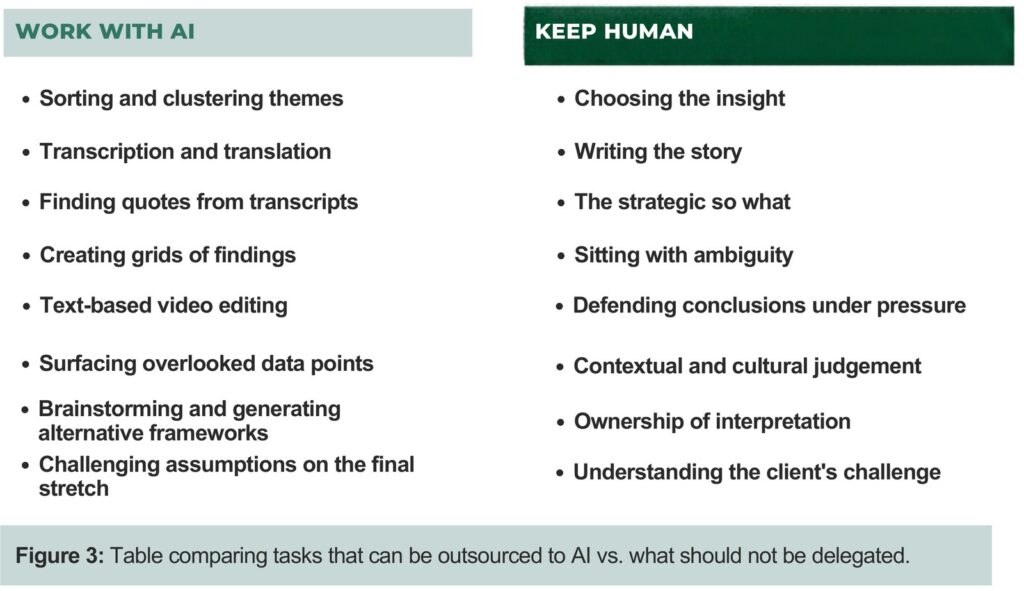
Researchers repeatedly described the alchemy of insights as something that cannot be outsourced: the skilled act of synthesizing evidence, interpretation, and strategic judgment into not just a coherent point of view, but a transformative story. In practice, this alchemy shows up in deep reflection on the strategic “so what”; frequent consideration of what to do with the information and why it is relevant; and the use of interpretative judgment coupled with effective communication skills. Good work emerges from reflection, ownership, and the ability to sit with ambiguity. The CEO of an audience research consultancy introduced me to the metaphor of “the insights professional as a sculptor,” reflecting, writing, and chiseling text and data down until it has reached its core meaning.
When this stage is rushed or delegated to AI, the result feels like sloppy writing, which results in generic insights that lack sharpness, depth, and conviction. Intentional outsourcing to AI, by contrast, is limited to tedious grunt work that would otherwise cause brain fatigue: looking for quotes, sorting of themes, creating grids of findings (not insights), or detecting differences between segments. As one boutique agency founder put it: “the job of the machine is to find data points, the job of the researcher is to fall in love with the client’s challenge.”
What AI Can Support: Protecting Thinking Time
By delegating the descriptive what and how much to AI, researchers who produce good work protect the time needed to discover the so what? for the client. They do not use AI to choose the insight or write the story, but instead to remove friction around the work that drains cognitive energy. In this sense, good work is as much about knowing what not to ask AI as it is about knowing what to delegate. Researchers also described this supporting role of AI as a “second brain,” a way to test blind spots after a human-led analysis session. Used this way, AI can challenge judgment rather than replace it. A senior Head of Insights, for example, noted that AI surfaced a core theme so obvious and present, but the whole team looked past it because it was hiding in plain sight. This focus on delegation is not about speed for its own sake. We have defined good work as being about clarity, but clarity and speed are not mutually exclusive when speed is achieved through efficiency of routine processes rather than a reduction in thinking time. Researchers see AI as a tool to speed through the mundane tasks, like clustering data or finding quotes, to free up time for the heavy lifting of strategic thinking.
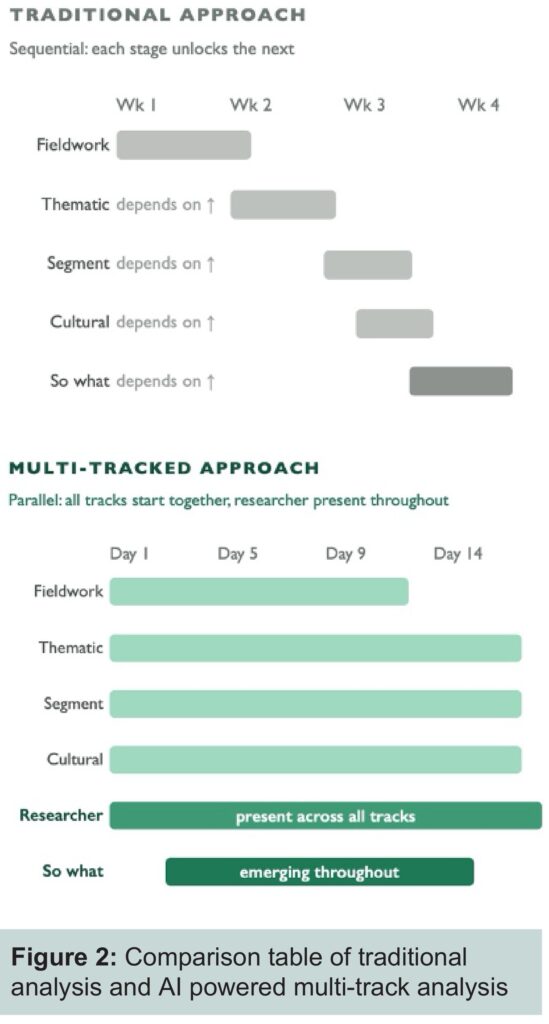
AI also unlocks efficiency through creative analysis methods. A Head of Research described deploying AI towards multi-tracking analysis flows. This involves exploring parallel routes of inquiry that would have previously required multiple team members but can now be done by one consultant working through different frameworks concurrently. This is especially true on complex multi-dimensional projects. In these cases, good frameworks and analysis methods are essential because they act as guardrails: they help to digest information, guide the researcher in knowing exactly what to look for, identify what’s new and unexpected, and identify and interpret patterns. Researchers are creating systems that are designed to interact with data as quickly as possible while still owning the process and developing the confidence needed to stand behind the insight.
Creating the Conditions for Good Thinking
Researchers agree that good work and good insights require unbroken cognitive time, as well as allowing time for moments of immersion and deep reflection. Research needs friction—analysis performed by a human, the ability to bounce ideas around, disagree with someone, and sit with uncertainty. Many researchers deliberately put time aside to focus on these activities, blocking out time on the calendar to be in the same room (virtual or in-person), uninterrupted and with clear rules around technology. For example, rules can include no phones and notifications, clear boundaries on how AI is used, and specific designation of who manages the digital whiteboard or easel notes. These sessions, sometimes called “hot box” or “jam” sessions, provide for a concentrated period of collective thinking, often lasting several hours and including external senior voices as an outside provocation. I like to think of those techniques as rituals. However, that word does not mean that these ways of working should be treated as nostalgic, outdated habits, but rather as intentional cognitive breaks that move the researcher from a passive data capture role (which technology does well) to one of active data processing (where human judgment resides). Rituals enable researchers to slow down interpretation. The process of writing things down helps the brain remember and see associations that then act as a conduit to get the clean ideas out. Rituals create a form of scaffolding that makes judgment visible. They create a physical space for judgment to be shared and challenged, preventing the sea of sameness that comes from everyone using the same large language models. Getting the team together with whiteboards and papers is described as a short-circuit and decluttering process designed to compress the mess into a clear answer.
One example described by several researchers was the “Plain Paper Ritual.” A session is started without computers, using only blank paper to ask: “What is missing? What does the client need that’s not there?” This removes the noise of existing content and allows intuition to surface, which is a key ingredient to crystallized thinking.
Rituals can act as reality checks. A cultural strategist we spoke to believes that good work requires staying attuned to the world around you to avoid delivering insights that are removed from reality. He swears by watching linear TV and visiting non-metropolitan hometowns to see where “normal people” live, ensuring that a team’s cultural antenna isn’t just tuned to a niche, metropolitan echo chamber.

These rituals contribute to good work by ensuring the final mile of research is a creative act of alchemy rather than a mechanical act of data management.
The challenge with rituals is that the industry is heading in the opposite direction with faster timelines, leaner budgets, and the pressure to deliver that makes a “hot box” session feel like a luxury rather than a professional standard. Researchers, especially independents, have turned to AI to protect the conditions that make good thinking possible. Rather than skipping the time-consuming rituals, they make space for it intentionally, and at times, through the use of AI. The most interesting shift is seeing people use it as a thought partner. Someone to kick the ball around when there is no colleague in the room or as a collaborator to ask, “Did we really see that?” or “Does it make sense if we say it that way?” I have heard all sorts of projective metaphors for the technology from “the junior assistant” to the “alter ego” to the “all-knowing entity.”
Some researchers also talk about fighting with AI on the final stretch of the project and creating friction by design, pushing back on assumptions and forcing crisper ideas. My favorite quote is from a researcher at a large insurance company: “I see people on my team use AI to write decks for them, going from 0% to 67% ‘good enough’ and call it a day. For me it’s about going 0% to 67% alone and then using AI to take my output to 99% quality, which would have been unthinkable before.” (Her numbers were illustrative).
Ownership is Your Added Value
After over 25 hours of conversations on this topic, it’s clear that researchers are not resiting AI, but are making deliberate and occasionally counterintuitive choices about where to use it and where to hold the line. Saying “AI handles the data, humans own the interpretation” is easy but hard to maintain when a tool is offering polished-looking answers in 30 seconds. There is a new discipline requiring us to say “not yet,” to sit with the mess, and wrestle with the output before accepting an AI-generated answer. I argue that this discipline is a new form of professional rigor.
The best researchers who are thriving were not the ones using AI the most but those who knew precisely what not to give it—knowing that judgment and accountability cannot be delegated without consequences. The risk is to end up with what an agency founder called “fishbowl research” and “machine-generated slop without a soul,” resulting in bland conclusions that no client wants to read.
For researchers the implication is practical: figure out your own way of leveraging AI but embrace the fact that ownership is your added value. When a curveball question lands in the room, you need to justify your point with conviction, which is only possible if you have lived and breathed the work. Your value is not just speed to insight but your ability to stand behind the thinking, bring contextual intelligence, and defend a conclusion under pressure. That’s what clients are paying for, whether they articulate it or not.
Speaking to end clients directly, the implication is about what you commission and how it’s exaluated. If you’re buying speed and volume alone, you will get speed and volume, but you won’t be able to tell if your insight is a well-dressed hallucination. The researchers worth investing in are those who push back on methodology, ask difficult questions, and know when to delegate to AI.
As for the future of qualitative research, I don’t think it will be completely taken over by AI moderators and automation. There is certainly a role for AI in the process with disciplined and imaginative ways to use it. The emerging norm is one of intentional cognition, accelerating processes with the human still responsible for sense-making. I’m optimistic that what we bring to the table is so much more than moderation and good conversations, and that there is a role for the “quallie way of thinking” in the future of insights work. We are, after all, a rare breed of curious deep thinkers who turn dust into gold for our clients.