
By Josh LaMar
CEO
Amplinate
Paris, France
joshlamar@amplinate.com
The Translation Problem
In this new, AI-powered, impact-driven world, research as a discipline is having a tough time. Amidst layoffs and the promise of AI to simplify and streamline job roles, the need to show impact is more important than ever and that impact needs to be shown to those in charge—that’s right, the business.
Researchers offer a truly unique benefit to a business, but the difficulty is not in generating the insights—rather, it’s in the translation of customer needs into what it means for the business. Insights aren’t framed in business terminology, and thus, the managers and executive suite have difficulty understanding how research fits into the broader plan. And when that happens, anyone not contributing directly to business growth is a prime candidate to be laid off.
Having started my own business, Amplinate, participated in networking events with CEOs, and worked directly for and consulted with other CEOs and entrepreneurs, I know firsthand the challenges and worries of other executive leaders. I also understand the language and frameworks they use to think about their own businesses, and it is with this in mind that I share the following four strategies researchers can use to translate research insights into business value.
Let’s begin by getting into the mind of a business owner. A business needs to grow and make money to survive, thus, a primary concern of a CEO is to focus on making money and saving money—mostly in that order. Therefore, it is your primary responsibility as a researcher to support this goal. When the business makes money, you keep your job. When you translate your work into insights that help the business grow, you make research invaluable to the business.
The Impact Problem
The key issue in translation is the difference between experience impact versus business impact , which is why this translation problem exists in the first place. Business stakeholders operate in a different epistemological system that values quantitative insights, quantifiable outcomes, KPIs, and return on investment (ROI). If there’s an obtuse acronym, it’s probably something the business cares about. To simplify things, it’s easier to focus on two questions:
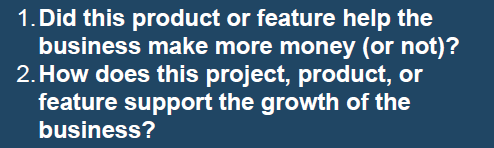
Researchers, on the other hand, are more likely to be focusing on and evaluating the impact to the customer experience: the lives of the humans that use a product or service got better because the product got better. It’s intangible, though qualitatively better. But just “interesting” won’t cut it. We must translate interesting findings into impact to the business, not just the customers who use the product.
The cause of the impact problem is not a lack of value but a failure in translation of customer insights into business value. This article offers the solution. I offer four concrete strategies to reframe research in terms of business goals (making or saving money and growing the business) using language business leaders recognize.
Below I will take you through these four strategies that translate research insights into business value. Each strategy is seen through three lenses of product development. Let’s review the three lenses of product development first.

Three Strategic Lenses of Product Development
There are two frameworks I will introduce that will frame the translation strategies: Three strategic lenses of product development (this is my framework) and Jay Abraham’s “Three Ways to Grow a Business.” We’ll start with the three lenses of product development.
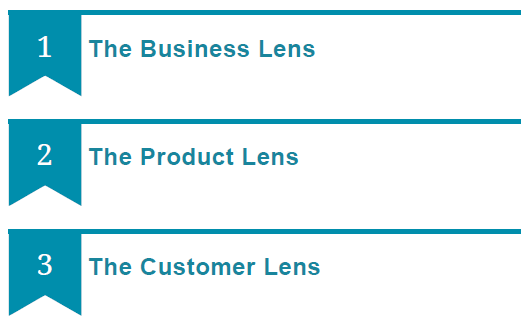
When we conduct research with customers, the end goal is to solve their problems through the product or service that is being created or refined to make the business money. We use each of these lenses in distinct, yet interconnected ways, and each of these three lenses also map to the three ways to grow a business.
The Business Lens: What Drives Growth?
This is how your executive leadership thinks. The business lens is about strategy, differentiation, and long-term viability. It asks:
- How does this product or service contribute to the company’s financial success?
- What market trends or competitive forces should influence our decisions?
- How do we create a sustainable, scalable model that aligns with our business objectives?
Often, businesses view research as a means to validate their market strategy. But this doesn’t tell the whole story. The goal is really to understand what customers value and how that aligns (or misaligns) with the business objectives. Based on what you learn, you can either reorient your marketing messaging to speak to what your customers need your product or service to do or reorient your product to solve the problems your customers have.
The Product Lens: What Can We Build?
This is typically how designers, product managers, marketers, and developers think. The product lens focuses on feasibility, execution, and technological constraints. It asks:
- Can we build what the customer wants within our current technical and operational limitations?
- What trade-offs do we need to make between innovation, scalability, and efficiency?
- How do we balance competing priorities from business and customer needs while building a product that is technically feasible within the given timelines?
This lens helps ground the conversation in what is realistically possible while ensuring that product development remains customer-centered rather than feature-driven.
The Customer Lens: What Do People Actually Need?
This is how researchers (both UX and market researchers) typically think. The customer lens is about context, behavior, and unmet needs. It asks:
- What pain points, motivations, and behaviors shape how customers interact with our product?
- What needs do they have, whether they articulated directly or not?
- How do they define success in their own terms?
Many companies assume that customers know exactly what they want and can express it clearly. But the reality is that customers don’t always have the language to describe their needs, which is why the skills of deep listening, behavioral observation, and iterative testing that researchers possess are so critical.
Jay Abraham’s Three Ways to Grow a Business
This next framework comes from marketing pioneer, Jay Abraham, and his famous “Three ways to grow a business.”
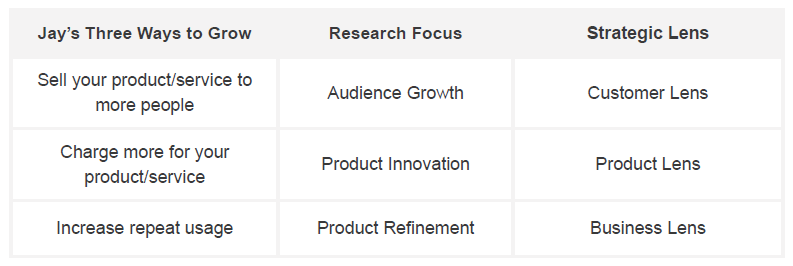
Jay’s model is well known in the business community. In fact, Jay’s protégé, Tony Robbins, teaches this model in his Business Mastery workshops for CEOs and entrepreneurs. This is THE playbook for CEOs to grow their businesses:
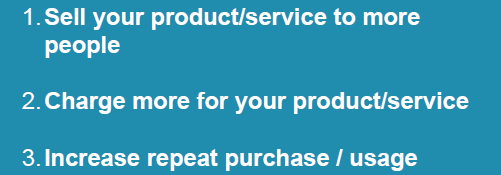
My four strategies build upon Jay Abram’s growth axioms—I take his three and add one of my own. I’ll go over each below individually and address how the lenses inform questions you can ask to help you gain a holistic perspective.
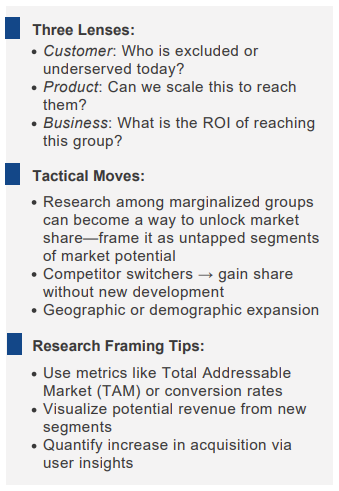
Strategy 1: Sell to More People (Audience Growth)
To sell to more people, you need to understand what your current customers value about your product or service. That usually means starting with the Customer Lens to gain a deep understanding of their motivations and goals, current behaviors, and (perhaps most importantly), deterrents and pain points.
Once you have a good understanding of your customers, the next step is to figure out how to adapt your product to a niche audience or a new market entirely. It all comes back to understanding value. You can’t get more customers if you don’t have alignment between customer needs and the product features: the product needs to solve a problem the customers have better than the competitors.
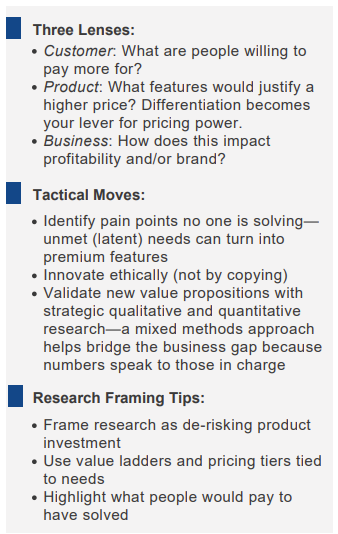
Strategy 2: Increase Pricing with Product Innovation
Building on your understanding of your customers using the Customer Lens, the next step is to use the Product Lens to ensure your product or service either:
- Solves a known, existing problem in a new way
- Solves a new problem (based on a latent/unmet need) in a new way
Innovation comes from solving your customers’ pain points through your product in a different and better way.

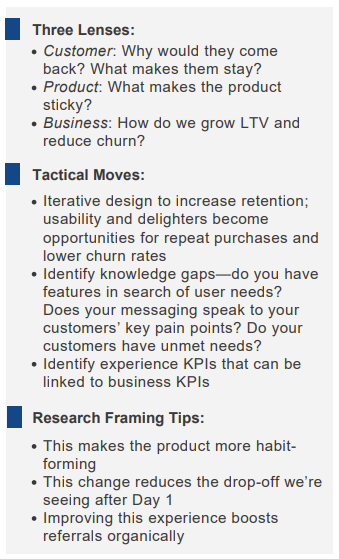
Strategy 3: Increase Repeat Use Through Retention & Loyalty
Retention is a sweet spot where experience metrics (what researchers are good at) can directly feed into business metrics like customer lifetime value or churn. But we need to define those KPIs up front—with stakeholders—so our findings can be attributed to real outcomes later.
A product or service must get better with time, so a business needs the ongoing processes and systems of research and User-Centered Design to continue listening to your customers, identify trends and emerging needs, and cutting ruthlessly the features no one wants or uses in your product.
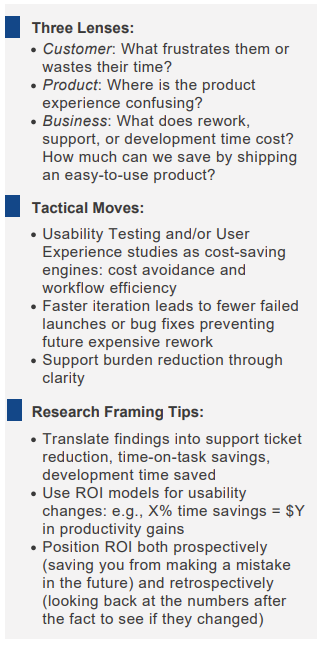
Strategy 4: Save Money by Reducing Inefficiency
It’s not one of Jay’s Three Ways to grow but saving money is always a good thing for the business as well. A business and its product development processes should be like well-oiled machines—they work smoothly and efficiently.
There are a few ways to help identify opportunities to save money. The first is usability testing and user experience research, which helps you to ensure that your product is easy to use, supports your customers’ goals, and helps streamline the experience. Another approach is to study customer support calls or review feedback to identify parts of the experience that don’t make sense or could be better.
Unifying the Frameworks: Negotiated Product Truth
Product Truth is my term for the alignment between the three lenses of Business, Product, and Customer. Essentially, every product decision is a negotiation between:
- Customer: What your customers need your product to do
- Product: The product that can feasibly be built
- Business: What the business wants (aka money)
When teams operate with only one or two lenses, they risk making flawed decisions:
- Business + Product (without Customer): Leads to commercially viable but irrelevant products
- Business + Customer (without Product): Creates desirable but unfeasible solutions
- Product + Customer (without Business): Results in great UX with no path to profitability
Misalignment can lead to product failure and thus business failure—a lack of growth. Research plays a unique role—it illuminates all three lenses at once, allowing insights to become a bridge into business strategy.

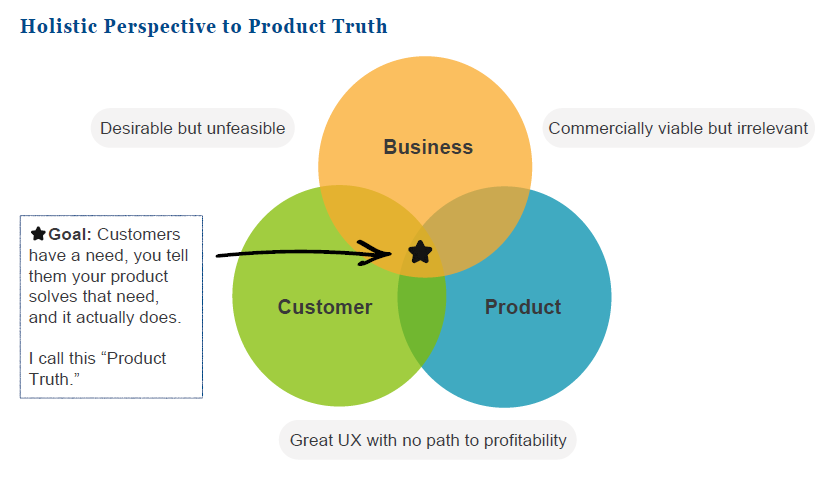 Successful businesses arrive at a balance between business viability, product feasibility, and customer desirability. This means:
- The business doesn’t dictate what customers should want; it listens and adapts.
- The product team doesn’t just build what’s easiest; it prioritizes what’s meaningful.
- The customer’s voice isn’t taken at face value; it’s interpreted through behavioral insights.
By actively negotiating between these perspectives, businesses can create solutions that are not only usable and valuable but also sustainable and scalable.
Conclusion: Research is a Strategic Role
Thinking like the business doesn’t mean you have to abandon caring about the customer experience. It means framing your insights in the language of business growth or cost savings.
With the right framing, your work and your role become essential. And it starts with a single question: “How might this help my client or my company make or save money or grow?”
References
(1) Josh LaMar, “The Research ‘Impact’ Problem,” Medium, March 4, 2024.
(2) Jay Abraham, “Three Ways to Grow Your Business,” Abraham.com, March 24, 2026.
(3) Tony Robbins, “Business Mastery,” TonyRobbins.com, March 24, 2026.