
 By Chris Arning
Founder / Director
Creative Semiotics, Ltd.
London, United Kingdom
chris@creativesemiotics.co.uk
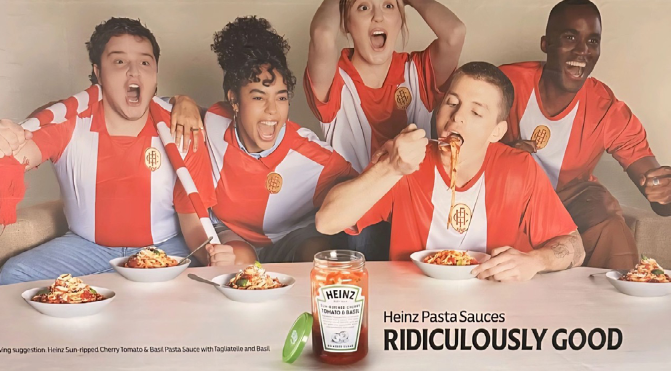
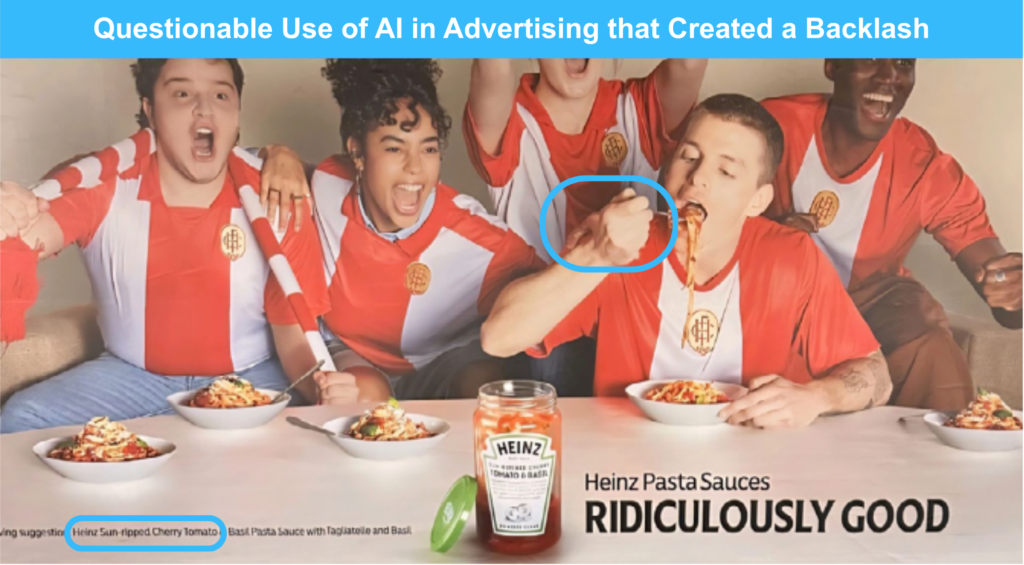 Image: Heinz ad, as shared by Rodd Chant on LinkedIn, October 2025. Original source: Heinz. Used for commentary purposes.
Introduction
How Does (Perceived) Image Origin Affect How Consumers React to Brand Campaigns?
We are living through a strange shift in visual culture in marketing and advertising. From eerily polished synthetic scenes to strangely generic compositions that feel “off” without being obviously fake, AI imagery is becoming part of the everyday visual diet. Advertising imagery can now be produced at unprecedented speed and scale, yet their credibility, humanity, and distinctiveness are increasingly in question.
This article explores an emerging trend I have observed across advertising and branding—the growing tension between AI-enabled image production and consumer trust. I argue that AI imagery may not automatically erode brand trust, but when it is used indiscriminately or as a wholesale substitute for human-crafted, visual storytelling, it often does. Conversely, brands that use AI transparently, even explicitly and creatively signposting its role rather than hiding it, can strengthen brand trust and even unlock new sources of brand value.
I worked in qualitative research for close to a decade but now work in brand semiotics. That means I spend more time dissecting brand images, pulling apart their visual features, and looking at how the “codes” or patterns of brand meaning evolve in the cultural wild than I do analyzing discussion group dynamics.
Recently, I have become curious about how generative AI images in advertising affect consumer brand trust and how we can equip ourselves as researchers to get ahead of the big upheavals to come. Semiotics is certainly part of the answer, but I’ll come back to that later.
Before diving into specific examples, it is worth stating that the observations below are not presented as definitive evidence of how all consumers respond to AI imagery. They are patterns I am noticing through being engaged in industry discourse and my own professional observations—signals of an emerging shift rather than any sort of definitive proof.
The trigger for this article was encountering a couple of LinkedIn posts. First, independent Creative Director Rodd Chant was slamming a Heinz pasta sauce ad and accusing those behind the spot of not “using experienced creatives who know what they’re doing, including photographers” and not having “a creative idea worth remembering.”
This happened shortly after the scandal around a J.Crew ad, which was revealed through visual inconsistencies to be a campaign created by an AI artist who was not acknowledged, nor was the work flagged as AI. “Good Morning America” reported the backlash as having hit brand trust.
A few days later, I came across a similar reaction to a Scientology ad on LinkedIn. It was the sort of basic image you never would have seen in public some years ago—either the result of amateur art direction or perhaps created algorithmically. The poster was harshly criticizing the ad, characterizing it as creatively lazy and devoid of any distinctive brand assets. His critique was less about the specific use of AI and more about what the image signaled: a lack of care, craft, and strategic intent.
As you followed down, the comments in the feed were scathing or mocking, and I admit, I piled on—perhaps a little too enthusiastically (the words “a contempt toward branding principles” were used!). My underlying point was that this was not just “slop” but sloppy; the weirdness of the imagery made me question the brand integrity and got me thinking about how AI affects brand trust.
We know that consumers want transparency. This is a trend that has been discussed since at least the classic business book The Clue Train Manifesto back in 1999. The authors argued that the internet would undermine corporate dominance and end an age of consumer deference through creating a marketplace of conversations.
Getty Images put out a report, “Building Trust in an Age of AI,” which was based on a survey that “draws from the global perspectives of over 30,000 adults in 25 countries from 2022 to 2024.” The topline findings suggest that 98 percent of respondents believe “authentic images and videos are pivotal in establishing trust,” while 90 percent want to know whether an image has been created using AI. As the report puts it, “people don’t want to feel that they have been fooled or lied to.” Leaving aside Getty’s obvious self-interest in commissioning this research, it highlights a critical point: consumers want authenticity, but if AI must be used in image creation, they expect it to be flagged.
I ran an admittedly much smaller poll on my LinkedIn profile in the Fall of 2025 (only 100 respondents) but the results were strikingly unequivocal: while only five percent thought that using AI in the creation of an image would damage brand trust (if acknowledged), more people felt that stock images (17 percent) and poorly art directed images (18 percent) would have a bigger detrimental effect on brand trust, while 60 percent objected to AI being used surreptitiously.
Obviously, my network skews toward more AI-literate folks than a general population sample, but it indicates that it is not necessarily the use of AI per se, but rather the transparency around it that is the issue.
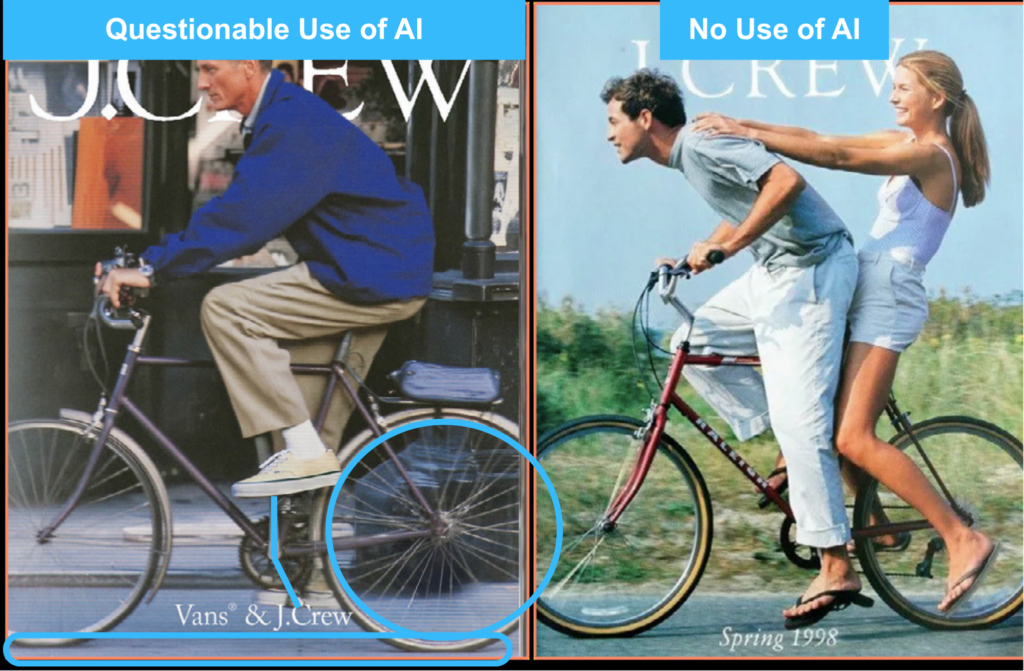 Image: J.Crew and Vans ad, as shared by Good Morning America on YouTube, September 2025 and BlackbirdSpyplane, August 2025. Original source: J.Crew. Used for commentary purposes.
Taken together, these reactions suggest that consumers are not uniformly hostile to AI-generated imagery. What they appear to feel most strongly is discomfort with deception. AI imagery can provoke irritation, or even ridicule when it feels lazy, generic, or a covert substitute for human effort. Yet, when its use is disclosed, intentional or playful, it often generates curiosity rather than rejection.
Complicating matters further, however, is the fact that AI imagery is becoming increasingly difficult for consumers to reliably detect, which raises the stakes for brands around the value of disclosure and creative responsibility. In other words, consumer sentiment seems less about the technology itself and more about what its use signals about a brand’s respect for its audience.
This raises a deeper question: What is the trouble with AI images though? Is it the fakeness or the lack of honesty about the fakeness?
Lost in the Fake or the Revenge of the Real: the Changing Codes of Images
Well, it’s partly the artificiality of it. To really understand this, we must delve into a little semiotic theory. Charles Sanders Peirce, a 19th-century U.S. philosopher and one of the two pioneers of semiotics, said there were three ways a sign could link with its referent:
- Icon – which links by resemblance (for instance, a toilet door sign which uses the silhouette of a man or woman);
- Symbol – which links by learned convention (for instance, the biological signs for men and women); or
- Index – which is physical connection (for instance, a lipstick or moustache).
The one that is most important for our context is an index—where something stands for something through physical connection, such as smoke indicating fire.
For example, since the dawn of digital images, traces of the human touch have dwindled significantly. Images once captured through chemical photo-processing have been replaced with pixels in a digital matrix of 1s and 0s.
We know that consumers still crave human connection. This is potentially why the biggest camera brands have made anti-artificiality (and implicitly anti-AI) the centerpiece of recent brand campaigns.
For example, German brand Leica launched its “The World Deserves Witnesses” campaign advocating the value of photography as vital evidentiary truth; U.S. brand Polaroid with their Real Life campaign celebrated the serendipity—organic nature of photography as a co-existence of light, movement, and serendipitous mistakes that brings an imperfect sincerity; and finally Japanese brand Nikon with their “Don’t give up on the Real World” campaign played on the gap between artificial AI and the magnificence of natural landscape.
For an analogy to better visualize what happens as the human touch dwindles, we can consider the last 20 years and how a slew of what is known as “stock photography” has invaded newspaper pages, corporate brochures, website mastheads, and social media feeds. The main thing about these images is that they are generic and reused multiple times, so they lack any sense of human care, a photographer’s idiosyncrasy, or artistic perspective.
What does detecting stock imagery imply? Well, there are several possible inferences. Viewers, i.e., consumers, may conclude that the brand is lazy or cynical, that it lacks imagination, doesn’t pay creative people to take photos, doesn’t take care of their signature look and feel, or that it takes their audience for granted (hint: NONE of these are good!).
This also links back to “indexicality” (a term we use in semiotics to describe the link between a sign and a distinct time and particular place); stock images lack a unique link and stink of genericity. This is an accusation many also level at AI imagery: a coldness, a lack of humanity!
In fact, to some, things are even worse than that because AI is not just a lack of something human, it can also carry ideological connotations of capital intensive, energy-hungry, machine-based productivity. This is, for many, antithetical to the bohemian world of the idiosyncratic creative—or indeed the qualitative researcher.
Images as Drivers of Brand Trust and Distinctiveness: What is Really at Stake Here?
Leaving aside broader debates about ideology or aesthetics, there are potentially more important issues for brands to consider when it comes to using AI imagery, such as the issue of brand distinctiveness in a world of increasing visual sameness.
Brands using LLMs are pulling randomly from a common data set, and the underlying generative architecture is undifferentiated. This compounds an issue brands were dealing with even before the diffusion of generative AI imagery: code convergence and NOT being meaningfully differentiated.
Kantar’s BrandZ survey concludes that being salient, meaningful, and differentiated are critical success factors in building brand equity. Byron Sharpe at the Ehrenberg-Bass Institute argues for prioritizing distinctive assets in building brand equity. This is bound up with the idea of brand codes—the unique signature or semiotic imprint every brand should have.
What my experience doing semiotic analysis shows is that brands are much less distinctive in their codes than they think they are. Many brands inadvertently use similar “category codes.”
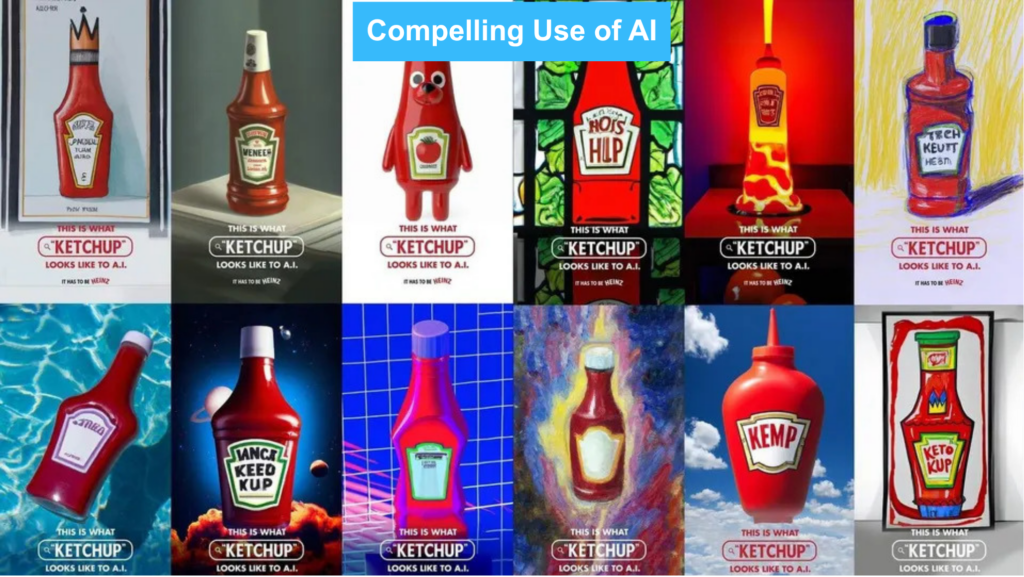 Image: Heinz ad, as shared by Noor Salam Khan on LinkedIn, May 2025. Original source: Rethink Canada. Campaign: Heinz A.I. Ketchup. Media: Carat (Canada), Starcom (U.S.) Social: Kitchen PR: Media Child (Canada), Zeno Group (U.S.). Used for commentary purposes.
Indeed, a recent study on sameness by Twitter, Contagious, and Pulsar showed how similar brands are and how difficult it is to stand out over time: “When Twitter asked respondents to look at redacted tweets and guess which brand was responsible, only 38% could pick the right brand from a list of five options.”
This survey was conducted in 2021, and things now are likely to have worsened since the flood of AI has exacerbated general suspicions that a lot of content is being automated and recycled by brands via similar tools.
The influence of agentic AI on corporate dynamics is profound. The pursuit of ever-cheaper, scalable content automation also creates lapses in brand safety protocols, and a growing risk that brand equity will be compromised. This is a cause for concern, but at the same time agencies are under pressure to realize efficiencies, as it is suddenly possible to rapidly generate content.
Efficiencies without enough care, however, as British behavioral economist at Ogilvy Rory Sutherland once said, are a false economy: “given the focus on efficiency rather than effectiveness, we have overinvested in media automation (i.e., algorithms) and undervalued creativity.”
Brand trust can be so easily lost, and it is so hard to regain—efficiency needs to be reined in. But are there any brands doing better or something new with AI images? Well, I’ve come across a few.
So, We Know Some Brands Do it Badly. Are Some Brands Doing this Better?
FMCG (fast-moving consumer goods) brands like Heinz Canada exploited the ability of generative AI to show us how large data sets regurgitate human knowledge by asking image generators “What is ketchup?” showing just how firmly embedded the “iconic” Heinz Tomato Ketchup visual schema is culturally. This got Heinz into new conversations with new audiences, demonstrating its creativity and cultural currency.
Another campaign worthy of attention is that of Burger King, a brand unafraid to court controversy. Burger King used Grilliam, a proprietary AI app, to recreate the “Have It Your Way” creations of users in a successful personalization campaign. Rather than vaunt a singular vision or schema as Heinz did, Burger King used generative AI to create deliberately outrageous, extravagant versions of the Whopper.
Another good example is from 2023. Virgin Voyagers used AI imagery to bring to life Jennifer Lopez as the spoof “Chief Celebration Officer” for their new venture. Revealing that the actual operator of the avatar was Kyle, a bearded middle-aged man, was a comical twist. Reveling in the potential for AI, while exploiting the discrepancy between the fantasy and reality, more explicitly helps build social currency but also creates humor. For brands wanting to enhance their sense of humor, there is rich potential here.
What about AI brands?
Ironically, we have a highly technical and super advanced tech behemoth like OpenAI running an advertising campaign for ChatGPT, which has an almost nostalgic visual tonality—redolent of classic Coca-Cola ads—seemingly aimed to associate them with everyday life.
How are Qualitative Researchers in the U.K. and U.S. Seeing this Trend Right Now?
What do qualitative researchers think about this emerging issue? Well, I spoke with some contacts, and it seems that the attitude toward dealing with such images is polarizing.
On the one hand, Pam Goldfarb Liss, who is based in Minnesota, said she has been doing a communications check for a brand who created imagery in AI and was transparent about it. None of her respondents objected to using it in the creative process, only opining that the final version should not be an AI image.
My U.K. contact, and convenor of the Worldwide QRCA conference David Kaye, said that the use of AI imagery by brands “screams laziness and a lack of proper investment.”
Another contact, U.K.-based award-winning researcher Tom Woodnutt, who has written a number of pioneering think pieces on the use of AI in the research process, said: “…from a communications point of view, I think people are very good at spotting AI fakery, even when it looks incredibly realistic. And so there will be a premium in authenticity. And perhaps also a pervasive cynicism as we start to question the validity of something by default…and if a brand can only afford fake imagery and people can see through it…it may lose its stature.”
What these conversations point to is a subtle shift in how images are being “read” and interpreted—consumers, and thus respondents in qualitative research, may no longer be reacting solely to what an image depicts, but are increasingly curious about how it was produced, and whether anything is being concealed. Questions of provenance and process are becoming part of how brand communications are evaluated.
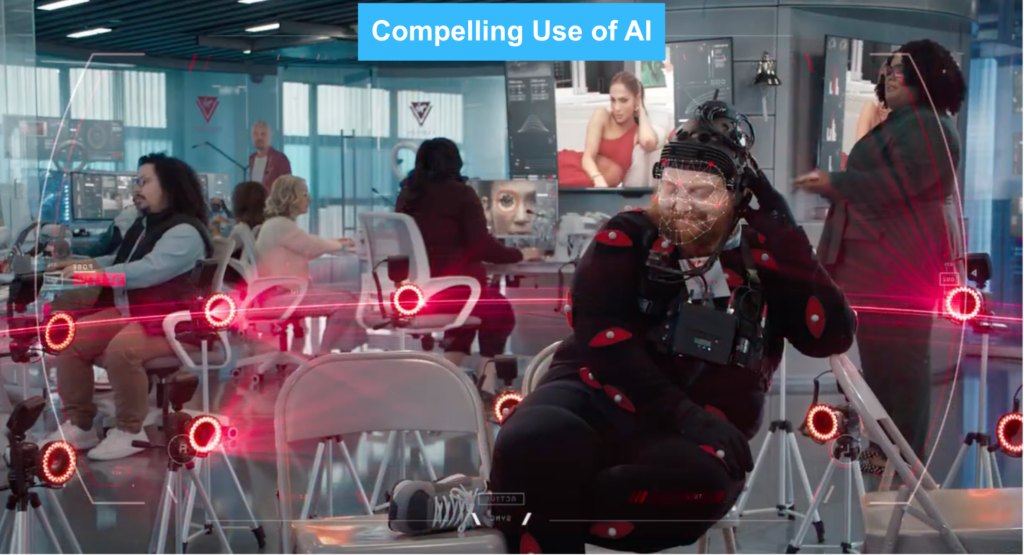 Image: Virgin Voyages “Jen AI” ad, as shared by Keep Calm and Manifest on YouTube, June 2023. Original source: Virgin Voyages. Used for commentary purposes.
What the Future Holds: an Evolution of AI Detection Tech and a Shift in Aesthetic Norms
As a semiotician, this is part of my remit. In the realm of newsgathering there are already ventures in play to fight against the influx of counterfeit images or portrayals.
The most widely recognized is the C2PA, an open technical standard for digital provenance. The C2PA was formed to guard against digital assets being repurposed, misappropriated, or misused. By understanding the origins (provenance) of digital files, and any changes made to them along their journey from creation to publication, it is possible to create a digital “nutrition label” or “content credential” for each asset. The C2PA standard allows for a combination of tamper-evident metadata, invisible watermarking, and fingerprinting to be attached and embedded in the asset itself.
Another organization, the Content Authenticity Initiative (CAI) spearheaded by Adobe, in collaboration with several major partners, including the BBC, Microsoft, New York Times, and multiple major camera and smartphone brands, is working to accelerate implementation of the C2PA standard across the digital ecosystem to include image, video, audio, and text.
Santiago Lyon, Head of Advocacy and Education at CAI, says that C2PA use cases are multiple and include creators, news media, AI companies, and corporations as well as governments, insurers, and law enforcement. The guidelines would apply to any industry where digital asset trust is important.
Major advertising holding companies (e.g., Publicis, Omnicom, WPP, and others) are already exploring using content credentials in the advertising space to ensure brand reliability and consumer protection, as well as asset licensing compliance, says Lyon.
As legislation catches up and mandates transparency around the use of AI, it seems that solutions like the C2PA will be increasingly useful, even if the firehose of AI content increases at an accelerated rate.
At the same time, AI images will perfuse everything. We will have to accept that AI imagery is here to stay—and that we must get better at reading it.
As semiotician Massimo Leone writes about the breakdown of settled meaning in his 2019 book On Insignificance: “It is not difficult to imagine a distant future…according to which an increasingly combinatorial aesthetics progressively downplays the value of creativity in the digital world emphasizing instead assembling existing pieces in a local manner. It is not difficult to imagine (that this) will make the defense of originality increasingly odd.”
Visual culture experts Lev Manovich and Emanuele Arielle in their book Artificial Aesthetics on generative AI believe that as future neural machines start to evaluate our perceptual judgements, AI agents will become better at anticipating our aesthetic preferences and make AI indistinguishable from human production.
Are we on the brink of a huge shift here and should we be bracing ourselves?
Here are a few thoughts on what the implications might be for qualitative researchers and for brand owners.
For Qualitative Researchers
For Brand Owners
References
- Rodd Chant LinkedIn post
- Good Morning America / J.Crew discussion
- Dan Gregson LinkedIn post
- Getty Images: Building Trust in an Age of AI
- Leica: The World Deserves Witnesses
- Polaroid Real Life campaign
- Nikon campaign
- Kantar: Meaningful Difference
- Byron Sharp / evidence-based marketing
- Contagious / Twitter distinction research
- Rory Sutherland commentary
- Forbes: Heinz Is Ketchup to AI
- Burger King AI campaign
- Virgin Voyages Jen AI campaign
- Creative Review: ChatGPT brand campaign
- Leone, M. (2020). On Insignificance: The Loss of Meaning in the Post-Material Age. Routledge.
- Manovich, L., & Arielli, E. (2024). Artificial Aesthetics. manovich.net
Images featured in this article were sourced from publicly available posts on LinkedIn and other social media platforms and are the property of their respective creators/copyright holders. These images are used solely for the purpose of commentary, criticism, and educational discussion regarding trends in AI-generated advertising imagery. Their inclusion is intended to support analysis and critique, not to claim ownership or to imply endorsement by the original creators. This use is believed to qualify as fair use under Section 107 of the U.S. Copyright Act. If you are the rights holder of an image featured here and have concerns about its use, please contact Dean Stephens, Editor-in-Chief, QRCA VIEWS to discuss.
 Thanks to VIEWS’ feature editor Johanna Simpson for her collaboration with the author.