

By Pam Goldfarb Liss
President/Big Brain
LitBrains-Igniting Ideas!, Inc.
Minneapolis, Minnesota
pam@litbrains.com
A new generation is coming into its own—Generation Alpha—the age group just behind Generation Z. According to a January 2026 United Nations tally,1 this is the largest global generation, with an estimated two billion people worldwide which amounts to approximately 24.4 percent of the world’s total population. This group is bigger than Baby Boomers who are now in their 60s and 70s. For reference, Gen Alpha is an estimated 200,000 more in population than the once-largest generation of Baby Boomers.
Most importantly, Gen Alpha is fast becoming one of the biggest consumer groups around the world who live and connect seamlessly online and in real life (IRL). Essentially, they are “digital natives”—a group who learned digital habits, unknowingly, during the COVID-19 pandemic when they were little. Their generation is more than just digital natives; they are seamless integrators of living comfortably with both offline and online tools.
Gen Alpha: Who Are They?
This is a group who many generational experts like the McCrindle Research firm (who coined the name “Gen Alpha”)2 and others say were born between 2010 and 2025; while others like Pew Research3 argue their time span is 2013-2025. Either way, its oldest members are teenagers—getting their driver’s licenses and preparing for college—while its youngest are just toddlers. Right now, Gen Alpha is not a fully formed consumer generation. It is the teenage years when we start paying attention to them as consumers. In the next 10 or so years, the youngest Gen Alphas will come together with the older Gen Alphas as a truly powerful consumer group—a group filled with possibilities.
What Do They Do Differently?
Unlike those of us in older generations, they have always had digital tools as part of how they connect with people. These digital natives grew up during COVID-19, when we all relied on digital tools to interact with the world around us—using platforms like Zoom for work and school, while also embracing digital tools as a more convenient part of everyday life. Digital tools are part of their (and our) lifestyles—from the digital assistants like Alexa or Google Home, to simulation video games like Roblox and Minecraft, to community/social media tools like Zoom, WhatsApp, FaceTime, Instagram, and TikTok.
What makes Gen Alpha different is they can move seamlessly between a digital world and the offline world. Gen Alpha connects naturally and easily with everyone because they prioritize community and interpersonal relationships. COVID-19 was scary to us, but to the older Gen Alphas who were between 5 and 10 years old, it was a time they effortlessly lived and connected with school, family, and friends using digital, video games, and social media tools. And the younger Gen Alphas who were not yet born are taking cues from their older siblings growing up on YouTube and TikTok cartoons, as well as finding fun times playing outside with their neighborhood “bubble” of friends. Many enjoy in-person gatherings with their friends at shopping malls and coffee shops—much like we did too.
Lilah, a 14-year-old girl who was 8 during COVID-19, illustrates the importance of their online and offline lives to Gen Alpha and how they move fluidly between each:
“I mean I knew that COVID-19 was scary, but for me—here in Minneapolis—I was playing outside with my neighborhood friends and being with good family and friends from our ‘bubble’ we had, who were safe to be around. It was more of that, and my mom, who is a teacher, let me spend a lot more time on screens. I made a special YouTube channel where I did some getting ready videos and fun make up try-ons with my Sephora gift cards. I played a lot of basketball outside with my sister. It was fun to FaceTime everyone. And my parents, sister, and I all watched a ton of great TV shows together like ‘The Good Place’ and ‘Community.’ I remember that. It was nice to have everyone home.”

Surprisingly, Gen Alpha has a lot of money to spend—and they earn it themselves. With an estimated $100 billion in spending power according to Price Waterhouse Coopers’ (PWC) March 2026 study,4 86 percent of Gen Alpha fund their purchases by odd jobs, allowances for chores, and holiday/birthday gifts. This same study claims that 97 percent of Gen Alpha children ages 7-14 say that they decide what to buy independent of their parents. The top five things Gen Alpha buys are food/drink, toys, clothes, digital apps, and in-game purchases according to the same PWC March 2026 study.
Coffee shops and the shopping mall are popular meeting places for Gen Alpha. The meet-up places you and I might have gone to with our friends is making a comeback. Many kids I talk to now want the tactile experience of trying something on or even seeing how it works before buying it. According to a recent Bloomberg story,5 “Mallmaxxing” has been popularized among teens and tweens who explore stores and see new trends, touch and feel products, and simply want to be together in real life. Indoor malls are now outperforming pre-pandemic numbers because teens and tweens have returned to this in-person experience.
Brands such as Hollister, Garage, and Sephora are catering to teens with Instagram and TikTok-able stores and larger dressing rooms so kids can try on products together. A recent survey from retail consultancy MG2 Advisory6 notes that 73 percent of Gen Alpha prefer good, old-fashioned, brick-and-mortar shopping to buying online.
As 13-year-old Gen Alpha Viveka says:
“I like to meet my friends at the mall because we get to walk around and see what’s new, try on stuff, and just have fun with each other. My mom drives me there and then I meet up with a bunch of my friends. We go into stores and try out new things, see what’s new. We don’t buy big stuff, but we do buy things. If I want something, I’ll tell my mom about it and either save for it or she’ll get it for me for my birthday, or a holiday, or something.”
Coffee culture is also seeing a return from the 90s era—the TV show “Friends” epitomizes this era—where teens and tweens meet up at local coffee shops armed with their TikTok or Instagram influencer’s latest customizable drink to try. According to Marketing Brew’s April 2026 issue,7 the ideals around creating an in-person experience are rooted in connection and community. There are several Instagram trends that challenge Gen Alpha to know their best friend’s latest customized favorite drink as a sign of a “friendship currency” that demonstrates how close they are.
Penelope, a 17-year-old Gen Alpha, says it perfectly:
“I love meeting my friends in a local Starbucks or coffee shop with a new drink combination to try. My friend really likes the Brown Sugar and Vanilla Combo. I love the Strawberry Pink Matcha because it’s so pretty. We will order for each other if we get there sooner than the other and pay each other back later. It’s like a back-and-forth with Venmo or just I’ll-get-you-later kind of thing.”
When asked what they want older generations to know about them, Gen Alphas say they don’t want to be known as always on their screens. An 8-almost-9-year-old explained it eloquently:
“We aren’t just on our screens. We like to play games outside. Some of us like nature—like I do with bugs and rocks. Some of us like baseball and other outdoor games. We also like to play video games. It’s both. We do it together. We do it alone. We are kids just like you were.”
Why It Matters for Researchers
When you think about how to connect with Gen Alpha, they live in a more chaotic world but it’s still moving slowly enough for them to figure out how to grow up. For those of us who make our living understanding people, Gen Alpha asks us to work a little differently than the generations before them. They live to “try things on”—literally and figuratively—before they commit, whether that’s a Hollister dressing room built for friends, a Rivian showroom set up like a mall kiosk, or a pop-up inside a virtual Roblox world.
When designing research plans aimed at uncovering Gen Alpha truths, our methodologies should mirror that try-before-they-buy instinct and their shopping preferences. A two-phased approach—an online community that doubles as both a screening tool and a first round of insight, followed by in-person shop-alongs or journey mapping—captures both how Gen Alpha performs online and how they actually behave when someone’s watching in real life. The insights found in these two phases rarely align perfectly, but that gap is often where the really cool insights live.
Scheduling matters more than you’d think, too: weekend sessions tend to work best, or if that’s off the table, aim for the 4-to-7 p.m. window on weekdays, after school lets out but before dinner.
Recruiting and prework deserve extra care with this generation. A well-designed screener that asks kids to submit a photo or complete a small task does more than confirm eligibility—it separates participants who will genuinely engage from those who won’t. Given how packed kids’ schedules already are, I recommend that you build in catch-up time, too: a week-long community needs “down days,” not just content days. Recruiting itself should run in stages—first a parent, then the child, then a final check-in with the parent—with at least three weeks set aside for the entire recruiting process. And treat the parent as a partner throughout—someone who helps and monitors, not someone who answers for the child.
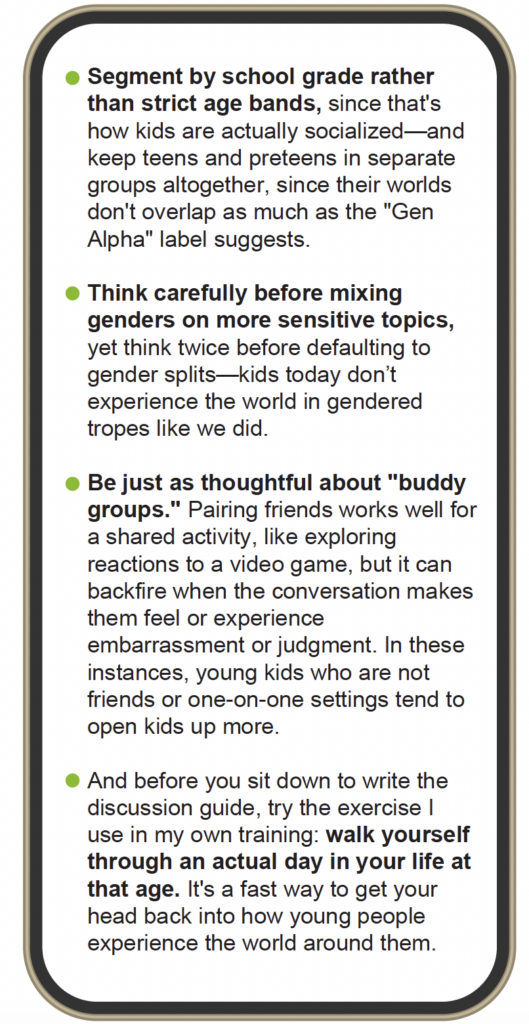
Moderating Calls for Its Own Adjustments
Above all, do the work of remembering what it felt like to be that age. Gen Alpha may be growing up faster than we did in some ways, but they still need us to meet them with real empathy—not just a discussion guide.
References
- United Nations World Population Prospects. 2024. https://population.un.org/wpp/
- McCrindle, Mark. McCrindle Research, 2008.
- Pew Research. https://www.pewresearch.org/topic/generations-age/generations
- Price Waterhouse Coopers. 2026. “Generation Alpha Survey 2026 Report.”
- Bloomberg. March 30, 2026. “Teens Sick of Their iPhones Are ‘Mallmaxxing.’” And, Bloomberg. Video, 4:03. March 29, 2026. “Gen Z Is Bringing Back the Mall.”
- MG2 Advisory. January 2026. “Young in Age, Mighty in Impact: Gen Alpha Is Rewriting the Rules for Brands.”
- Hicks, Katie. Marketing Brew. April 16, 2026. “How Gen Alpha Is Changing the In-Store Experience.”