

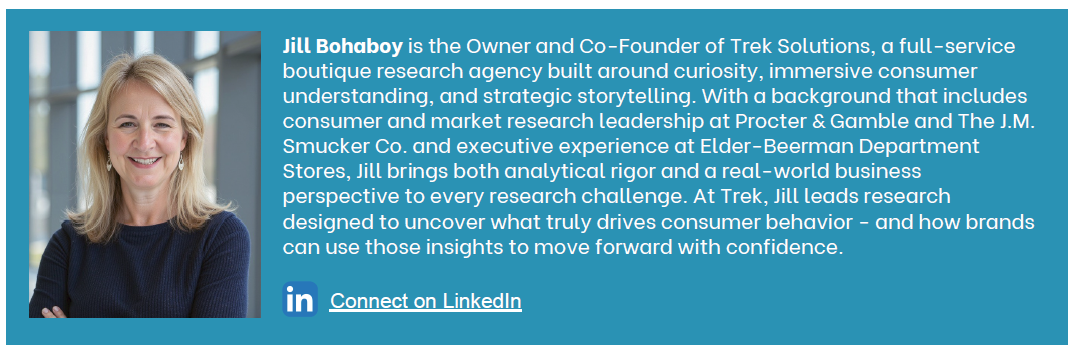
By Jill Bohaboy
Owner
Trek Solutions
Oakwood, Ohio
jill@trek-solutions.com

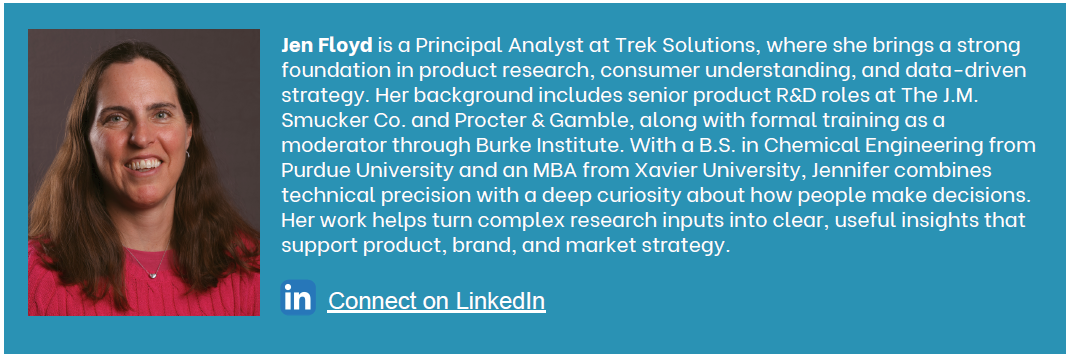
By Jennifer Floyd
Principal Analyst
Trek Solutions
Oakwood, Ohio
jen@trek-solutions.com

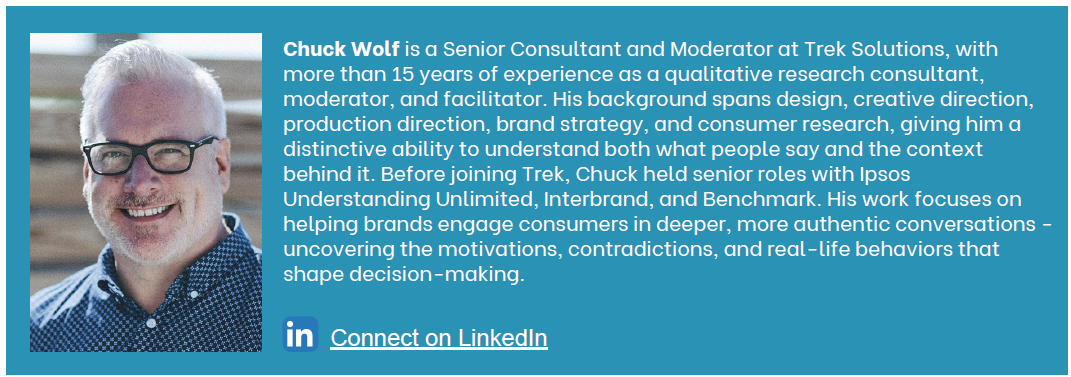
By Chuck Wolf
Moderator + Senior Consultant
Trek Solutions
Oakwood, Ohio
chuck@trek-solutions.com

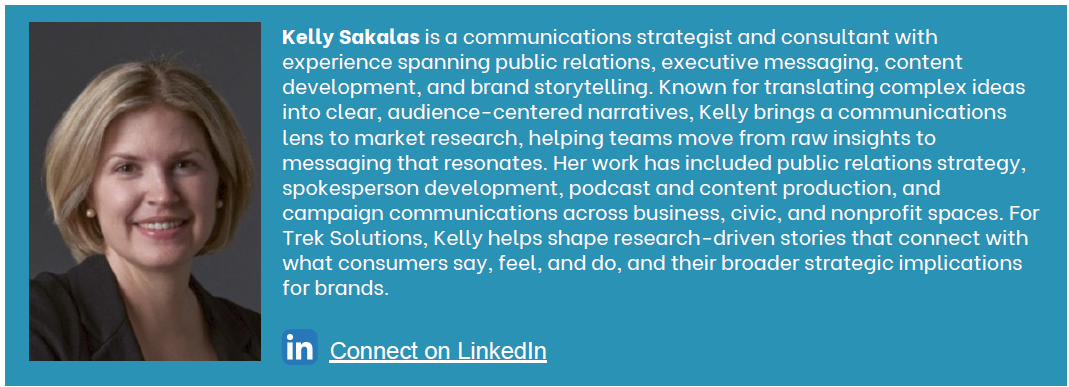
By Kelly Sakalas
Strategic Communications Consultant
Trek Solutions
Oakwood, Ohio
kelly.sakalas@gmail.com
A Category Fueled by Love
There are few categories as emotionally laden as pet care. Researchers entering this space are not simply studying products or claims—they are stepping into the daily rituals that pet parents use to protect, comfort, and care for the pets they love deeply and feel personally responsible for. Across hundreds of in-home visits, shop- alongs, and interviews, we’ve watched pet parents tear up over aging animals, laugh through guilt about over-treating, and agonize over whether they’re “doing enough.” These decisions are driven less by logic than by love, anxiety, and habit. What has fundamentally changed is not how much pet parents care—but who they trust. The long-standing veterinarian- as-singular-authority model has fractured. In its place is a layered ecosystem of vets, peers, influencers, platforms, rescues, groomers, and brands. Each of these elements conveys a different kind of credibility and trust. Nearly every modern pet care behavior is shaped by these shifts.
To understand pet care today, researchers must stop looking for a “single source of truth” and start seeing the category through pet parents’ eyes. In this article, we will examine how authority fragmentation reshapes qualitative research in pet care, from design and recruiting, through fieldwork and reporting. We will also discuss the skills this work demands and what keeps us returning to the category.
The Macro Shift: The Fragmentation of Authority in Pet Care
The fragmentation of authority in pet care is not a surface-level shift; it represents a fundamental change in how trust is built and maintained in a diverse pet care category landscape. Ten years ago, pet parents largely accepted a linear decision model centered around the veterinarian: a concern led to a vet visit, which led to a diagnosis, then a recommendation, and then a purchase or treatment. Today, the journey is far more circuitous and layered.
Information and advice are gathered before, during, and after professional care. Validation of pet care decisions can come from multiple sources, often repeatedly, before confidence is achieved.
This matters because pet care decisions carry emotional risk. When something goes wrong, the pet parent—not the brand, nor the influencer, nor the vet—bears the guilt or emotional stress. As authority fragments, responsibility of pet care decisions consolidates emotionally with the owner. That psychological weight explains why re- assurance, proof, and habit have become so powerful, and why changing behavior is so difficult once routines are set. Understanding this shift reframes every trend that follows—not as isolated behaviors, but as coping strategies in a trust-fractured ecosystem. For decades, the category was anchored by a single truth source: the veterinarian. Today, authority is shared, negotiated, and constantly revalidated. This fragmentation is the spine connecting today’s trends—and the reason traditional research approaches often fall short.
From Vet-as-Authority to Vet-as-One-Voice
Veterinarians still matter deeply, but their role is changing. As practices consolidate under corporate ownership, interactions feel less personal. Consumers tell us stories like, “Dr. John always knew Fluffy. Now, I can’t even get a refill without $500 worth of tests.” There’s a growing sense of distrust—that the system is more transactional and less relational.
Add to that the rise of tele-health and app-based vet services, and the interaction can feel impersonal: texts, follow-ups, and digital portals. The care may be good, but it’s no longer the neighborly, small-town experience many pet owners crave. As a result, pet parents are rebalancing vets’ influence on their decisions. Veterinarian recommendations still carry weight but no longer close the decision. Pet parents now distill and triangulate advice from multiple sources.
The Democratization of Pet Advice
When pet parents have a question, they don’t start and then stop with their vet. They turn to TikTok trainers, Reddit threads, groomers, rescue fosters, Facebook groups, and friends with “a dog just like mine.” Authority today is built on relatability and lived experience, not credentials alone. For researchers, this flattens the hierarchy of influence. The most persuasive voice may be unexpected—and it may differ by life stage, social media platforms used, or pet type.
Pets as Family—and Now, Emotional-Support Partners
“Pets as family” is no longer shorthand—it’s literal. Since the pandemic, owners have increasingly articulated the emotional benefits that pets provide: comfort, grounding, and companionship. Emotional-support animals are increasingly common, especially among students and young adults, and many campuses have formalized policies around them.
This humanization of our pets fuels the development of new product categories: calming chews, CBD treats, products like Feliway (a cat-calming pheromone diffuser), melatonin, and anxiety-focused solutions. Pet mental health has also become a concern, mirroring human wellness trends and raising the bar for products that can provide reassurance.
Humanizing Products, Questioning Proof
From fresh refrigerated food to probiotics and plant-derived treatments, pet care now mirrors the human grocery store. Ingredient reassurance and storytelling now dominate product communications. But with that comes skepticism. Overused terms such as “natural” feel safer, but consumers also question purity and efficacy. The result is a paradox: “natural” is now the baseline expectation, not a differentiator, and it must be paired with credible proof.
Loyalty, Stretching, and the Reassurance Economy
Pet care remains resilient in times of economic uncertainty—but not untouched. We see stretching behaviors: delaying treatments, buying smaller bags, mixing premium food with lower-cost options, or relying heavily on subscriptions to manage both cost and consistency. Subscription, auto-ship, and one-click reorders, offer more than convenience. They deliver emotional reassurance: “I’m being a responsible pet parent. I’m not forgetting. I’m staying consistent.” In a category where doubt is common, automation removes decision anxiety.
But that reassurance comes at the expense of discovery. When food or litter arrives automatically, other choices become invisible. New claims, formats, or benefits struggle to break through—not because they lack appeal, but because the consumer never enters an active decision mindset.
Across income levels, love for our pets transcends demographics. As frequent pet researchers, we routinely meet households on human food assistance feeding premium brands to their pets, while higher-income households quietly stretch or downgrade.
Confusion, Language Gaps, and the Need for Confidence
Pet parents often struggle to translate industry language into lived meaning. Terms like “clumping,” “dual-action,” or “grain-free” don’t always land as intended. Confidence erodes when understanding falters. Products that show performance (e.g., color-changing litter, visible ingredients) can restore confidence. Reassurance, not just claims, is becoming a primary driver of innovation and adoption.
Designing a Great Pet Care Project
As authority fragments, research itself has changed. Today’s pet care clients are commissioning more exploratory, behavioral, and contextual work than they did a decade ago. The questions have evolved from “Does this claim resonate?” to “Who is really driving decisions and why?” Clients want to understand influence pathways, decode the “say-do” gap, and see real behavior unfold.
That shift demands different research design choices.
Project Design: Following Influence, Not Assumptions
Where we once accepted, “I listened to my vet,” as a sufficient answer, pet owners now go wider for a broader perspective. For example, researchers might ask which staffers at the vet’s office did you listen to (i.e., the vet, vet tech, office manager)? What online resources did you consult (i.e., what sites, what content)? Which influencers or creators did you consult (i.e., who was talking, what was the context, what were they saying or doing)? And, importantly, what made them credible to you? A casual “I saw it online” becomes a map of influence when followed with curiosity. TikTok trainers, Instagram rescue foster parents, and peer communities often carry more weight than clients expect.
And no category benefits more from in-context work than pet care. In-home visits, ethnographies, and shop-alongs reveal the truth behind routines: using expired flea treatments, unconscious and excessive treat-giving, and other workarounds that surveys might never surface. These aren’t intentional misstatements—they’re habits, and only observation uncovers them. Empathy—not expertise—anchors good project design.
Recruiting: Designing the Room Carefully
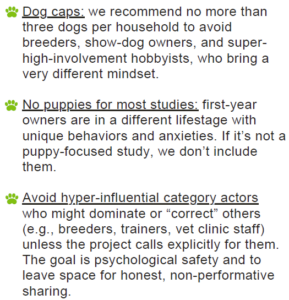
Pet care recruiting is deceptively complex. Here are some quality and implementation checks that we recommend to all fellow qualitative researchers.

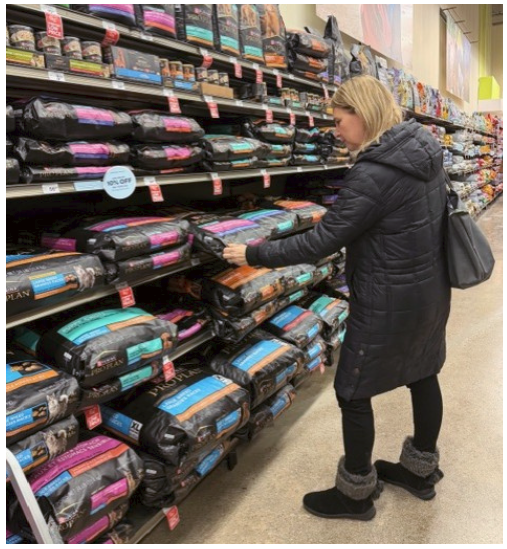
We often request a photo of the item participants are using—not because we doubt them, but because what’s in the pantry doesn’t always match what’s in their mind. A quick ask, such as “Snap a photo of the bag of food you fed your dog this morning,” helps ensure we’re bringing in the right people. Pet care language can be confusing, and consumers don’t always use the same terminology that clients do.

Let the research goals lead, not preconceived notions about who buys what. It’s easy to assume that premium, niche, or natural products only appeal to higher-income households, but that simply doesn’t reflect the behavior in pet care that we have observed. People consistently make trade-offs to prioritize their pets, even when budgets are tight. We see households stretching their dollars in other non-pet care areas while still purchasing premium kibble, supplements, or fresh food. Pet love doesn’t map neatly to traditional demographic logic—and your screening criteria shouldn’t either.

Age mixing matters here. Retirees, for example, may appear to fall outside traditional income thresholds, but household wealth, routines, and ordering habits tell a very different story. Someone may be spending $200 a month on pet food using auto-ship, yet technically “does not qualify” on minimum household income. Also, generational differences impact information sources—older owners often still defer to vets, while younger owners may mix vet advice with online influencers and peer reviews. Capturing both ends of the spectrum gives a more accurate view of the evolving authority landscape.

With the rise of multiple sources of pet care authority, group dynamics can spark tension or lead to a false understanding of what’s really going on in the category. To protect the quality of insight and avoid unproductive debate, we intentionally screen out certain extremes.
Fieldwork: Getting Close to Reality
Context is everything in pet care. We consistently learn the most when we see behavior unfold where it actually happens: in homes, aisles, cars, and storage spaces for pet sundries. While facility work still plays a vital role in claims testing, packaging feedback, and shelf-set evaluation, we prioritize exploratory learning over traditionally-structured facility work.
Group dynamics require particular care. Authority fragmentation often surfaces quickly, with participants positioning themselves as more knowledgeable or morally correct in their care choices.
Left unmanaged, this can silence quieter voices or skew insight toward performative or domineering behavior. Our role is to normalize differences, reinforce curiosity, and redirect posturing into shared storytelling.
Technology extends access when in-person work isn’t possible. Mobile ethnography and video diaries allow us to capture feeding rituals, supplement routines, treat moments, and shopping decisions in real time. These methodologies often surface contradictions that participants are genuinely unaware of— details that can disappear entirely in recall- based methods.
Whether in person or remote, proximity to reality is non-negotiable. The closer we get to lived behavior, the more accurate—and humane—our insights become.
Reporting: Show, Don’t Tell
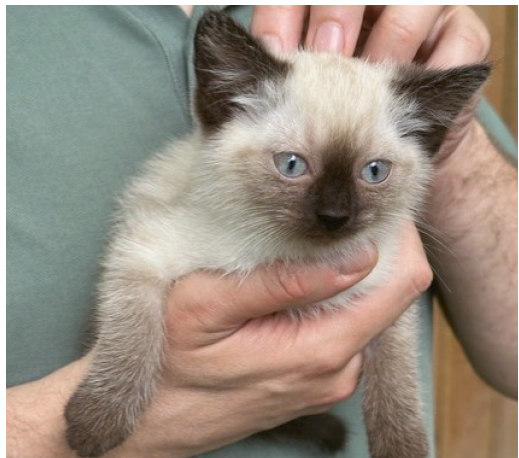
Pet care insights move fastest when they’re visible. Photos and video often do more than slides ever could; a frozen, undecided shopper in front of a shelf set, a pantry of half-used solutions, a lovingly improvised feeding station. Visual proof collapses the distance between insight and action. Focus on delivering the “so what” quickly, then layer on the polish as needed. In this category, clarity beats perfection.
The Skills and Mindset That Matter
Pet care research isn’t for everyone—and that’s okay. This work sits at the intersection of emotion, responsibility, and habit, and it demands a specific mindset.
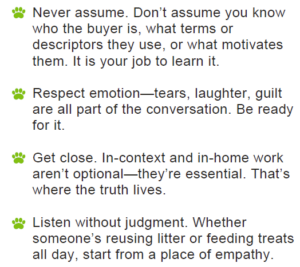
Emotional intelligence is foundational. Researchers must be able to sit with tears, guilt, and vulnerability without rushing to resolve them. These moments are not tangents—they are often where the deepest insights live.
Observational discipline matters just as much. The ability to notice unconscious behaviors—treats handed out without purpose or discipline, expired medications tucked behind newer ones, elaborate storage systems built around convenience—separates surface insight from real understanding. Strong interviewing instincts are critical in a fragmented authority landscape. When a participant says, “I saw it online,” the work is just beginning. Knowing how to probe without judgment (i.e., uncover who influenced them, why that voice mattered, and what emotional need it met) is a learned skill.
Finally, humility is essential. Loving pets helps, but it’s not enough, nor a requirement. Effective pet care researchers respect that pet parents are the experts on their pets’ lives. Our job is not to correct, educate, or impress, but to understand.
Where the Category Goes Next?
Pet care research is demanding—but deeply rewarding. Few categories provide such candid insight into how people express love, responsibility, and identity. When someone shows you how they care for a being who cannot speak for itself, you are seeing values in action.
The work is emotionally intimate. It requires trust, patience, and presence. But it also offers rare clarity: pet parents may be confused, conflicted, or overwhelmed, but they are almost never disengaged. That sincerity is a privilege to witness. It’s why, despite the complexity, we continue to return to this category curious, humbled, and committed to seeing it clearly.
Best Practices: No Assumptions, but Observations
When we’re working in pet care, we remind ourselves: we’re not the experts—the pet parents are. Our job is to see what they see. To capture what’s experienced, what’s habitual, or what’s comforting. We want to feel the frustration they feel in the aisle when they can’t easily find something, or to understand the quiet pride when they say, “My dog deserves the best.” Because what people do for the pets they love tells you everything—if you’re willing to look and listen.
About the Authors
About the Feature Editor