
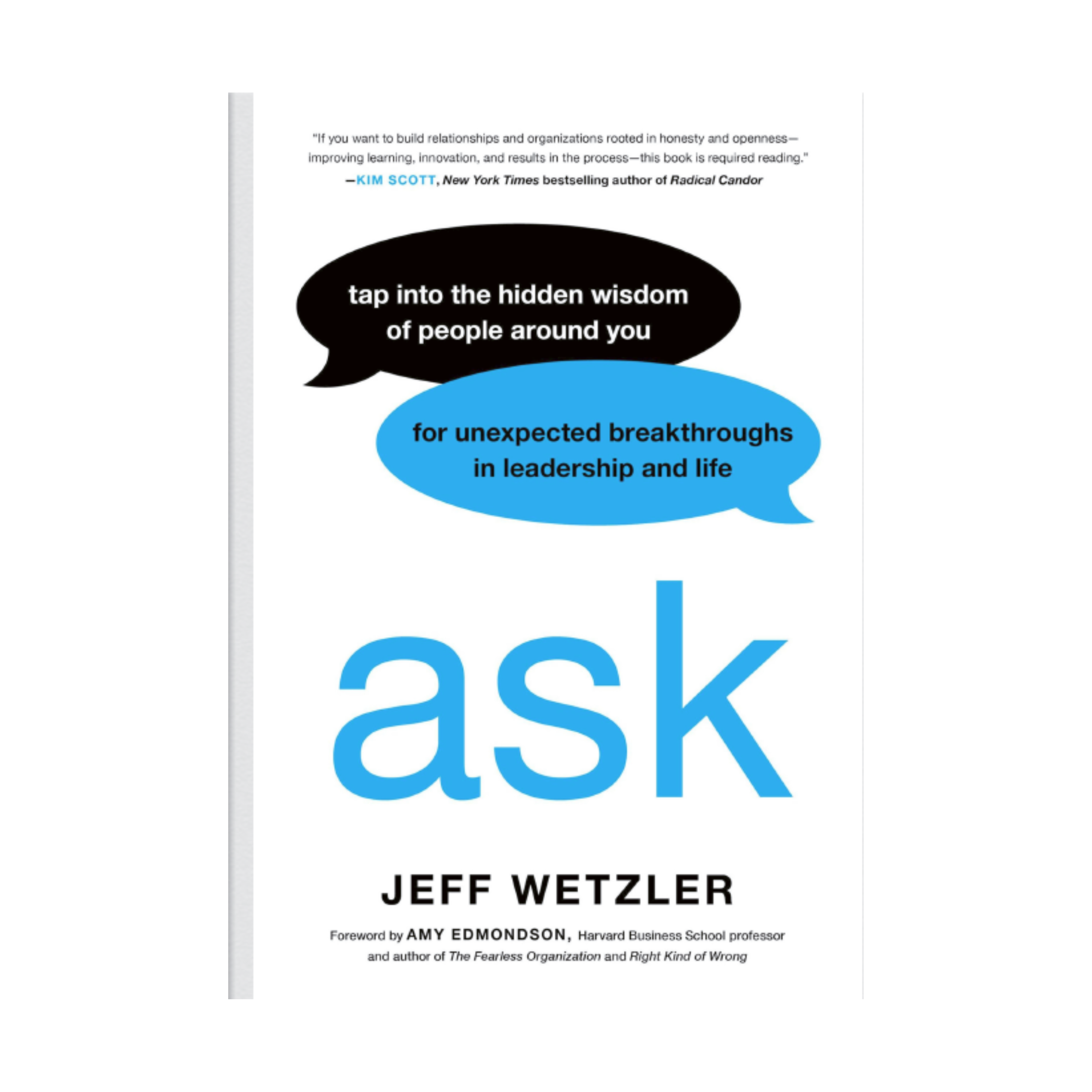
By Jeff Wetzler, Balance, Hachette Book Group, 2024

Reviewed by Jen Floyd
Founder & Principal
JRF Insights
Vienna, West Virginia
jen@jrfinsights.com
As a qualitative researcher, I spend my days asking questions and listening for meaning beneath the words. So, when I picked up Jeff Wetzler’s Ask, I wondered if anything here would feel new. To my surprise, I found myself underlining constantly, not because the ideas were revolutionary, but because they reminded me how the same questioning and listening skills that serve us in qualitative research can also transform conversations in every other part of life. What if those same skills could also transform our work relationships, our families, even our civic conversations? The book invites readers to rediscover curiosity as a tool, not just for insight, but also for connection and change.
Wetzler’s premise is simple yet powerful: in every interaction, people hold back what they really think and feel—their doubts, feedback, ideas, and hopes because they fear conflict, judgment, or unintended consequences. He calls this the “left-hand column,” an invisible layer of insight that can change decisions and relationships if we can only bring it to light. His “Ask Approach” method lays out five habits to help us do just that: Choose Curiosity, Make It Safe, Pose Quality Questions, Listen to Learn, and Reflect & Reconnect.
For qualitative research professionals, much of Wetzler’s advice feels familiar—creating psychological safety, asking open questions, and listening for emotion and meaning. Yet his framing offers a fresh reminder that these same techniques apply far beyond interviews and focus groups. I find it particularly valuable that Ask bridges professional and personal domains. Wetzler shows how the same questioning skills that help us elicit consumer truths can improve conversations with colleagues, clients, and loved ones. He also broadens the lens even further, showing how curiosity and deep listening can strengthen organizations, nurture children’s curiosity, and bridge divides in our increasingly polarized world.
He encourages us to find the right space, both physically and emotionally, so others feel comfortable sharing honestly. We should listen through three channels: content (what’s said), emotion (what’s felt), and action (what’s intended). Good research involves all three channels, as we listen to words, pick up subtle emotional cues, and observe intent and action. I relate this to using methodologies thoughtfully and allowing for words, emotion, and observed actions to come through.
Sections explaining the importance of hearing directly from end users and frontline workers may be already ingrained in qualitative research practitioners, but it is validating to see it articulated for other readers who turn to Ask to improve their businesses. His examples, such as a leader learning from a frontline employee and a parent rekindling a child’s curiosity, illustrate how empathy and genuine inquiry can shift dynamics anytime humans interact.

His final message feels especially relevant in today’s polarized climate: asking and listening deeply are acts of bridge-building. In a time when conversation often collapses into debate, curiosity may be one of the few tools capable of reopening connection.
I initially hesitated at a premise early in the book: simply asking someone what they are thinking and feeling will magically unlock hidden truths. If it were that easy, moderators would not need creative and tangential ways to ask questions. After all, the knee-jerk, surface-level response is often only partially the true answer. But he builds the process throughout the book to encapsulate deeper probes and methodologies to get at deeper insights.
Wetzler’s writing is warm, clear, and accessible. The five steps are easy to grasp and reinforced with stories and exercises. His tone invites practice, not perfection; he normalizes awkwardness and backslides as part of learning to ask better.
It’s a quick read, at 275 pages. Wetzler’s Ask can easily serve as a thought-starter for reflecting on how we communicate, listen, and build understanding in our work and personal lives—or as a springboard for deeper engagement with the habits of curiosity and empathy. I appreciate that each chapter ends with a “Key Points” summary that makes it easy to revisit the main takeaways, along with simple exercises that help you internalize and act on the learnings.
In the end, Wetzler’s message is both simple and urgent: breakthroughs don’t come from having all the answers; they come from asking the right questions and making it safe for others to tell us what we most need to hear.