

 By Susan Saurage-Altenloh, PhD
Chief Insights Officer
Saurage Research, Inc.
Baton Rouge, Louisiana
ssaurage@saurageresearch.com
The Moment After the Debrief
The qualitative research is complete. Interviews, focus groups, ethnographies, or online communities generated rich conversations and compelling insights. Stakeholders leave the debrief energized, often hearing customers, patients, employees, or consumers in ways they have not heard before. Then comes the inevitable question: “What should we do next?”
For many organizations, this is where uncertainty begins. The qualitative phase uncovered tensions, unmet needs, emotional drivers, or emerging opportunities, but insight born of exploratory research alone rarely resolves the business problem. Leaders want to know how widespread a behavior really is, which ideas matter most, whether findings differ across segments, or whether enough market potential exists to justify investment.
Too often, the response is to launch directly into a broad survey without defining what the research is supposed to decide. The result is an overloaded questionnaire, excessive metrics, and data that generate activity rather than clarity. Quantitative research becomes reactive instead of strategic.
Qualitative Research Is Rarely the Finish Line
Qualitative approaches help organizations hear how people think, surface contradictions, reveal motivations, and frame problems in ways leaders may not have previously considered. That exploratory depth is precisely what makes qualitative methods so valuable early in a learning process. It identifies the unexpected. It reveals not only what people do, but often why they do it. In many cases, qualitative work reshapes the entire direction of a project by challenging assumptions that originally framed the research.
But stakeholders often reach a different kind of decision point, one shaped by what the qualitative findings still cannot answer on their own. When qualitative research is used only to fine-tune language after strategic work is complete, it may be sufficient on its own. More often, stakeholders want to know whether findings represent widespread market reality, or conversely, a narrow viewpoint.
They seek confirmation about which consumer needs matter most, perhaps how segments differ, or whether sufficient demand exists to support investment. At this point, exploratory insight alone may not be enough to fully support strategic, operational, or financial decisions.
This is where quantitative research becomes essential. Quantitative approaches help determine scale, incidence, priority, and confidence when supported by larger sample sizes, rigorous survey design, and questions specifically aligned with strategic decision-making. They move organizations from hearing hypotheses to evaluating probabilities. Rather than replacing qualitative insight, quantitative research extends it by helping organizations understand how broadly findings apply and how strongly they should influence decisions. (See Figure 1.)
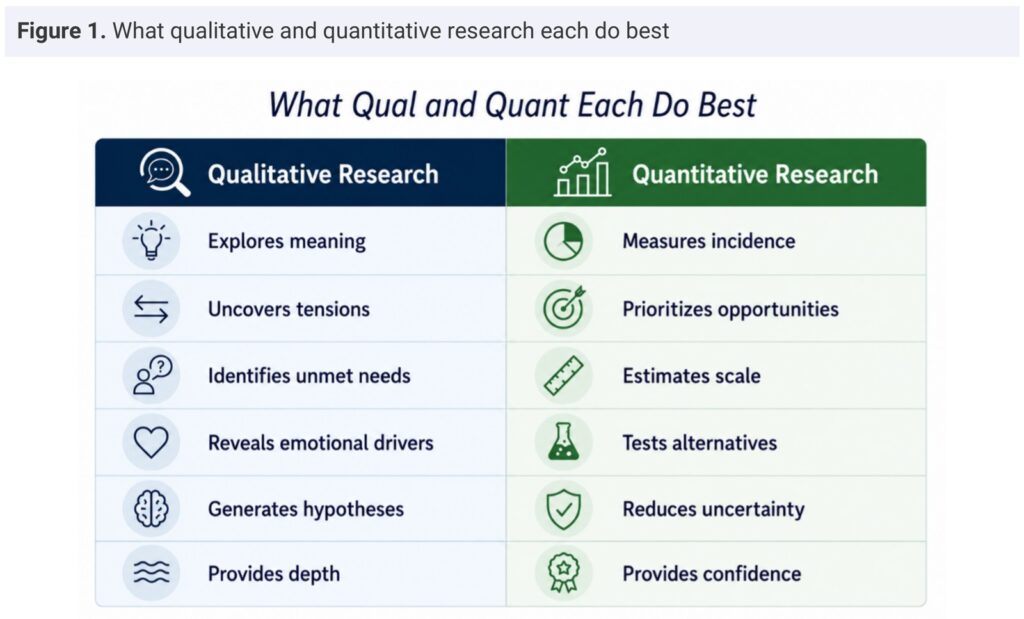
The strongest research teams recognize that qualitative and quantitative research are not competing approaches: they are complementary forms of learning. Qualitative research primarily helps organizations develop hypotheses to test, learn new things about consumer behavior and language, and understand people at a deeper psychological level. Quantitative research supports those findings through validation, and in doing so helps organizations determine how confidently they should act.
Strong Quantitative Starts with Strong Qualitative
Well-designed quantitative research is often built on the foundation of strong qualitative exploration. In many ways, the qualitative phase quietly determines the effectiveness of everything that follows. Qualitative research helps organizations understand the language people naturally use, the tensions they experience (e.g., the frustrations and obstacles during a buying experience), the motivations that drive behavior, and the factors that can influence decision-making. Without that exploratory groundwork, quantitative studies may focus on areas that are completely irrelevant to the buyer and at the same time measure the wrong assumptions.
Qualitative work typically improves questionnaire wording, response options, segmentation hypothesis, concept development, and prioritization frameworks. It can reveal that stakeholders are asking the wrong questions entirely or are focused on issues that matter far less to consumers than originally believed.
Strong qualitative research also improves interpretation. Numbers alone rarely explain why patterns exist. When quantitative findings are informed by prior exploratory learning, researchers are better positioned to understand the emotional, contextual, and behavioral forces behind the data.
This is one reason the relationship between qualitative and quantitative research should not be viewed as sequential boxes to check. The strongest research programs allow the methods to inform one another continuously. Qualitative researchers bring a distinct advantage into this process: they are often closest to the human context behind the data. They understand nuance, ambiguity, emotional tension, and the language people use when describing their experiences. These insights are invaluable when designing quantitative research that measures something meaningful rather than merely measurable.
The Most Common Mistake: “Let’s Just Field a Survey”
When Quantitative Research Becomes Reactive
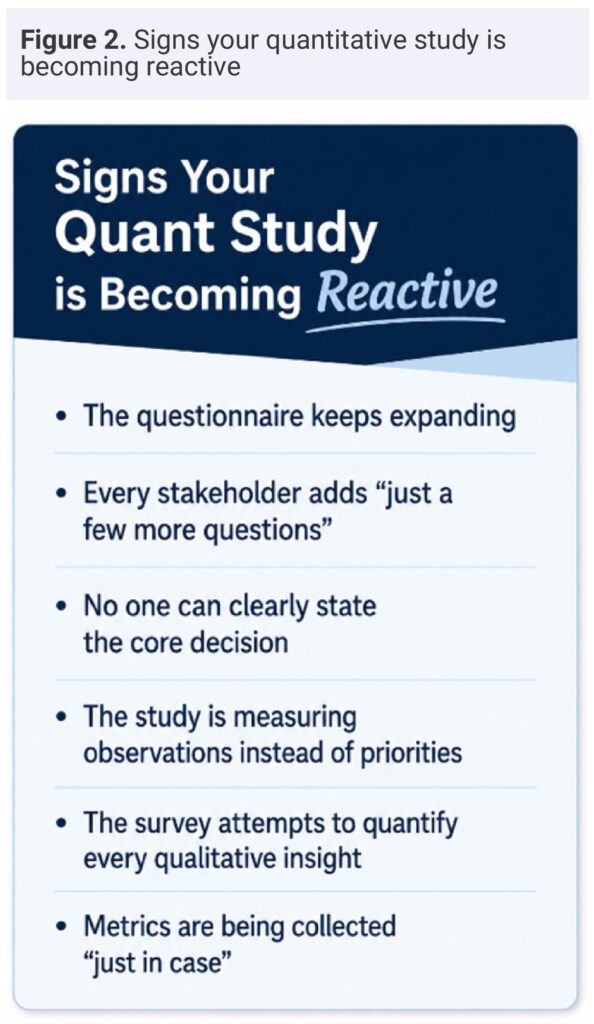
One of the most common mistakes organizations make after qualitative research is moving directly into a broad survey without clearly defining the decision that needs to be made. Once stakeholders hear compelling qualitative findings, the instinct is often to measure everything. Ideas, reactions, tensions, unmet needs, emotional themes, and hypotheses from the qualitative phase all begin competing for inclusion in the questionnaire. The result is often a long, unfocused survey filled with loosely connected questions attempting to quantify every observation uncovered during exploratory research. Instead of sharpening decision-making, the study risks creating additional ambiguity. Large amounts of data are collected, but the research may still fail to answer the organization’s most important strategic questions.
Not every qualitative insight requires quantification. Some findings are directional. Some serve as contextual understanding. Some help refine language, positioning, or customer empathy without needing formal measurement. A finding that consumers feel overwhelmed by product choices, for instance, may sharpen questionnaire language without requiring its own scale. Attempting to measure every qualitative observation dilutes the focus of the quantitative phase and burdens respondents with excessive questioning that adds little practical value. (See Figure 2.)
Effective quantitative follow-up studies begin not with a method, but with a decision needing made. The purpose of the quantitative phase is not to validate every idea uncovered qualitatively. It is to reduce uncertainty around the decisions organizations need to make next.
Start with the Decision, Not the Method
What Are You Actually Trying to Learn?
Once organizations decide to move beyond qualitative research, the next conversation often centers on methodology. Should the team conduct a survey? Use conjoint? Run segmentation? Measure demand? Test concepts?
Those are important questions, but they are not the first ones to ask. The more important question is this: what decision needs to be made?
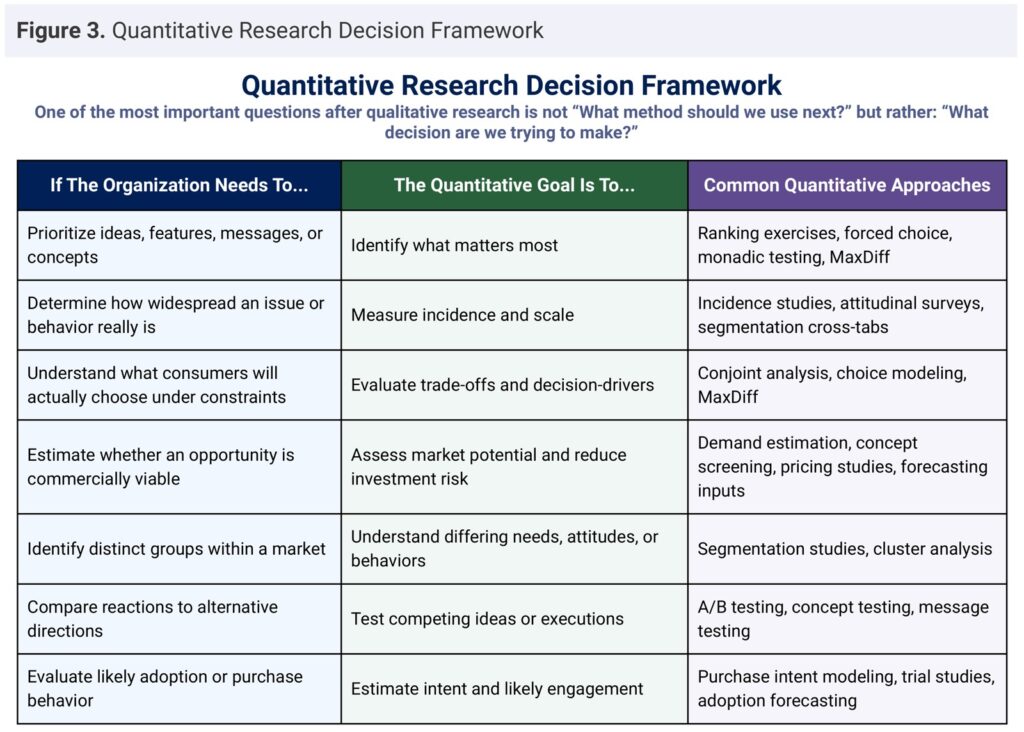
Strong quantitative research begins with question clarity, not methodological enthusiasm. Different business decisions require different types of evidence, and the quantitative design should serve the decision at hand rather than default to familiar methods. By the time an organization reaches the quantitative phase, the research is often more structured than early-stage exploration—yet well-designed quantitative studies frequently surface unexpected patterns that open new lines of inquiry. The key is to begin by naming what the organization is trying to resolve (See Figure 3.):
- Are we trying to prioritize ideas or features?
- Are we measuring how widespread an attitude or behavior really is?
- Are we testing alternatives?
- Are we identifying meaningful market segments?
- Are we estimating demand or market opportunity?
- Are we forecasting commercial potential or reducing investment risk?
Four Common Quantitative Paths After Qualitative Research
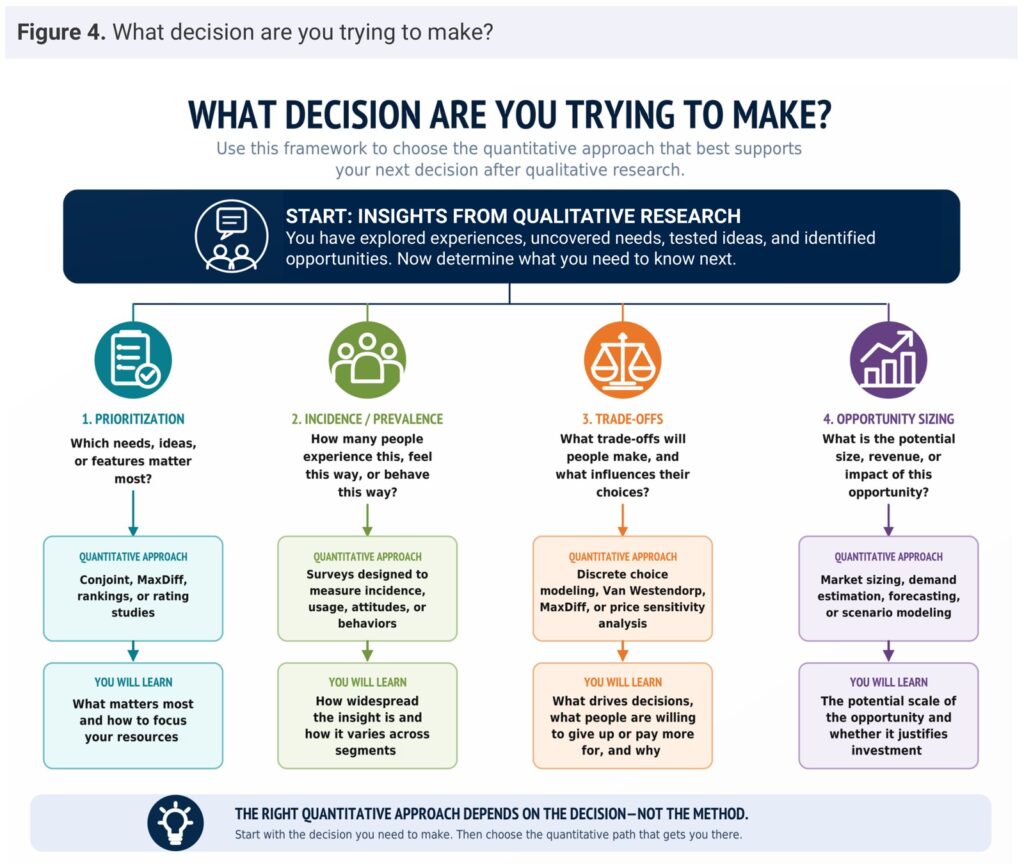
While every research initiative is different, most quantitative follow-up studies after qualitative research tend to fall into one of four broad categories. The appropriate path depends less on the preferred methodology and more on the decision the organization is attempting to make. (See Figure 4.)
1. Prioritization Research
Which Ideas Should We Pursue?
Qualitative research often surfaces multiple promising directions simultaneously. Participants may respond positively to several concepts, messages, features, unmet needs, or innovation ideas during exploratory discussions. While this breadth is valuable, organizations eventually need to determine which opportunities deserve the greatest attention and investment.
Prioritization research is not about proving one idea is good and another bad. It helps organizations allocate attention, resources, and investment more strategically. Simple ranking exercises, forced-choice designs, concept screening evaluations, or maximum difference scaling (MaxDiff) studies help move organizations from a broad list of possibilities to a focused set of priorities without requiring in-depth evaluation of every option.
2. Incidence Research
How Many, How Much, How Big?
One of the most common questions stakeholders ask after qualitative research is whether the findings represent a broader market reality or only a limited set of perspectives. A powerful emotional theme uncovered in interviews or ethnographies may reflect a widespread market tension, or it may represent something only experienced by a few.
Quantitative research helps organizations understand how broadly an attitude, behavior, frustration, or unmet need actually exists within a larger population. These studies measure incidence, frequency, penetration, or adoption across segments such as age, geography, income, customer type, or depth of engagement. They help separate anecdotal reactions from market realities and clarify whether a finding is emerging, mainstream, isolated, or unique to a specific segment.
3. Trade-Off and Decision-Modeling
What Will People Actually Choose?
One challenge in qualitative research is that participants often respond positively to multiple ideas simultaneously (sometimes referred to as favorability bias). In research settings, consumers are often asked to evaluate concepts individually rather than make real-world trade-offs between them. On the flip side, organizations cannot offer every product configuration that consumers want. They face real constraints involving tooling, materials pricing, operational complexity, timing, and investment priorities. All of these determine what product configurations can realistically be made. Consumers, too, must make trade-offs between price, value, and benefits.
Trade-off and decision modeling helps researchers move beyond stated enthusiasm to understand what competitive offerings are most likely to be chosen by consumers. Conjoint analysis and choice modeling simulate realistic decision environments and force respondents to choose between competing combinations of features, benefits, and prices. MaxDiff is also used here when the goal is to identify which attributes matter most under constrained choice conditions, distinguishing it from the simpler ranking exercises used in prioritization. This type of research is particularly valuable when product, pricing, positioning, or portfolio decisions are complex and require trade-offs.
4. Opportunity and Demand Estimation
Is the Opportunity Large Enough?
At some point, organizations must move from a more general understanding of consumers to evaluating the business potential of a specific idea. Companies must know whether there is enough demand to justify investment—specifically, how large is the opportunity, and what is the level of investment risk they must accept?
These studies translate consumer interest into business potential through concept and product testing, purchase intent measures, market sizing, volumetric forecasting, pricing sensitivity, and adoption modeling. Demand estimation significantly reduces uncertainty before major investments are made. At this stage, organizations are no longer asking whether consumers find an idea appealing. They are asking whether the opportunity is large enough to justify a capital commitment, a launch investment, or a go-to-market build-out. The difference matters: the research design, sample size, and modeling approach must be calibrated accordingly. Qualitative research may reveal excitement and unmet need. Quantitative demand estimation helps organizations evaluate whether that enthusiasm is substantial enough to support meaningful market action.
Not Every Project Needs Advanced Analytics
As organizations move from qualitative exploration into quantitative measurement, there can be pressure to increase methodological sophistication. Advanced modeling, segmentation frameworks, predictive analytics, and complex statistical approaches may appear more strategic or more credible simply because they sound more technical. More complexity does not automatically produce better decisions.
One persistent risk is the pursuit of false precision. Organizations sometimes attempt to generate exact numerical confidence around issues that remain highly dynamic, exploratory, or uncertain by nature. The outputs may look impressive in charts and dashboards while offering limited practical guidance for decision-makers. A common example: organizations attempt to assign precise numerical scores to emotional tensions or motivational drivers that qualitative research surfaced as nuanced and context-dependent. The result is a scale that looks authoritative but cannot bear the weight placed on it.
The most effective quantitative studies are not necessarily the most sophisticated. They are the ones most appropriately aligned with the decision organizations need to make next.
The Best Research Programs Are Integrated, Not Divided
For decades, market research discussions have often framed qualitative and quantitative approaches as separate disciplines, competing philosophies, or even opposing ways of understanding consumers. In practice, however, the most effective organizations treat research as a connected learning process. Qualitative and quantitative approaches are not isolated stages performed independently of one another. They are complementary forms of evidence that work together to reduce uncertainty and improve decision-making over time.
Qualitative research often serves as an exploratory foundation. It helps organizations uncover unmet needs, emotional drivers, emerging tensions, behavioral patterns, and new ways of framing problems. Quantitative research then extends those insights by determining incidence, prioritizing opportunities, evaluating trade-offs, estimating potential, and increasing confidence around the business decision.
Importantly, the process is not always linear. Quantitative findings frequently generate new qualitative questions. Unexpected survey results may require follow-up interviews or ethnographic exploration to better understand the “why” behind the numbers. Likewise, qualitative work may reveal emerging hypotheses that later become measurable variables in larger-scale studies. (See Figure 5.)
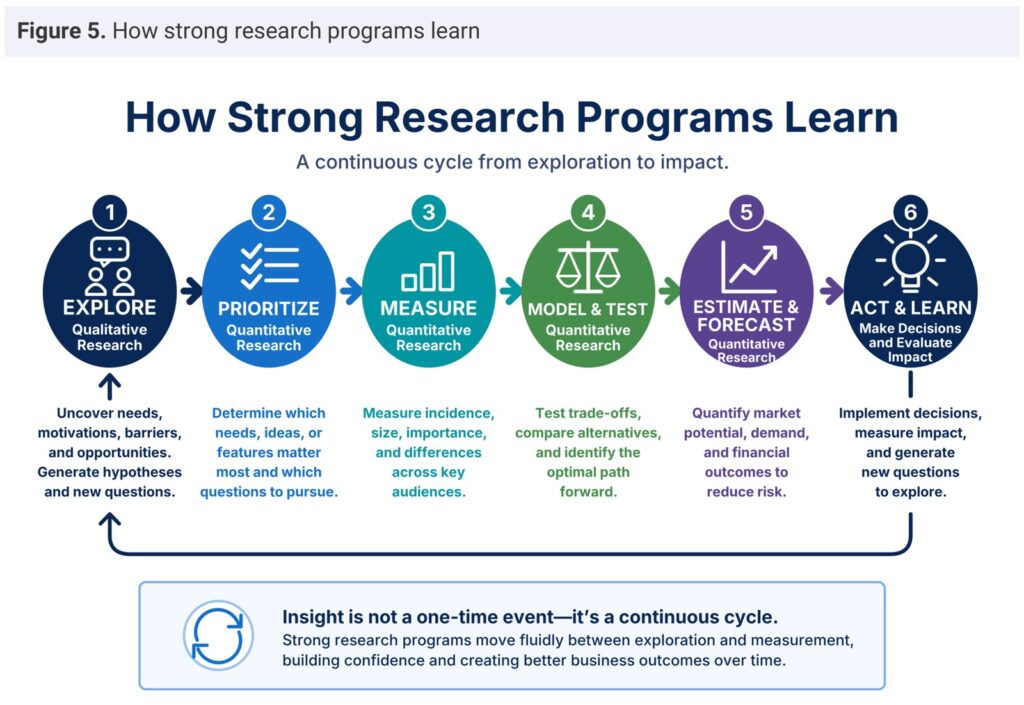
Organizations that integrate qualitative and quantitative learning effectively are better equipped to make decisions with both confidence and context. They gain not only statistical evidence but also a deeper understanding of the human realities behind the data. The goal is not to determine whether qualitative or quantitative research is more valuable. The real value comes from knowing when each approach is most useful, and how they work together to guide stronger decisions.
Conclusion: The Goal Is Better Decisions, Not More Data
Qualitative research gives organizations the opportunity to hear people more clearly. It uncovers emotions, motivations, unmet needs, and tensions that structured measurement alone may never fully reveal. Quantitative research serves a different but equally important purpose: it helps organizations determine how broadly insights apply, which opportunities matter most, what trade-offs people are willing to make, and how confidently leaders should act.
The relationship between qualitative and quantitative research should be intentional, not automatic. Not every insight needs quantification. Not every project requires advanced analytics. Not every survey needs to measure everything uncovered during qualitative exploration. The most effective next step depends entirely on the decision the organization is trying to make.
Strong quantitative research rarely begins with a spreadsheet. More often, it begins with listening carefully through well-designed qualitative methods. Then, the next question is always: what decision are we trying to make next?